My Mother Had Been Dead for Four Years—But Someone Was Still Collecting Her Social Security
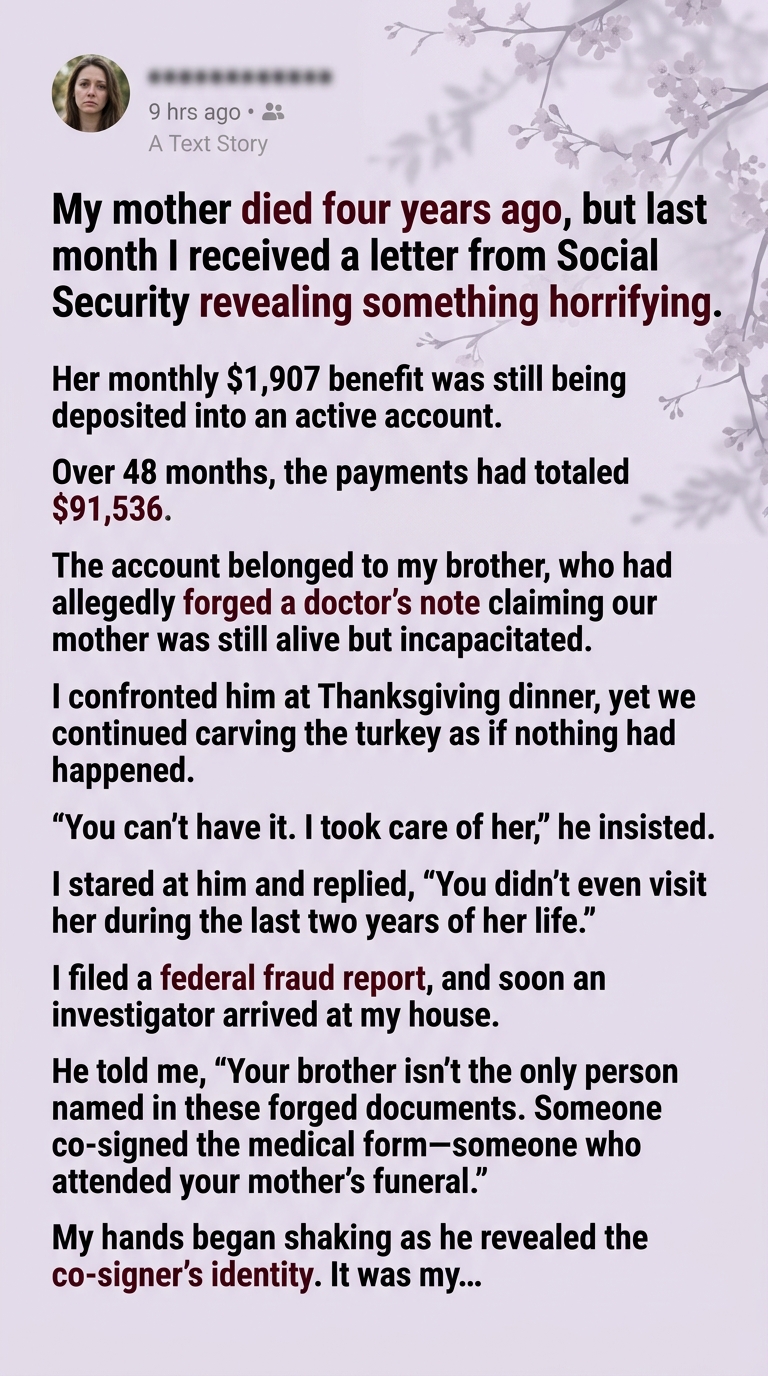
My mother died four years ago, but last month I received a letter from Social Security revealing something horrifying.
Her monthly benefit of $1,907 was still being deposited into an active bank account.
For 48 months, someone had collected every payment.
The total was $91,536.
And the account belonged to my older brother, Michael.
At first, I thought it had to be a mistake. Mom had died after a long illness. I remembered the hospital room, the funeral, the flowers, and the day we buried her. Michael had even stood beside me at the graveside, wiping his eyes while relatives offered their condolences.
But according to the letter, someone had submitted documents claiming Mom was still alive but medically incapacitated. A doctor’s statement supposedly explained why she couldn’t manage her own affairs.
The signature looked official.
The medical office listed on the paperwork, however, had no record of issuing it.
I called Michael immediately.
He didn’t answer.
I tried again that evening. Finally, he picked up.
“Did you use Mom’s Social Security payments after she died?”
Silence.
Then he sighed.
“Who told you about that?”
I felt my stomach drop.
“So it’s true?”
“I took care of her,” he snapped. “I was the one handling everything. You have no idea what I went through.”
“Mom died four years ago, Michael.”
“I know when she died!”
“Then why are you still collecting her money?”
He lowered his voice.
“You can’t have it. I took care of her.”
I almost laughed.
“You didn’t even visit her during the last two years of her life.”
He hung up.
I spent the next several days gathering everything I could find: Mom’s death certificate, the Social Security letter, bank statements she’d left behind, and copies of the documents Michael had supposedly submitted.
Then I filed a federal fraud report.
I wasn’t trying to get revenge on my brother. I wanted to know how someone could use my mother’s name after she was gone and keep collecting money that was never theirs.
Three weeks later, an investigator arrived at my house.
He introduced himself as Agent Collins and asked me to sit down.
“We’ve reviewed the benefit records,” he said. “Your brother is connected to the account receiving the payments.”
“Can you make him return the money?”
“That will depend on the investigation. But there’s something else you need to know.”
He opened a folder.
“Your brother isn’t the only person named in these forged documents. Someone co-signed the medical form. Someone who attended your mother’s funeral.”
My hands began shaking.
“Who?”
He turned the document toward me.
I recognized the signature immediately.
It belonged to my aunt Linda.
My mother’s younger sister.
She had been sitting in the front row at the funeral. She had held my hand while we lowered the casket. She had brought food to the house afterward and told everyone how much she missed her sister.
I stared at the signature.
“Why would she do this?”
Agent Collins explained that the investigation had uncovered several messages between Michael and Linda. They appeared to discuss keeping the payments coming, handling the paperwork, and making sure nobody questioned the account.
But the most disturbing discovery was a message Linda had sent my brother shortly after the funeral.
It read:
“Your sister doesn’t need to know. Mom always said you deserved more because you were the one who stayed.”
I couldn’t breathe.
My aunt had known Mom was dead. She had attended the funeral. She had watched me cry over the woman who raised us.
And afterward, she had helped my brother pretend Mom was still alive.
I asked Agent Collins whether Linda had received any of the money.
He nodded.
“Some of the funds were transferred into an account in her name. We’re tracing the remaining transactions now.”
That evening, I called her.
She answered cheerfully, as if nothing had happened.
“Sweetheart! How are you?”
“Did you sign a medical form saying Mom was alive?”
Silence.
Then she whispered, “Michael explained everything.”
“Everything? You knew she was dead.”
“I know how it looks.”
“How it looks? You went to her funeral!”
Her voice suddenly hardened.
“Your mother wanted Michael to have something. He was struggling. You had your own life, your own job. He needed help.”
“Then why didn’t you help him with your own money?”
She had no answer.
I asked one final question.
“Did you ever think about what Mom would have said if she knew you were using her death to steal from the government?”
Linda started crying.
But I had no sympathy left to offer.
The investigation continued for months. Financial records showed that Michael had used much of the money for personal expenses, including credit card payments, a vehicle, and several large transfers. Linda had received a portion of the funds and had helped submit documents that investigators believed were fraudulent.
Both were interviewed.
Michael initially claimed he had been entitled to the money because he had once helped Mom with her bills. But the investigators found no legal authorization allowing him to keep collecting her benefits after her death.
Eventually, the case moved forward through the appropriate federal process. Michael and Linda faced serious consequences, including demands to account for the money and potential criminal charges. The final outcome would be decided through the legal proceedings, not by family arguments or promises.
I never attended another Thanksgiving dinner with them.
For a long time, I kept Mom’s photograph on the dining-room table. I used to look at it and wonder how two people who had stood beside her coffin could later use her name to collect money.
Then one afternoon, I found a small envelope tucked inside her old recipe book.
It contained a handwritten note.
“To my children: I hope you never let money become more important than family. When I’m gone, remember me with love. Don’t fight over what I leave behind. Take care of each other.”
I read it twice.
Then I folded it carefully and placed it beside her photograph.
Michael had insisted he deserved the money because he had taken care of her.
But the truth was that he hadn’t visited her when she needed him most.
And my aunt, who had promised to protect her sister’s memory, had helped turn that memory into a fraud.
I couldn’t bring Mom back. I couldn’t undo what they had done.
But I could make sure her name was no longer being used to hide the truth.
And that was the last thing I ever did for her.