AFTER MY HUSBAND’S FUNERAL, HIS MOTHER AND EIGHT RELATIVES TRIED TO THROW ME OUT OF MY OWN HOME—BUT THEY HAD NO IDEA WHAT HE HAD SIGNED BEFORE HE DIED…
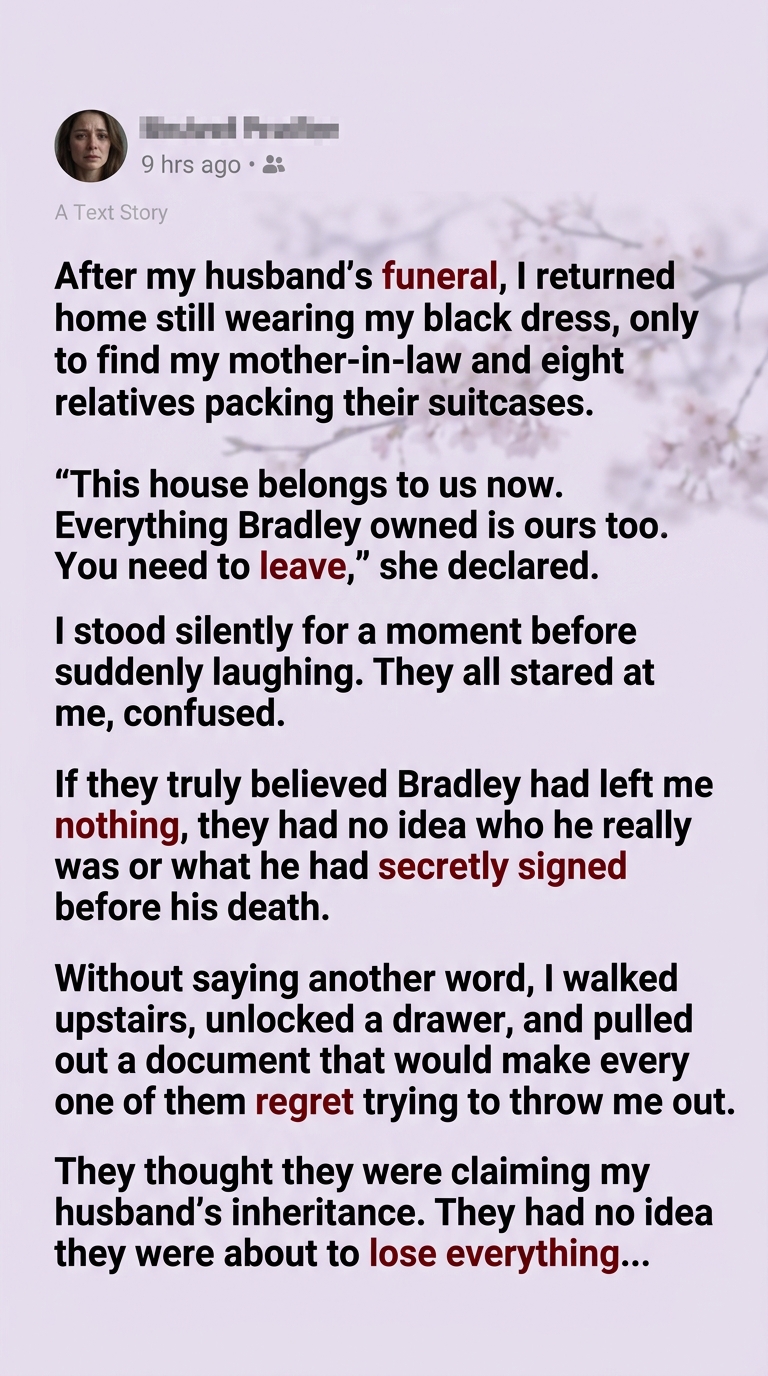
I returned home from my husband Bradley’s funeral still wearing my black dress.
My eyes were swollen from crying, my feet hurt, and all I wanted was to sit in the quiet living room where we had spent so many happy evenings together.
But when I opened the front door, I stopped.
Eight relatives were walking through the house carrying suitcases. Two were emptying the kitchen cabinets. Another was removing framed photographs from the walls.
And standing in the middle of my living room was my mother-in-law, Margaret.
She held a folder against her chest and looked at me as if I were an unwanted visitor.
“Finally,” she said. “We need to settle this.”
I stared at the suitcases.
“What is everyone doing?”
Margaret lifted her chin.
“This house belongs to us now. Everything Bradley owned is ours too. You need to leave.”
For a moment, I couldn’t speak.
Bradley and I had lived in that house for twelve years. We had painted its walls together, planted flowers in the backyard, and celebrated every anniversary in the small dining room.
I had held his hand through his final illness.
I had slept beside him in hospital rooms.
I had listened to him whisper that he was sorry he couldn’t give me more time.
And now, barely hours after his funeral, his family was trying to erase me from the home we had built.
His younger brother, Kevin, stepped forward.
“Mom is right. You’re not part of the family anymore. Bradley’s property should stay with his blood relatives.”
One of his cousins nodded.
“We’ve already discussed who gets what.”
I looked around the room.
They weren’t grieving.
They were dividing.
Margaret pointed toward the staircase.
“Pack your personal belongings. You can take your clothes and whatever small things belong to you. The rest stays here.”
Then something unexpected happened.
I laughed.
Not because the situation was funny, but because I suddenly understood how little they knew about the man they claimed to love.
They all stared at me.
“What’s so funny?” Margaret demanded.
I wiped a tear from my cheek.
“You really believe Bradley left you everything?”
“Of course he did,” she replied. “He was my son.”
I didn’t argue.
I simply walked upstairs.
Behind me, Kevin shouted, “Where are you going?”
I didn’t answer.
I entered the bedroom, opened the wooden drawer beside Bradley’s desk, and removed a sealed envelope.
Inside was a document I had helped Bradley organize several months before his death.
It was a copy of his properly executed estate plan, including his will and a separate trust agreement.
Bradley had known his illness was serious. He had also known his family.
For years, Margaret had treated our marriage as something temporary. She believed that because Bradley was her son, she automatically had a right to everything he owned.
But Bradley had quietly taken steps to make sure his wishes were clear.
I remembered the afternoon he had sat beside me at the kitchen table.
“There’s something I need you to understand,” he had said.
“What is it?”
“My family might make things difficult after I’m gone. I don’t want you fighting them while you’re grieving.”
He had explained that he wanted me to remain in our home and have financial security.
He had consulted an estate attorney, reviewed his assets, and signed the necessary documents.
The house had been transferred into a properly established trust, with me named as its beneficiary and permitted occupant under the terms of the agreement.
His will also addressed his remaining property, accounts, and personal belongings.
The arrangements had been prepared according to the applicable legal requirements.
Bradley hadn’t done it to punish his family.
He had done it because he knew I would need protection when he was no longer here.
I carried the documents downstairs.
Margaret immediately reached for them.
“What is that?”
“Bradley’s estate documents.”
She laughed.
“A piece of paper won’t change anything.”
I placed the folder on the dining table.
“Then you should have no problem reading it.”
Kevin grabbed the first page.
His expression changed as he read the heading.
“Mom…”
“What?”
He turned the page toward her.
Margaret snatched it from his hands.
Her eyes moved across the document. First confusion. Then disbelief. Then anger.
“This is impossible!”
I remained calm.
“Bradley made these arrangements with his attorney. You can verify everything through the estate representative.”
Margaret slammed the folder onto the table.
“He would never leave his mother’s family with nothing!”
“I never said he did.”
I opened the folder and pointed to the relevant sections.
Bradley had made specific provisions for his mother and certain relatives. But he had not left them ownership of our home or control over the entire estate.
The trust gave me the rights Bradley had intended me to have, subject to its terms.
His will also appointed an independent executor to handle the remaining estate.
And there was one more document.
A signed letter from Bradley.
I unfolded it carefully.
“My darling,
If you’re reading this, I wish I could be beside you.
I know my family may question the decisions I’ve made. Please don’t let anyone make you feel guilty for protecting yourself.
You were with me through the hardest years of my life. You were my home, my partner, and my greatest comfort.
I want you to remain in the house where we built our memories.
I have made arrangements so that my wishes are documented and can be carried out properly.
Don’t spend your remaining years fighting for what is already yours under these documents.
Live. Laugh again. Open the windows in the morning. Keep the garden alive.
And please remember that loving me should never mean giving up your own life.
Forever yours,
Bradley.”
By the time I finished reading, the room was silent.
Even Kevin looked uncomfortable.
Margaret lowered herself into a chair.
“But I’m his mother,” she whispered.
“I know,” I replied. “And he loved you. But being his mother didn’t give you the right to throw his wife out of her home.”
She looked at the suitcases scattered across the living room.
“We were only trying to protect the family property.”
I shook my head.
“You were packing my belongings before you even checked the estate documents.”
Kevin finally spoke.
“We thought everything automatically went to us.”
“That’s exactly why Bradley made sure his wishes were written down.”
I called the estate attorney, Mr. Harrison, and asked him to come to the house. He arrived later that afternoon with the relevant records and explained the estate arrangements to everyone.
He made it clear that no one had the authority to take possession of property simply because they were relatives.
Any dispute would have to be handled through the proper legal process.
Margaret protested.
Kevin argued.
One cousin demanded to know whether they could challenge the documents.
Mr. Harrison calmly explained that they could seek independent legal advice, but any challenge would need a valid legal basis. Their disappointment alone would not invalidate Bradley’s signed estate plan.
The relatives began gathering their suitcases.
One by one, they left.
Margaret was the last.
At the doorway, she turned toward me.
“Bradley would have wanted us to stay together.”
I looked at her.
“Then you should have treated me like family before you tried to take everything from me.”
She said nothing.
The door closed.
For the first time since the funeral, I was alone in the house.
I walked into the living room and looked at the empty spaces where our photographs had been.
I put them back one by one.
Then I went into the kitchen, made a cup of tea, and sat at the table where Bradley had once explained his plans.
I cried again.
But this time, I wasn’t crying because I was afraid of losing everything.
I was crying because I missed him.
Over the following months, the estate was administered according to the documents. The relatives eventually stopped making demands, and the remaining questions were handled through the attorney.
I kept the house.
I kept the garden.
And I kept the memories.
I also made one change.
I turned the spare bedroom into a small reading room, with Bradley’s favorite books on the shelves and a photograph of him beside the window.
Sometimes, when the afternoon sunlight falls across the floor, I can almost hear him laughing.
His family believed that inheritance was about blood.
Bradley understood that it was also about love, responsibility, and the promises people make when no one else is watching.
They had come to my home expecting to take everything.
Instead, they discovered that Bradley had already made his wishes clear.
And the document they thought would mean nothing became the reason I never had to leave the home we built together.
I didn’t win because I had more money or because I shouted louder.
I simply respected the promises my husband had made—and refused to let anyone take advantage of my grief.