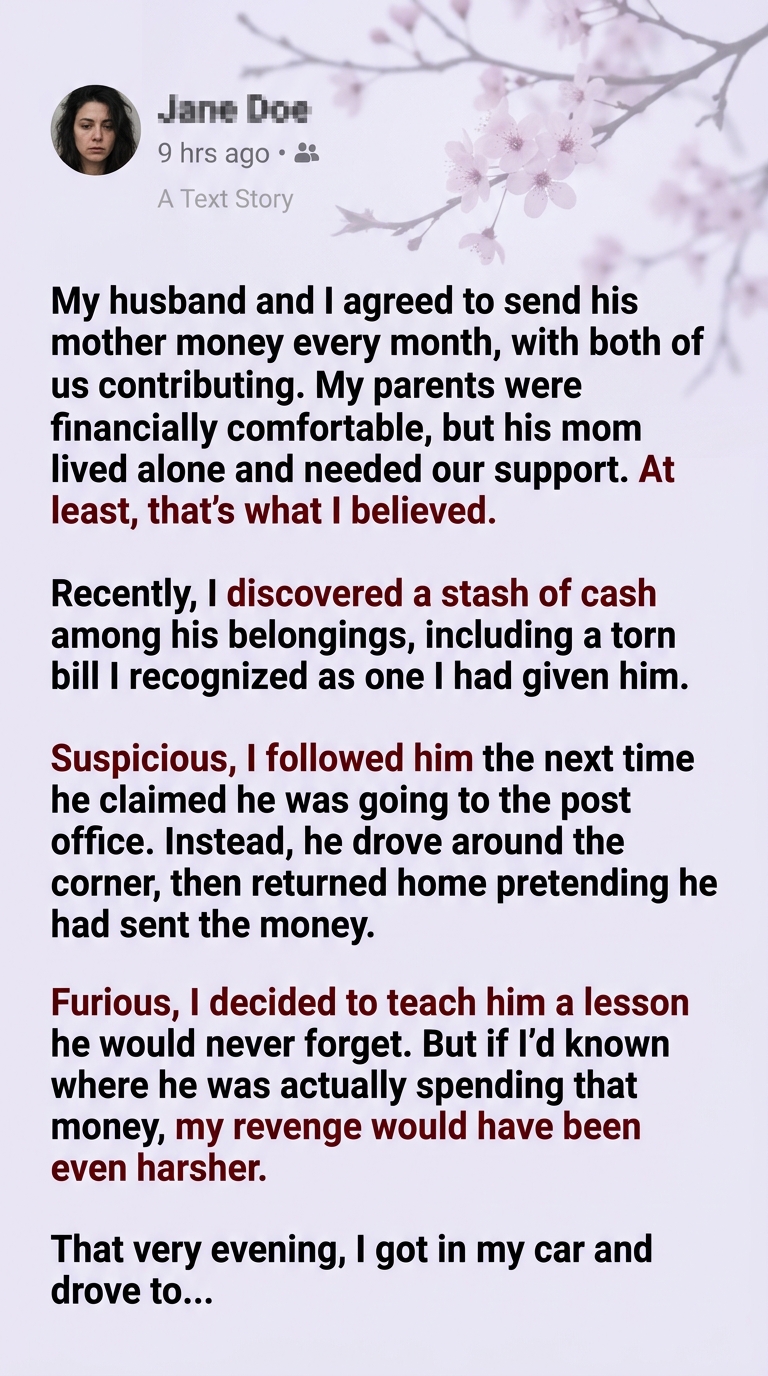
My Husband Lied About Sending Money to His Mother—Then I Discovered Where It Really Went
My husband and I had made a promise.
Every month, we would send money to his mother, Margaret. We would both contribute, and neither of us would complain about the expense.
My parents were financially comfortable. They owned their home, had retirement savings, and never needed to ask us for help.
But his mother lived alone in a small apartment. She was getting older, her pension barely covered her expenses, and my husband insisted she needed our support.
I believed him.
For almost two years, I handed him my contribution in cash. He would add his share, put everything into an envelope, and take it to the post office.
Sometimes he showed me the receipt.
Sometimes he said the line was too long and he would send it the next morning.
I never questioned him.
Until I found the money.
It happened on a Saturday morning when I was putting away some of his winter clothes. I opened a drawer in his old desk and discovered a small envelope tucked beneath a stack of documents.
Inside were several hundred-dollar bills.
At first, I assumed it was emergency money.
Then I noticed something strange.
One of the bills had a torn corner.
I recognized it immediately.
A few weeks earlier, I had given my husband that exact bill as part of my contribution for his mother.
I remembered it because the corner had been damaged when I pulled it from my purse.
I sat on the floor, staring at the money.
There was no way he had sent that particular bill to his mother if it was still sitting in his desk.
I searched the drawer more carefully.
There were more envelopes, some containing cash, others containing handwritten notes with dates.
The dates matched the months we had supposedly sent money.
My stomach tightened.
For two years, I had been contributing money to support a woman who might not have received a single payment.
I waited until my husband, Michael, came home.
He kissed my cheek, asked what we were having for dinner, and complained about traffic.
I wanted to throw the money at him.
Instead, I smiled.
The next morning, he announced that he was going to the post office.
“I’m sending your mother’s money,” I said.
He nodded casually.
“Of course.”
I watched him take the envelope from the kitchen counter and leave.
Then I grabbed my car keys.
I wasn’t proud of following my own husband, but I needed to know the truth.
He drove toward the post office.
At the next intersection, he turned onto a side street, drove around the block, and eventually returned home.
He didn’t stop at the post office.
He didn’t mail anything.
He simply parked in our driveway, walked inside, and said, “It’s done. I sent it.”
I stood in the kitchen, holding a cup of coffee.
“Good,” I replied.
He smiled.
I didn’t.
That afternoon, I counted the money in his drawer.
Then I compared it with the amounts we had contributed over the previous months.
The numbers didn’t match perfectly, but enough was there to convince me this wasn’t an isolated incident.
He had been keeping money that was supposed to go to his mother.
I was furious.
I considered calling Margaret immediately, but I stopped myself.
I wanted to know how much he had taken and where it had gone.
So I checked the household budget.
I found withdrawals, cash transfers, and several payments I didn’t recognize. Some were small. Others were large enough to make my hands shake.
There was one recurring payment to a storage facility.
Another to a private parking garage.
And a hotel charge that had been disguised under a different business name.
I printed the records and placed them in a folder.
Then I made a decision.
If Michael wanted to pretend he was sending money to his mother, I would make sure he experienced what it felt like to have his financial arrangements suddenly changed.
But I still didn’t know the whole story.
That evening, I got into my car and drove to the address listed on the hotel receipt.
It was a small boutique hotel on the other side of town.
I parked across the street and checked the time.
A few minutes later, a familiar car pulled into the entrance.
Michael stepped out.
He wasn’t alone.
A woman in her early forties came out to meet him. She kissed him on the cheek, took his hand, and led him inside.
I felt my entire body go cold.
I knew her.
Her name was Vanessa.
She had once been introduced to me as a former colleague of Michael’s.
I had even invited her to dinner at our home.
Now I was watching my husband walk into a hotel with her.
I sat in my car for several minutes.
Then I took a photograph of the two of them entering the building.
I didn’t go inside.
I didn’t create a scene.
I drove home.
And when Michael returned later that night, I was waiting at the kitchen table.
He looked surprised.
“Why are you still awake?”
I pushed the photograph toward him.
His face changed instantly.
“Who is she?” I asked.
He stared at the picture.
“It’s not what you think.”
I almost laughed.
“That’s what people say when it is exactly what it looks like.”
He sat down.
I placed the cash envelope beside the photograph.
“Now explain why the money I gave you for your mother is sitting in your desk.”
He rubbed his forehead.
“I was going to send it.”
“For two years?”
“I had some expenses.”
“Hotel expenses?”
He said nothing.
I opened the folder and showed him the transactions.
The recurring payments. The cash withdrawals. The hotel charges.
Then I asked the question that mattered most.
“Does your mother know we haven’t been sending her the money?”
Michael looked away.
“No.”
That single word hurt more than the photograph.
I stood up.
“Then tomorrow, I’m calling her.”
“Please don’t.”
“Why? Are you afraid she’ll discover that her son has been using her name to fund an affair?”
He began speaking quickly.
He said Vanessa was going through a difficult divorce. He claimed she needed help. He said their relationship had started as friendship and had become complicated.
I listened.
Then I asked him how much of our money he had spent.
He couldn’t give me a number.
That was when I realized this wasn’t just about infidelity.
It was financial betrayal.
He had used our shared household money, taken my contributions, and hidden the truth behind his mother’s needs.
And he had allowed me to believe an elderly woman was receiving help that never arrived.
The next morning, I called Margaret.
I had spoken to her many times over the years, but I had never discussed the monthly payments directly. Michael always insisted he handled everything.
When she answered, I tried to keep my voice calm.
“Margaret, I need to ask you something. Have you been receiving the money Michael and I send every month?”
There was a pause.
“What money, dear?”
My heart sank.
“The money for your living expenses. Michael said he was mailing it to you.”
“Oh,” she said quietly. “He told me you two were struggling financially. I didn’t want to ask for anything.”
I closed my eyes.
“He told you that?”
“Yes. He said you were having trouble with the mortgage and that I should be patient.”
I gripped the phone.
“Margaret, we don’t have mortgage trouble. We have been sending money every month.”
She became silent.
Then I heard her crying.
“I didn’t know,” she whispered. “I thought you didn’t want me to depend on you.”
I felt sick.
For two years, Michael had not only kept the money. He had also told his mother that we were struggling so she wouldn’t ask questions.
I promised Margaret I would explain everything.
I also told her that I wanted to help her directly, but I would not make another financial arrangement until I had reviewed our household finances and spoken with an attorney.
She understood.
Before hanging up, she said something that stayed with me.
“Please don’t let this destroy your marriage because of me.”
I looked toward the hallway.
“Margaret, you didn’t do anything wrong.”
That afternoon, I met with a family attorney and a financial adviser.
I brought the bank statements, photographs, notes, and the records I had found.
They advised me to preserve everything, review our joint accounts, and make sure any changes to shared finances were handled properly.
I also opened a separate account for my personal income and arranged for my salary to be deposited there going forward.
I did not empty our joint accounts or take money that wasn’t mine.
I simply stopped handing Michael cash and stopped allowing him to manage the money intended for his mother.
I also contacted the post office to confirm that there were no regular payments being sent to Margaret from our address.
There weren’t.
The next weekend, I drove to Margaret’s apartment.
I brought groceries, helped her review her bills, and showed her how to receive future support directly through a bank transfer.
She cried when she saw the records.
“I never wanted to cause problems between you two,” she said.
“You didn’t,” I told her. “Michael made these decisions himself.”
I arranged a modest monthly contribution from my own account, one I could afford and would send directly to her.
It was important to me that she no longer had to depend on Michael’s promises.
When Michael discovered what I had done, he became furious.
“You went behind my back and changed everything!”
I looked at him.
“You went behind my back for two years.”
He said he wanted to explain.
I told him I had already heard enough explanations.
Then he made a mistake.
He said, “I was going to put the money back.”
I asked him when.
He couldn’t answer.
“After Vanessa stopped needing it? After your mother passed away? After I discovered everything?”
He slammed his hand on the table.
“Why are you making this so dramatic?”
I stared at him.
“Because you made me believe your mother was going without necessities while you spent our money on hotel rooms.”
He lowered his voice.
“I never meant to hurt you.”
“Then you should have stopped lying.”
I told him I was considering separation and that any future discussion would happen with legal advice.
He begged me not to make a permanent decision.
But I was no longer interested in promises.
I needed accountability.
The following weeks revealed even more.
Vanessa had known Michael was married. She had also known that some of the money came from an arrangement supposedly intended for his mother.
Michael had been paying for hotel visits, meals, and other personal expenses. He had also used money from a savings account we had both contributed to.
When confronted with the records, he admitted the affair had lasted more than a year.
I didn’t need to hear anything else.
I filed for separation.
The financial settlement took time. Our attorney reviewed the shared accounts, identified the money Michael had diverted, and addressed it as part of the financial negotiations. I made sure Margaret’s support remained separate from the dispute between us.
Michael eventually agreed to repay a portion of the money through a documented settlement.
He also apologized to his mother.
But an apology didn’t erase the fact that he had allowed her to believe she was unwanted.
Margaret and I continued speaking.
Our relationship became closer than it had ever been.
She told me that she had always been afraid of becoming a burden. I told her that needing help did not make her a burden.
And for the first time, she knew exactly where her support was coming from.
Six months later, I moved into a small apartment of my own.
I kept the photographs, my books, and the little dining table my mother had given me.
One evening, Margaret came over for dinner.
We sat together, eating soup and talking about ordinary things.
Before she left, she handed me a small envelope.
Inside was a handwritten note.
Thank you for making sure I wasn’t forgotten.
I hugged her.
Then I placed the note in my drawer.
I had originally planned to teach Michael a lesson by exposing him and making him regret every dollar he had stolen.
But the truth was, the person who needed help most wasn’t the person I had expected.
Margaret had been living quietly, believing her son was helping her and her daughter-in-law didn’t want her to ask for more.
She had been deceived just as I had.
Michael lost my trust, our marriage, and the right to manage money that wasn’t his.
I lost a husband I thought I knew.
But I gained something important.
I learned that generosity should never require blind trust, and that love should never be used as a cover for deception.
I still send Margaret money every month.
Not because Michael promised me he would.
Because I know exactly where it goes.
And because she deserves to receive the kindness we once promised her.