MY FIANCÉ DEMANDED HALF OF MY PAID-OFF HOUSES BEFORE OUR WEDDING—THEN HIS REACTION TO A PRENUP REVEALED EVERYTHING
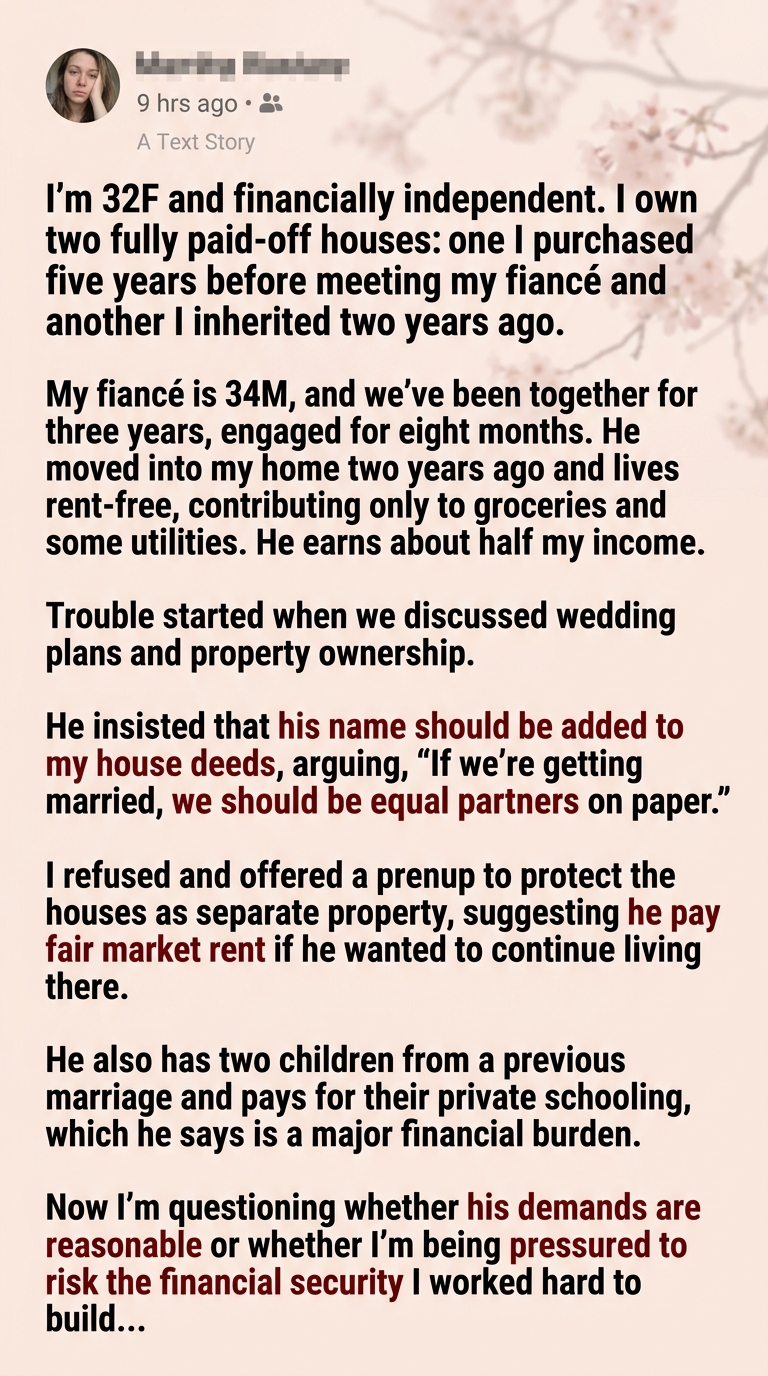
I’m 32, financially independent, and own two fully paid-off houses.
The first house took years of hard work to purchase. I bought it five years before I ever met my fiancé.
The second was inherited from a relative two years ago.
I never considered either property a lottery win. They represented years of saving, difficult decisions, and the security I had worked hard to build.
My fiancé, Daniel, is 34.
We had been together for three years and engaged for eight months.
He had moved into my primary home two years earlier. He didn’t pay rent, although he contributed to groceries and some utilities.
He earned approximately half my income and had two children from his previous marriage. He paid for their private schooling, which was a significant expense.
I respected his responsibilities as a father.
I had never asked him to stop supporting his children, and I never expected him to contribute equally to every expense.
But when we started discussing wedding plans, something changed.
One evening, while reviewing our wedding budget, Daniel brought up property ownership.
“If we’re getting married, we should be equal partners on paper,” he said.
I looked at him.
“What exactly do you mean?”
“I mean you should add my name to the house deeds. Both houses. We’re building a future together.”
I was stunned.
One house had been mine long before we met.
The other had been left to me through inheritance.
I asked why marriage automatically meant transferring ownership of property I had acquired independently.
He became defensive.
“Because I don’t want to feel like a guest in my own home.”
I reminded him that he had lived there rent-free for two years.
He replied:
“That’s not the point. If something happened to you, where would that leave me?”
I understood that he wanted security.
But adding someone to a property deed was not a small gesture. It could give that person significant ownership rights, depending on the law and how the transfer was structured.
So I proposed a prenuptial agreement.
My suggestion was straightforward: both houses would remain my separate property, while we would agree on how to handle shared living expenses, future purchases, and any property acquired together during the marriage.
I also suggested that if he wanted to continue living in the house without feeling like a guest, we could discuss a fair, written housing arrangement.
Daniel didn’t like that.
“Why are you treating me like a tenant?”
“I’m not. I’m trying to make sure we both understand our financial responsibilities before getting married.”
He stood up.
“You have two houses and I have nothing. How is that equal?”
I answered carefully.
“Equality doesn’t mean I have to give away half of what I owned before we met.”
He walked out of the room.
For the next several days, the atmosphere in the house became uncomfortable.
Daniel repeatedly mentioned his children.
He said their private school fees were expensive and that he couldn’t afford to save much for his own future.
I reminded him that I understood his responsibilities, but they didn’t automatically create an obligation for me to transfer ownership of my inheritance.
Then he said something that really troubled me.
“Once we’re married, your money is our money. Why are you so worried about protecting it from me?”
I didn’t know how to respond.
I wasn’t trying to protect myself from marriage.
I was trying to avoid entering one without clear financial boundaries.
A week later, I arranged a meeting with an independent family lawyer.
I wanted professional advice about the properties, the proposed prenup, and how marriage could affect ownership under the law where we lived.
The lawyer explained that the legal treatment of premarital property and inherited assets depends on jurisdiction, the wording of the agreement, and how property is managed during marriage.
Simply assuming that something would remain separate wasn’t enough.
We needed proper documentation.
I also learned that any agreement should give both partners adequate time to review it, disclose their finances, and obtain independent legal advice.
I told Daniel that I wanted both of us to have our own lawyers.
He laughed bitterly.
“So you’re already preparing for divorce?”
“No. I’m preparing for marriage responsibly.”
He refused to attend the first meeting.
Instead, he sent me a long message saying that I had made him feel financially inferior.
I read it several times.
I didn’t want him to feel small.
But I also didn’t want to be pressured into giving away something that had taken years to build.
A few days later, I asked him to sit down with me.
I explained that I was willing to discuss a fair household budget.
We could divide shared expenses according to our incomes rather than automatically splitting everything fifty-fifty.
We could also discuss a housing contribution that reflected the arrangement we both agreed was fair.
I was willing to plan for our future together.
But I wasn’t willing to add his name to properties simply because he believed marriage entitled him to them.
He listened.
Then he asked:
“What happens if I contribute money to the house? Would I still get nothing?”
I explained that we could document any agreed contributions to renovations or improvements and obtain legal advice about how those contributions should be treated.
I wasn’t opposed to recognizing his financial contribution.
I was opposed to making an irreversible ownership decision without understanding its consequences.
For the first time, he seemed willing to listen.
But then he asked another question.
“Would you add my name to the inherited house if I agreed not to ask for the first one?”
I stared at him.
“Why do you need either house to be in your name?”
He didn’t answer immediately.
Then he said:
“I just want to know that I’m not spending my life building something for someone else.”
I understood that fear.
But I also recognized that he was still treating ownership as proof of commitment.
I told him that I could offer a committed marriage, shared goals, financial transparency, and a fair arrangement for our household.
I could not promise him half of my properties.
The conversation ended without an agreement.
That weekend, I spoke with my closest friend.
She asked me one question:
“If you had no houses, would he still want to marry you?”
I didn’t know.
And that frightened me more than the argument itself.
I decided to postpone the wedding until we resolved the issue.
Daniel was furious.
He said I was humiliating him and making him look like a man who wanted my money.
I told him I wasn’t making that accusation.
I was simply refusing to make a major financial decision under pressure.
Eventually, he agreed to meet with his own lawyer.
The lawyers reviewed our financial positions and began discussing a possible prenuptial agreement.
Daniel’s lawyer raised concerns about his housing security and the possibility that he might make financial contributions to the property.
My lawyer suggested addressing those concerns through clearly defined terms rather than automatically transferring ownership.
We also discussed what would happen if we purchased another property together after marriage.
That way, any future joint investment could be owned according to the actual contributions and agreement between us.
The process was slow.
There were difficult conversations about income, debt, his children’s school fees, savings, and household responsibilities.
I made it clear that his children would never be treated as a burden simply because he had responsibilities from his previous marriage.
But I also made it clear that I wasn’t agreeing to become responsible for expenses I hadn’t voluntarily undertaken.
After several weeks, Daniel finally said something I hadn’t expected.
“I think I was afraid that if I didn’t get my name on the house, I’d never really belong.”
I told him:
“You belong because we choose each other. A name on a deed can’t create that feeling.”
He admitted that he had been comparing his financial position with mine and felt embarrassed about earning less.
I listened.
For the first time, we were discussing the insecurity beneath the argument rather than fighting about the properties themselves.
We haven’t signed the final agreement yet.
The wedding remains postponed until both of us are comfortable with the terms and have received independent legal advice.
I still love Daniel.
But I’ve learned that loving someone doesn’t mean giving up financial boundaries to prove it.
My houses represent years of work and an inheritance from someone who trusted me with their legacy.
I want to build a marriage based on partnership, not pressure.
And if we cannot agree on that before the wedding, then we need to know the truth before saying our vows.
Because the right person should want to build a future with me—not require me to surrender the security I already worked so hard to create.
=