One Year After Our Divorce, My Ex-Husband Bragged About His New Family—Until the Doctor Called My Name
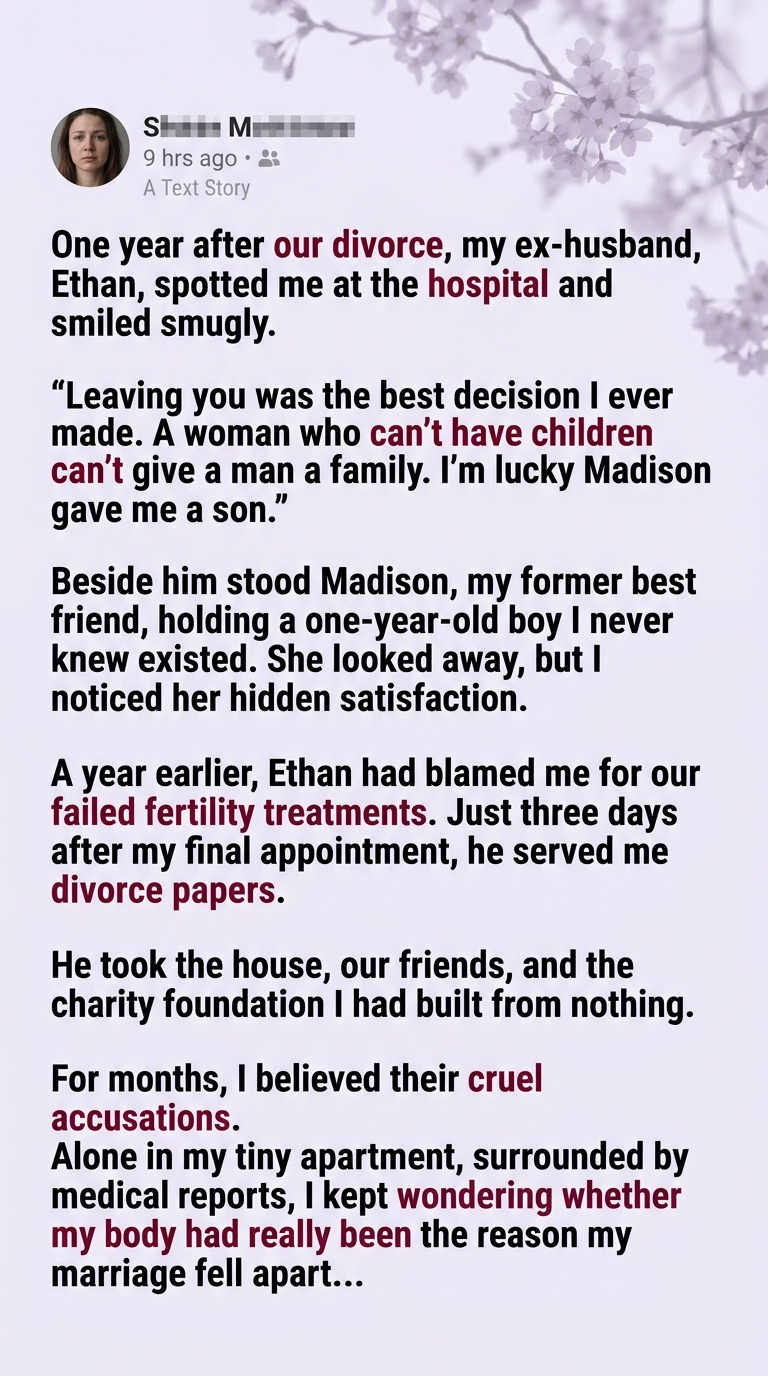
One year after our divorce, I ran into my ex-husband, Ethan, at the hospital.
I was standing near the reception desk, holding a folder against my chest, when I heard a familiar voice behind me.
“Well, look who it is.”
I turned.
Ethan stood a few feet away, wearing an expensive watch and the same confident smile that had once made me believe he could never hurt me.
Beside him was Madison, my former best friend. She held a little boy in her arms, a beautiful child with dark curls and bright eyes. He looked about a year old.
Ethan glanced at the folder in my hands, then at my face.
“Leaving you was the best decision I ever made,” he said loudly enough for people nearby to hear. “A woman who can’t have children can’t give a man a family. I’m lucky Madison gave me a son.”
My stomach tightened.
Madison looked down at the little boy, but I caught the faint smile she tried to hide.
For a moment, I couldn’t speak.
A year earlier, Ethan had blamed me for our failed fertility treatments. He said he had sacrificed enough, that he couldn’t spend the rest of his life waiting for something my body might never give him.
Three days after my final appointment, he handed me divorce papers.
He kept the house. He kept most of our shared possessions. Even the friends who had once celebrated our marriage slowly disappeared from my life.
Worst of all, he took control of the charity foundation I had spent years building.
I had started that foundation with a small community fundraiser. We helped women facing infertility, pregnancy complications, and financial hardship. I had spent countless nights organizing donations, meeting families, and finding doctors willing to volunteer their time.
Ethan had joined the foundation later, promising to help with its finances and administration.
When we divorced, he used the position he had gained to push me out.
I left with a suitcase, a few boxes, and a stack of medical reports.
For months, I wondered whether he had been right.
Maybe I had failed him.
Maybe my body had destroyed our marriage.
Then, standing in that hospital corridor, I looked at Madison’s son and realized something.
I wasn’t going to let Ethan humiliate me again.
I took a breath.
“Congratulations,” I said quietly.
His smile widened. He clearly expected me to cry.
“That’s all you have to say?”
“What else would you like me to say?”
He laughed.
“Nothing. I just hope you’ve accepted reality. Some women aren’t meant to be mothers.”
Madison finally looked at me.
“Ethan, let’s go,” she murmured.
But before they could leave, a nurse approached from the reception desk.
“Ms. Harper?”
I turned.
“Yes?”
“Dr. Collins is ready to see you. Your appointment is in room four.”
Ethan looked surprised.
“Appointment? Are you sick?”
“No,” I replied. “I’m here for a consultation.”
The nurse smiled warmly.
“And congratulations again. The specialist has reviewed your complete file. She wants to discuss your treatment options and the next steps.”
Ethan’s expression changed.
“Treatment options?”
I nodded.
“I’ve been working with a new medical team.”
He gave a dismissive laugh.
“Don’t waste your money. We already tried everything.”
I looked directly at him.
“You and I tried everything. That doesn’t mean I stopped trying.”
Then I walked toward the examination rooms.
I didn’t tell him what I had learned during the previous months.
I didn’t tell him that after our divorce, I had finally obtained copies of every fertility report from our old clinic.
And I certainly didn’t tell him that those reports had revealed something I never expected.
After the divorce, I spent several weeks gathering my medical records. I wanted answers, even if those answers were painful.
My new specialist, Dr. Collins, reviewed the documents carefully.
At first, she was confused.
My former clinic had repeatedly described our infertility as primarily a female-factor problem. But some of the tests in my file were incomplete, and several results had never been properly discussed with me.
Dr. Collins recommended repeating the evaluation.
I agreed.
The results changed everything I thought I knew.
My reproductive health was not perfect, but my tests did not support the claim that I was incapable of having children.
More importantly, the records showed that Ethan had been advised to complete additional testing before our final treatment cycle. Those recommendations had never been shared with me.
I asked the doctor why.
She explained that she couldn’t determine what had happened without reviewing the clinic’s records and speaking with the appropriate professionals.
I didn’t want revenge. I wanted the truth.
With my attorney’s help, I requested the full medical file and submitted a formal complaint about the missing information and the way our treatment had been documented.
The clinic eventually conducted an internal review.
It found serious communication and record-keeping failures. Some information about Ethan’s evaluation had not been properly incorporated into our treatment discussions.
That didn’t prove he had deliberately hidden anything, but it was enough to show that I had been unfairly blamed for a medical situation that had never been fully investigated.
I cried when Dr. Collins explained it.
Not because I suddenly knew I would become a mother.
I cried because for an entire year, I had carried shame that never belonged entirely to me.
And now Ethan was standing outside that examination room, acting as though he had won some kind of contest.
I finished my appointment and walked back into the corridor.
He was still there.
Madison was sitting with the little boy, and Ethan was checking his phone.
When he noticed me, he slipped it into his pocket.
“So, what did the doctor say?” he asked.
“That’s private.”
He smirked.
“Still pretending there’s hope?”
I looked at him for a long moment.
“Ethan, you don’t get to define my future anymore.”
His smile faded.
Before he could respond, a man in a hospital badge approached them.
“Mr. Ethan Brooks?”
Ethan turned.
“Yes?”
“I’m sorry to interrupt, but the pediatric department needs to clarify something about your son’s records. Could you come with me?”
Madison immediately stood up.
“Is something wrong?”
The staff member shook his head.
“Nothing urgent. We just need to verify a few details.”
Ethan looked irritated.
“Can’t this wait?”
“I’m afraid we need to speak with you today.”
He followed the staff member, leaving Madison beside me.
For the first time, her confident expression disappeared.
She adjusted the boy in her arms.
“You look well,” she said awkwardly.
“I am getting there.”
She nodded.
Then she whispered, “I never wanted things to happen this way.”
I stared at her.
“You were my best friend, Madison. You knew how many treatments I went through. You sat beside me when I cried after the last appointment.”
Her eyes filled with tears.
“I know.”
“Then why did you stay with him?”
She looked toward the hallway where Ethan had disappeared.
“I thought he loved me. He told me your marriage was already over. He said you two had agreed to separate, and that he was free to move on.”
I felt a bitter laugh rise in my throat.
“He served me divorce papers three days after my final appointment. You knew that.”
She didn’t answer.
Then she said something that made my heart sink.
“He told me the doctors had said you would never have children. He said he wanted a family, and I thought I could give him that.”
I looked at the little boy.
“Does he know what happened with my medical records?”
Madison’s face went pale.
“What do you mean?”
Before I could answer, Ethan returned.
He looked furious.
“What have you been telling her?” he demanded.
“Nothing you haven’t already told her yourself,” I replied.
He turned to Madison.
“Come on. We’re leaving.”
But she didn’t move.
“Ethan, what did the hospital need to verify?”
“It’s paperwork. Don’t make a scene.”
“Then why are you angry?”
He grabbed the diaper bag from the chair.
“Because I’m tired of everyone questioning me.”
Madison stepped back.
The little boy began to cry.
I watched them for a moment, then turned away. Their problems were no longer mine to solve.
I had an appointment to keep, a life to rebuild, and a future that no longer depended on Ethan’s approval.
Over the following weeks, I continued working with Dr. Collins. She explained that there were still uncertainties and no guaranteed outcome. But there were options worth considering.
For the first time in years, I made decisions about my body without someone making me feel guilty for the results.
I also began rebuilding the charity foundation.
My attorney helped me review its original documents. We discovered that Ethan had used his administrative position to change several internal arrangements after the divorce. Some of those changes had not followed the foundation’s required approval process.
The board hired an independent accountant to review the finances.
The review found questionable expenses and missing documentation. The board removed Ethan from his administrative role while the matter was investigated and restored my access to the records.
It took months, but the foundation eventually returned to its original mission.
We began helping women who were struggling to afford fertility consultations and second medical opinions.
I didn’t want anyone else to spend a year believing they were broken because someone had found it convenient to blame them.
One afternoon, several months later, I received a message from Madison.
She apologized.
She told me that her relationship with Ethan had become increasingly difficult. He had started using the same cruel words with her whenever she disagreed with him. He treated the child as proof that he had made the right decision and expected her to be grateful for everything he provided.
She said she had finally begun to understand how easily he could turn love into a competition.
I didn’t rush to forgive her.
An apology didn’t erase what she had done, and I wasn’t obligated to become her friend again.
But I replied with one sentence:
“I hope you find the strength to make better choices for yourself and your son.”
That was all.
A year after the hospital encounter, I stood in front of a room filled with women at our foundation’s annual fundraising event.
Some were holding babies. Others were still waiting for answers. A few had chosen adoption, while others were learning to build happy lives without children.
I looked at them and understood something I wished I had understood much earlier.
A woman’s worth is not measured by whether she can become a mother.
And a marriage ending does not mean the person left behind was a failure.
After the event, Dr. Collins called with an update about my treatment.
I still didn’t have a guarantee. There would be more appointments, more decisions, and possibly more disappointment.
But I wasn’t afraid of uncertainty anymore.
I had learned that hope wasn’t the same as a promise. It was simply the decision to keep living, even when the future was unclear.
I put my phone away and walked outside into the evening air.
For a year, Ethan had convinced me that losing him meant losing my chance at happiness.
But the truth was much simpler.
I hadn’t lost my family.
I had lost a man who believed my value depended on what my body could give him.
And that was not a loss I needed to mourn forever.
I was finally building a life that belonged to me.