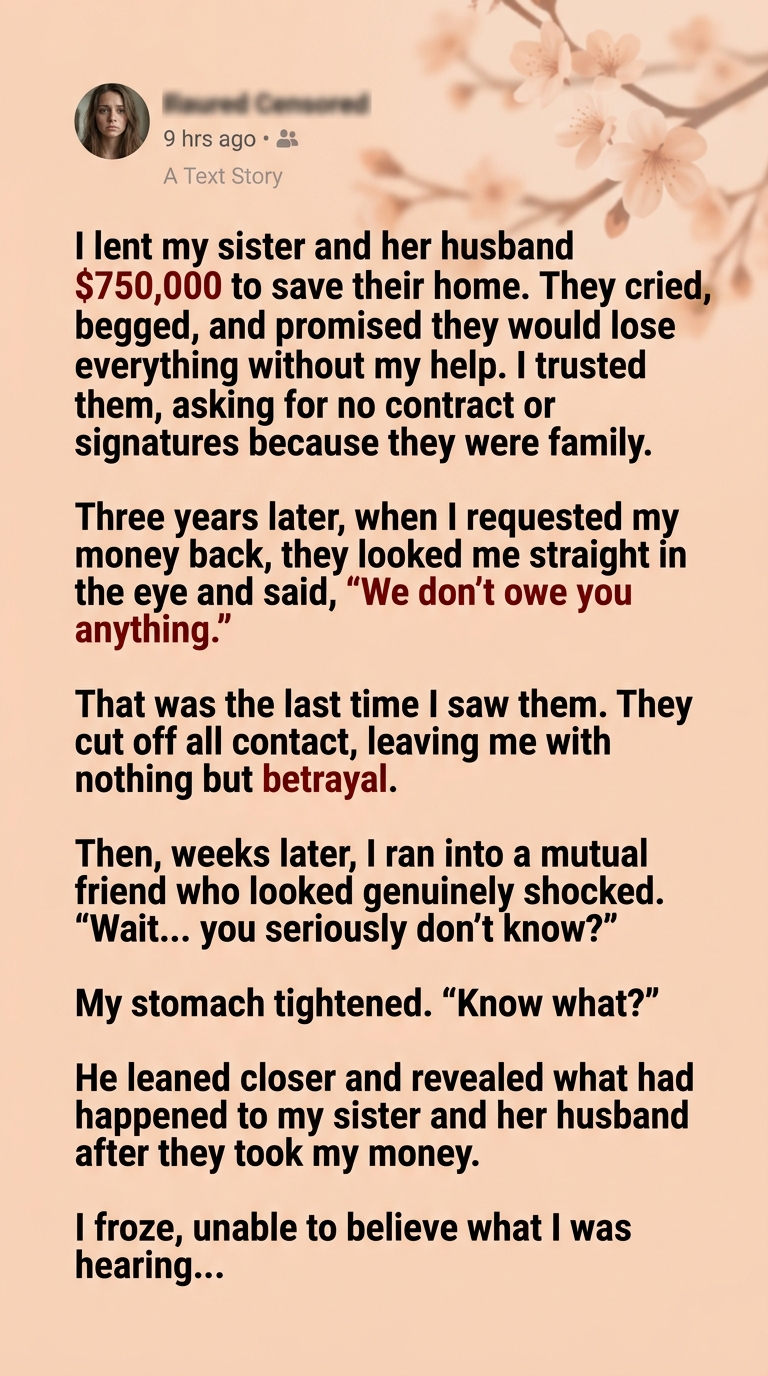
I Lent My Sister $750,000 to Save Her Home. Three Years Later, She Said She Didn’t Owe Me Anything. Then I Learned What Happened to Them.
Three years ago, my sister Emily called me crying.
Her husband, Jason, was losing their house.
They had fallen behind on their mortgage, received several warnings from the bank, and were facing foreclosure. Emily told me they had exhausted every option. Their savings were gone, Jason’s business was struggling, and they had nowhere else to turn.
“Please,” she begged. “They’re going to take our home. Our children will have nowhere to live.”
I had the money.
It was most of the inheritance our father had left me, combined with years of savings from my consulting business. I had planned to invest it, but when I heard my sister crying, those plans suddenly seemed unimportant.
I transferred them $750,000.
No contract.
No signatures.
No repayment schedule.
I didn’t even ask them to write a simple acknowledgment.
Emily hugged me so tightly that I could barely breathe.
“You saved us,” she whispered. “I swear we’ll pay every dollar back.”
Jason shook my hand.
“I’ll never forget this. You’re not just my sister-in-law. You’re the reason my family still has a home.”
I believed them.
For the next three years, I never mentioned the money.
I didn’t want to make my sister uncomfortable. I didn’t want her children growing up hearing arguments about debt. And I certainly didn’t want to become the kind of relative who treated every family favor like a business transaction.
But I expected them to remember.
I expected them to understand that $750,000 wasn’t a small gift.
Then, three years later, I needed the money.
My business was expanding, and I wanted to purchase a commercial property. I had already found the right location, but I needed my original funds to complete the purchase.
I called Emily.
“Hey, I wanted to talk about the money I lent you and Jason. I know things have been better for you lately. Can we discuss a repayment plan?”
She went quiet.
Then she said, “What money?”
I thought I had misunderstood.
“The $750,000. The money I transferred to save the house.”
She laughed.
Not nervously.
Not awkwardly.
She actually laughed.
“That was three years ago.”
“I know. That’s why I’m calling.”
“Well, you gave it to us.”
I sat down.
“No, Emily. I lent it to you.”
“There’s no contract.”
“Because I trusted you.”
She sighed.
“That’s your decision. We never signed anything.”
I couldn’t believe what I was hearing.
“Jason promised to repay me.”
“Jason says he never agreed to anything.”
Then she delivered the sentence that changed our relationship forever.
“We don’t owe you anything.”
I called Jason immediately.
He answered, and I asked him to explain.
He sounded irritated.
“Look, you helped us when we needed it. We appreciated it. But you can’t come back three years later and demand money we considered a gift.”
“A gift? I never said it was a gift.”
“Then you should have gotten something in writing.”
I stared at my phone.
They had accepted my money when their house was about to be taken.
They had thanked me.
They had promised repayment.
And now they were using my trust as their excuse for keeping everything.
I contacted my parents, hoping they might help resolve the situation.
My mother told me I should forgive Emily.
My father said family relationships were more important than money.
Neither of them asked why Emily and Jason had refused to acknowledge what they promised.
I realized I was completely alone.
I sent Emily one final message asking her to discuss repayment through a neutral mediator.
She blocked me.
Jason blocked me too.
Within days, their children stopped answering my calls, and mutual relatives began telling me that I was being greedy.
I didn’t respond.
I had lost $750,000, but I wasn’t going to spend the rest of my life begging people to admit what they had done.
Then, several weeks later, I ran into an old family friend named Michael at a restaurant.
He had known my sister and me since childhood.
We exchanged greetings, and he asked how things were going.
I told him I was fine.
Then he mentioned Emily.
“How are things with your sister?”
I hesitated.
“We aren’t speaking anymore.”
His expression changed.
“Because of the money?”
I nodded.
He looked genuinely shocked.
“Wait. You seriously don’t know?”
My stomach tightened.
“Know what?”
He leaned closer.
“Emily and Jason sold the house.”
I blinked.
“What?”
“They sold it about six months ago. They bought another place outside the city.”
I felt my face grow hot.
“Why didn’t they tell me?”
Michael shook his head.
“That’s not even the biggest part.”
He looked around before lowering his voice.
“Jason’s business was doing extremely well. He sold his share to another company. From what I heard, the deal was worth several million.”
I couldn’t speak.
“They weren’t struggling anymore,” Michael continued. “People thought you had been paid back already.”
I stared at him.
“Paid back?”
“That’s what Jason told people. He said the $750,000 was settled when he refinanced the house.”
My hands went cold.
“That never happened.”
Michael looked uncomfortable.
“Then you need to know something else. Emily has been telling people that you gave them the money as a wedding and family gift. She says you’re now demanding it back because you’re jealous of their success.”
I felt sick.
For three years, I had believed they were struggling to rebuild their lives.
Meanwhile, they had sold the house, made money from Jason’s business, and told people that my loan had been forgiven.
I thanked Michael and left the restaurant.
That night, I couldn’t sleep.
I kept replaying the conversation in my head.
The house sale.
The business deal.
The false story about repayment.
Then I remembered something.
When I transferred the $750,000, I had written a note in the bank transfer description:
“Loan to Emily and Jason for mortgage arrears — repayment expected.”
It wasn’t a signed contract, but it was a contemporaneous record of what I understood the payment to be.
I also remembered the messages Emily had sent afterward.
You saved our home. I promise every dollar will come back to you.
And Jason’s message:
Once the business stabilizes, I’ll start paying you back. You have my word.
I opened my old email account and began searching.
I found more than I expected.
Messages discussing the mortgage arrears.
A spreadsheet Jason had sent me showing how much they needed to avoid foreclosure.
A message from Emily asking me to transfer the money directly to the lender.
And a later conversation in which Jason discussed beginning repayment after a business sale.
I printed everything.
Then I called an attorney.
The following morning, I sat in a conference room with a lawyer named Rebecca.
I placed the bank transfer confirmation, messages, emails, and financial records on the table.
She reviewed everything carefully.
“First, don’t contact them angrily,” she said. “Second, don’t assume the absence of a signed contract automatically means you have no legal options.”
She explained that whether I could recover the money would depend on the applicable law, the evidence, the circumstances of the transfer, and whether the payment could be established as a loan rather than a gift.
The messages were important.
The transfer description was important.
The financial records were important.
But nothing guaranteed an immediate victory.
I asked her to investigate the property sale and Jason’s business transaction.
She arranged for appropriate searches and formal requests through the legal process.
Over the next few weeks, we discovered that the story was worse than Michael had described.
Jason had sold his business interest for a substantial amount.
The transaction had been completed months before I asked for my money back.
Emily and Jason had also sold the house and purchased a smaller property in another neighborhood.
They had enough money to discuss repayment.
They simply didn’t want to.
Rebecca prepared a formal demand letter.
It included the date of the transfer, the amount, the available written communications, and a request that they respond through our attorneys.
I didn’t ask for their entire fortune.
I asked for the $750,000 I had lent them, along with any interest or other amounts that could properly be claimed.
The letter was delivered.
Three days later, Jason called.
For the first time in weeks, he sounded nervous.
“What is this legal nonsense?”
“It’s a formal request to resolve the debt.”
“We already told you we don’t owe you anything.”
“Then explain that to the lawyer.”
He laughed bitterly.
“You’re really going to sue your own sister?”
I paused.
“You’re the one who decided our relationship was worth less than the money.”
He hung up.
The legal process took months.
Emily and Jason initially denied that the money was a loan.
Their lawyer argued that the transfer had been a voluntary family gift.
But our evidence told a different story.
The messages showed that repayment had been discussed repeatedly.
The bank transfer description identified the payment as a loan.
Jason’s own email referred to repayment after his business stabilized.
The documents were reviewed as part of the proceedings.
During the case, Emily’s lawyer tried to argue that I had never set a specific repayment date.
Rebecca explained that the absence of a fixed date did not necessarily turn a loan into a gift. The court would have to consider the entire agreement and applicable law.
The judge also examined the communications sent immediately after the transfer.
One message from Emily stood out.
I know $750,000 is a lot to ask. I promise we won’t forget this. When we’re back on our feet, we’ll repay you.
Emily claimed she had meant to express gratitude, not make a promise.
But Jason’s messages were harder to explain.
He had repeatedly discussed repayment as a future obligation.
The court eventually found that the evidence established the money had been provided as a loan, not an unconditional gift.
Emily and Jason were ordered to repay the amount according to the judgment, with the additional amounts determined by the court.
I didn’t celebrate.
I felt relief, but it was mixed with sadness.
I had spent years believing that my sister would never knowingly hurt me.
Now I had to accept that she had been willing to deny everything when she thought I couldn’t prove it.
A few weeks after the judgment, Michael called again.
“Have you heard from Emily?”
“No.”
“She’s telling people you destroyed her marriage.”
I sighed.
“She can tell them whatever she wants.”
He hesitated.
“There’s something else. Jason is furious. Apparently, the business money isn’t as available as everyone thought. He had already committed much of it to investments and other expenses.”
I wasn’t surprised.
They had spent years treating money as though it appeared whenever they needed it.
Now they had to face a repayment obligation they had hoped would disappear.
Jason’s attorney contacted Rebecca to discuss a structured repayment arrangement.
We agreed to review a proposal, but only if it was properly documented and secured where appropriate.
No more promises.
No more handshakes.
No more trusting someone simply because they shared my family name.
The first payment arrived several weeks later.
It wasn’t the entire amount, but it was a meaningful beginning.
Emily sent me a message that evening.
I hope you’re happy now.
I read it twice.
Then I replied:
I wanted my sister to keep her word. I never wanted a court to have to remind her.
She didn’t answer.
Almost a year later, I had recovered most of the money through the repayment arrangement.
The remaining balance was still being paid according to the agreed schedule.
My relationship with Emily, however, had not recovered.
My parents eventually admitted that they had believed her version of events because they didn’t want to accept that their daughter had lied.
My mother called one afternoon and apologized.
“I should have asked to see the evidence before blaming you,” she said.
I appreciated the apology, but I couldn’t pretend everything was normal.
Some things can be repaired with money.
Trust is different.
I eventually bought the commercial property I had wanted.
I turned it into a small office building and rented out the additional space. It wasn’t the investment I had originally imagined, but it became a fresh beginning.
One evening, I received another message from Emily.
It was short.
Can we talk? I miss being sisters.
I stared at the screen for a long time.
I missed her too.
I missed the sister who used to share secrets with me, who sat beside me during difficult times, who promised that family would always protect family.
But I couldn’t pretend that woman was the same person who had looked me in the eye and said she owed me nothing.
I finally replied:
We can talk when you’re ready to acknowledge what happened without blaming me for asking for my money back.
She never responded.
And that was the last message between us for a long time.
I learned something expensive from those three years.
Helping family isn’t wrong.
Trusting someone isn’t foolish.
But love should never require you to abandon every form of protection.
I had given my sister $750,000 because I believed she would do the right thing.
In the end, the money came back through a court judgment and a repayment agreement.
But the relationship I thought I was saving never returned.
And if I ever help someone again, I will still do it with a generous heart.
I’ll simply make sure the agreement is written down.
Because family should be the first people you can trust.
They should never be the reason you learn why a signature matters.