MY HUSBAND WANTED ME TO SELL MY APARTMENT SO HIS MOTHER COULD OWN OUR NEW HOUSE—BUT I HAD A PLAN THEY NEVER SAW COMING
My husband, Jack, had always said marriage meant sharing everything.
Apparently, that only applied to the things I owned.
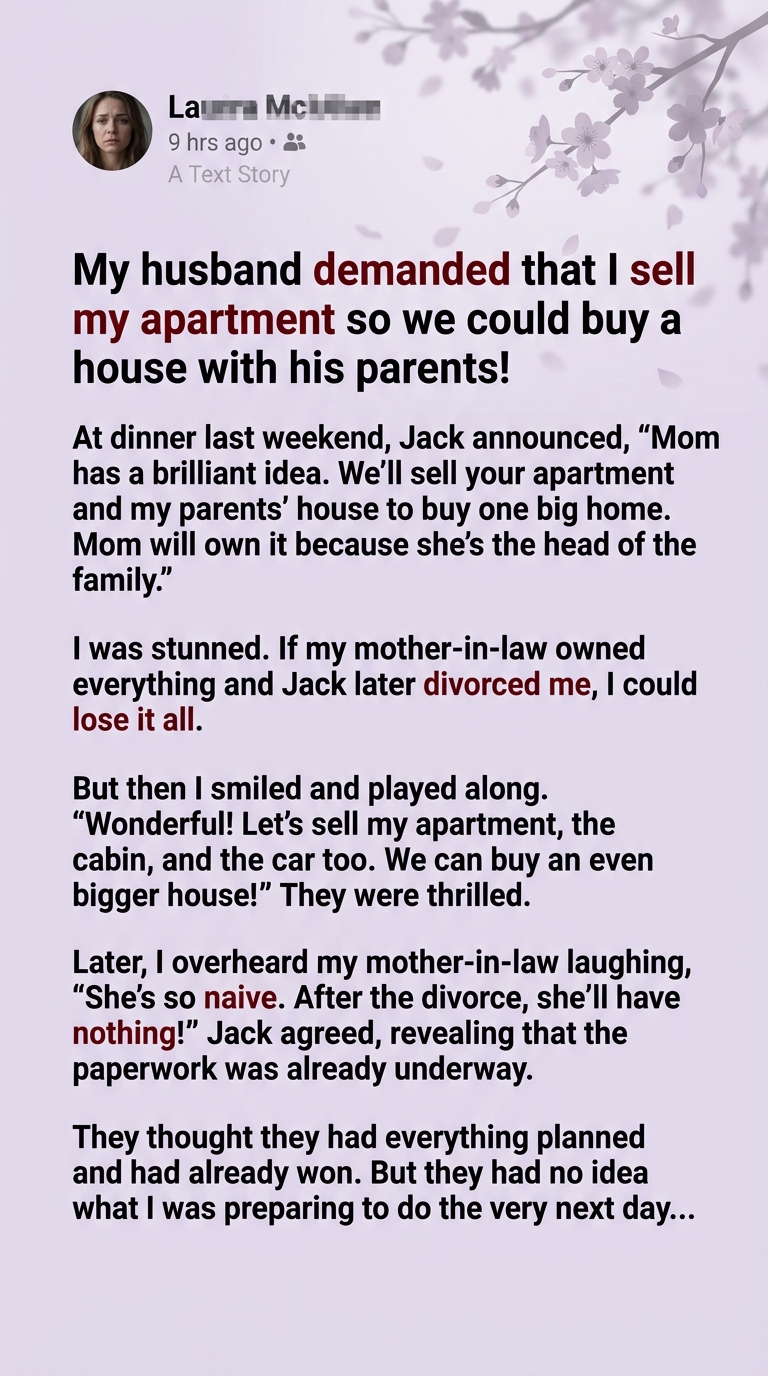
Last weekend, we were having dinner at his parents’ house when Jack suddenly put down his fork and announced that his mother had come up with a brilliant idea.
“Mom thinks we should sell your apartment and their house. Then we can buy one big family home together.”
I looked at him.
“Together?”
His mother, Patricia, smiled.
“Of course, dear. We’ll all live under one roof. It’ll be wonderful. I’ll manage the household, and everyone will contribute.”
Jack nodded enthusiastically.
“And Mom will own the new property because she’s the head of the family.”
I nearly dropped my glass.
My apartment had been purchased years before I met Jack. I had worked overtime, saved carefully, and paid the mortgage with my own money. I also owned a small cabin I had inherited from my grandmother and a car I had purchased before our marriage.
None of those assets belonged to his mother.
“Why would your mother own the entire house if we’re selling our properties to buy it?” I asked.
Patricia gave me a patient smile.
“Because someone has to be responsible. You’re young, and Jack is still building his career. I have experience managing family finances.”
Jack reached for my hand.
“Don’t make this difficult. It’s better for everyone.”
I immediately understood the danger.
If I sold my apartment and contributed the proceeds toward a house titled only in Patricia’s name, I could lose control of the money I had spent years earning. Depending on the legal arrangements, recovering that contribution later could become complicated.
And if Jack and I divorced?
I could be left fighting for money that had once been mine.
But instead of arguing, I smiled.
“That’s a wonderful idea.”
Jack looked relieved.
Patricia beamed.
I continued.
“Actually, why stop there? Let’s sell my apartment, the cabin, and the car too. We could buy an even bigger house. Maybe one with a swimming pool and a guest wing.”
Their expressions changed instantly.
Patricia clasped her hands.
“I knew you’d understand!”
Jack laughed.
“See? I told you she’d come around.”
I smiled and raised my glass.
“To the new family home.”
But inside, I was already planning my next move.
Later that evening, I went upstairs to get my coat. As I approached the living room, I heard Patricia laughing.
“She really is naive. Once everything is in my name, she’ll have nothing after the divorce.”
I stopped walking.
Jack chuckled.
“Don’t worry. The paperwork is already underway. The agent has the details, and Mom’s lawyer is preparing the documents.”
My blood ran cold.
Patricia continued.
“Once she signs the sale papers, we’ll have the money. She’ll never realize what she’s agreed to until it’s too late.”
Jack replied, “She trusts me. She won’t question anything.”
I stood silently in the hallway.
The man I had married was planning a divorce while trying to take the property I had owned before our relationship.
I quietly returned downstairs, said goodbye, and drove home.
I didn’t confront him.
I didn’t cry in front of him.
And I didn’t tell him what I had heard.
The very next morning, I contacted an independent property attorney.
I explained everything, including the proposed sale, the planned transfer of ownership, and the conversation I had overheard.
My attorney listened carefully.
“Do not sign anything,” she said. “And don’t authorize anyone to list or transfer your property until we’ve reviewed your documents.”
She explained that the legal consequences would depend on where the properties were located, how they were titled, whether any marital funds had been used, and what agreements existed between Jack and me.
But one thing was clear.
I had no obligation to hand over my separate property simply because my husband and mother-in-law wanted it.
My attorney helped me take several immediate steps.
First, I obtained updated copies of the property records for my apartment and cabin.
Second, I contacted the relevant agents and confirmed that I had not authorized anyone to sell either property.
Third, I reviewed my bank accounts, mortgage records, insurance documents, and financial authorizations.
I also changed passwords on my personal accounts and enabled additional security.
Finally, my attorney sent a formal notice to the property agent stating that no sale or transfer was authorized by me.
I went home that afternoon and waited.
Jack arrived around six.
“Good news!” he announced. “The agent says we can move quickly. We just need your signature.”
I placed a folder on the kitchen counter.
“Before I sign anything, I want you to read this.”
He opened it.
Inside was a letter from my attorney requesting complete disclosure of the proposed transaction, including the intended ownership structure, financial contributions, and any documents prepared on my behalf.
Jack’s smile disappeared.
“What is this?”
“Independent legal advice.”
He looked up sharply.
“Why would you need a lawyer? We’re married.”
“Exactly. That’s why I want everything properly documented.”
He slammed the folder shut.
“Are you accusing my mother of something?”
“I heard her talking last night.”
His face changed.
“What did you hear?”
I repeated her words.
Once everything is in my name, she’ll have nothing after the divorce.
For several seconds, Jack didn’t speak.
Then he tried to laugh.
“You misunderstood. Mom was joking.”
“Was the paperwork a joke too?”
He looked away.
I asked whether he had already contacted a lawyer about divorcing me.
He didn’t answer.
That was answer enough.
I told him I had not authorized the sale of my apartment, my cabin, or my car. I would not be contributing my savings toward a property owned entirely by his mother.
He became angry.
“You’re destroying our future over a misunderstanding!”
“No, Jack. I’m protecting my future because you and your mother were planning it without me.”
He insisted that Patricia only wanted to protect the family.
I asked why protecting the family required putting every asset in her name.
He had no convincing answer.
The next day, Patricia called.
Her voice was unusually sweet.
“Darling, Jack tells me you’ve been speaking to an attorney. There’s no need for that. We’re family.”
I replied calmly.
“Then there should be no problem with independent lawyers reviewing the paperwork.”
She immediately became irritated.
“You’re making us look dishonest.”
“I didn’t create the documents. I only asked to understand them.”
She ended the call.
Two days later, Jack came home carrying a stack of papers.
He placed them on the dining table.
“Mom wants to meet tomorrow. We need to settle this.”
I looked at the papers.
They included a draft agreement describing a proposed family property purchase. My apartment proceeds were listed as a major contribution, but Patricia was named as the sole intended owner.
There was also a section describing my contribution as a voluntary family gift.
I stared at the wording.
They weren’t simply asking me to sell my apartment.
They wanted me to give away the proceeds without retaining a documented ownership interest.
I photographed the documents and sent them to my attorney.
She advised me not to sign or transfer anything. She also recommended that any further discussions take place in writing or with legal representatives present.
The following afternoon, we met at a law office.
Patricia arrived looking confident.
Jack sat beside her.
My attorney placed the draft agreement on the table.
“Before anyone proceeds, we need to clarify the source of the funds, the intended ownership, and the legal basis for describing the contribution as a gift.”
Patricia waved her hand.
“We’re family. We don’t need to complicate everything.”
My attorney replied calmly.
“Family relationships don’t replace proper property documentation.”
Then she asked Patricia whether she intended to reimburse me for my apartment’s proceeds or give me a legal ownership interest in the new property.
Patricia hesitated.
“Why would I do that? The house will belong to me.”
My attorney nodded.
“Then our client will not be contributing her property proceeds.”
Jack leaned forward.
“She’s my wife. She should trust me.”
I looked directly at him.
“Trust is not signing away everything I own while you secretly plan a divorce.”
Patricia turned pale.
Jack looked at the floor.
I told them I had heard their conversation. I knew about the paperwork, the proposed divorce, and their expectation that I would be left with nothing.
Patricia immediately denied saying it.
Jack finally spoke.
“Mom was only trying to protect what belongs to our family.”
I asked him one question.
“Then why were you planning to divorce me after taking my money?”
He had no answer.
The meeting ended without an agreement.
Over the following weeks, I began separating my finances and working with my attorney to understand my rights. We reviewed the marriage’s financial history, including whether any shared funds had been used for either property.
Jack moved into his parents’ house.
He continued sending messages, first apologizing, then accusing me of destroying our marriage.
I didn’t respond to the accusations.
Eventually, he admitted that he had discussed divorce with his mother and believed the proposed arrangement would leave him financially protected.
He said he hadn’t expected me to discover the plan.
That was the moment I finally understood how little he had trusted me.
The divorce process began shortly afterward. My attorney made sure the property ownership and financial contributions were addressed through the appropriate legal procedures. No one could simply declare my apartment, cabin, or car to be Patricia’s property because she wanted them.
The final financial outcome took time to resolve, but I did not sign away my assets or hand over the proceeds of my apartment.
Months later, I returned to the cabin my grandmother had left me.
I sat on the porch, listening to the wind move through the trees.
For a long time, I had believed that marriage meant proving your loyalty by sharing everything.
Now I understood that a healthy marriage also required honesty, consent, and respect for each person’s independence.
Jack and Patricia had mistaken my kindness for weakness.
They thought I would sell everything, sign whatever they placed in front of me, and thank them for allowing me to become part of their family.
They were wrong.
I didn’t need to sell my home to prove I loved my husband.
And I certainly didn’t need to surrender my future to prove I belonged.
The biggest house in the world would never have been worth losing the life I had worked so hard to build.