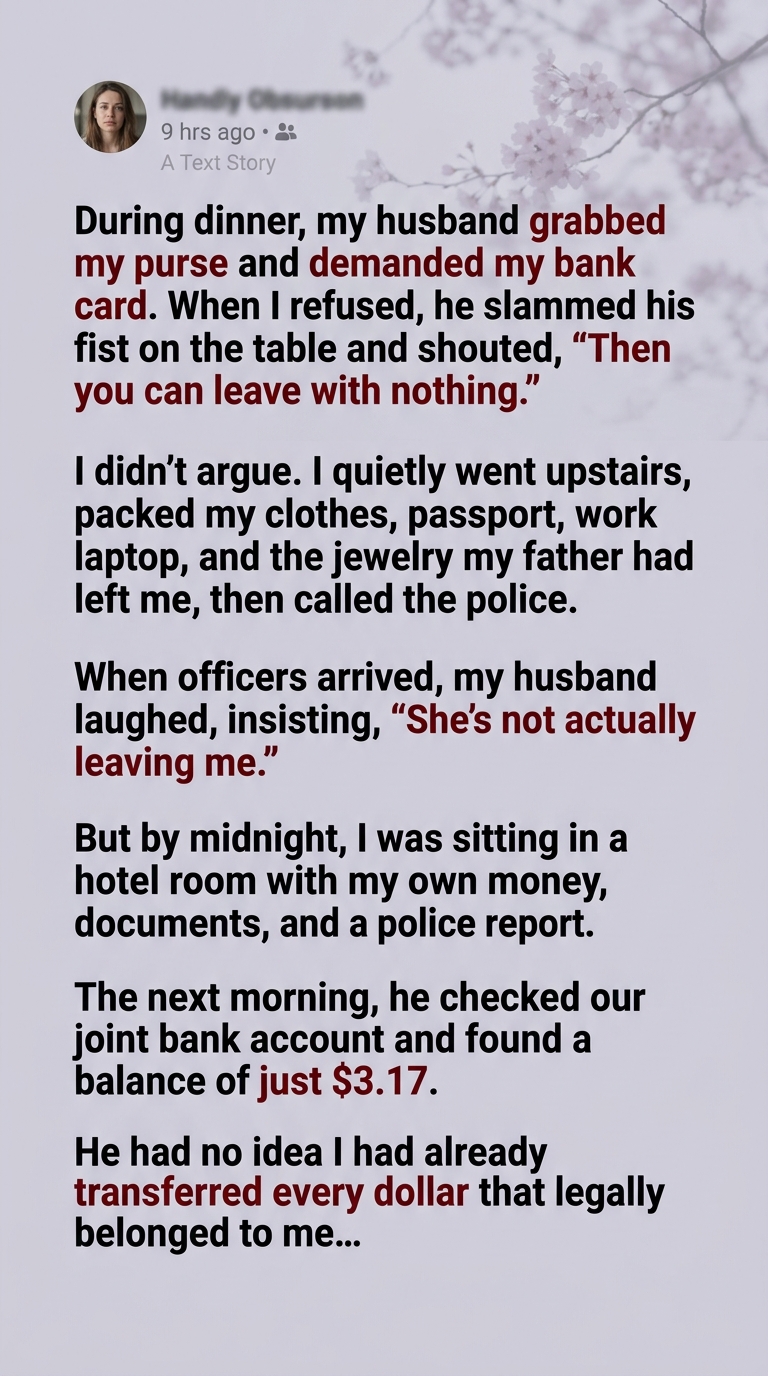
My Husband Demanded My Bank Card and Threatened to Throw Me Out With Nothing. By Morning, Our Joint Account Had $3.17.
During dinner, my husband grabbed my purse and demanded my bank card.
“Give it to me, Audrey.”
I stared at him.
“Why?”
“Because I said so. I need access to the money.”
When I refused, he slammed his fist against the table so hard that our glasses rattled.
“Then you can leave with nothing!”
I didn’t scream.
I didn’t throw anything.
I simply looked at the man I had been married to for fourteen years and realized that the person sitting across from me no longer felt like my husband.
“Okay,” I said quietly.
He laughed.
“That’s what I thought.”
I stood, walked upstairs, and began packing.
My clothes.
My passport.
My work laptop.
The jewelry my father had left me.
My personal documents.
And the small folder containing copies of our financial records.
Then I called the police.
By midnight, I was sitting in a hotel room with my own money, my belongings, and an incident report.
The next morning, my husband checked our joint bank account.
The balance was $3.17.
He had no idea that I had already moved the funds that legally belonged to me into an account he couldn’t access.
And he had no idea that the bank records I had quietly gathered were about to expose something much bigger than a fight over a bank card.
My name is Audrey Bennett. I was forty-two, worked as a financial operations manager, and had been married to Daniel for fourteen years.
For most of our marriage, I believed we were a team.
We bought a house together, built savings, and planned for retirement. I handled most of the household finances because Daniel disliked paperwork.
He used to joke that I was our family’s unpaid accountant.
But over the previous year, his attitude toward money had changed.
He began questioning every purchase I made.
He wanted to know why I bought new shoes, why I sent money to my younger sister, and why I kept a separate savings account.
At first, I thought he was worried about our expenses.
Then he began demanding access to my personal accounts.
He said married couples shouldn’t have financial secrets.
I agreed that financial transparency mattered.
But I also believed that having personal savings was reasonable, especially since I had maintained my own career throughout our marriage.
Daniel didn’t agree.
He began checking our bank statements without telling me, questioning transfers, and complaining whenever I spent money without asking him.
Then I noticed several withdrawals from our joint savings account.
They weren’t household expenses.
They were transfers to an account I didn’t recognize.
When I asked about them, Daniel said they were related to an investment opportunity.
He promised to explain later.
But later never came.
I started keeping copies of the statements I was legally entitled to access.
I also reviewed our mortgage payments, investment contributions, and outstanding debts.
What I found made me increasingly uncomfortable.
Over six months, nearly $28,000 had been transferred from our joint savings into an account connected to a small consulting company.
The company was registered under Daniel’s name.
I couldn’t determine whether the transfers were legitimate business expenses, personal investments, or something else.
But Daniel refused to provide a clear explanation.
Whenever I asked, he became angry.
“Why are you investigating me?”
“I’m trying to understand where our money is going.”
“You don’t need to understand everything.”
That sentence stayed with me.
Because suddenly, our marriage felt less like a partnership and more like a situation in which one person expected the other to obey.
The dinner incident happened on a Thursday.
Daniel had been unusually tense all week.
He had received several calls from someone named Martin and spent most of his evenings outside on the patio.
That night, I was clearing the plates when he asked about a recent deposit into my personal account.
It was my quarterly work bonus.
I had already planned to use part of it to pay my personal credit card and put the rest into savings.
Daniel wanted the entire amount transferred into our joint account.
“I need your bank card,” he said.
“No.”
He stared at me.
“What did you say?”
“I said no. I’ll contribute my agreed share toward our household expenses, but I’m not handing over my personal bank card.”
His expression changed.
He grabbed my purse from the chair and began searching through it.
I reached for it.
“Daniel, stop.”
He pulled out my wallet.
“Where is it?”
“Give me my purse.”
He threw the wallet onto the table.
Then his fist came down.
“Then you can leave with nothing!”
I looked at him.
I had heard him raise his voice before, but something about that moment was different.
He wasn’t asking for a discussion.
He was demanding control.
I quietly picked up my purse.
“Fine,” I said.
He leaned back, satisfied.
“Good. Maybe now you’ll understand how things work in this house.”
I walked upstairs.
He didn’t follow.
I packed carefully, making sure I had everything I needed.
Before leaving, I photographed the condition of my belongings and the documents I was taking.
I called the police because I was afraid the confrontation could escalate and I wanted the incident documented.
When officers arrived, Daniel laughed.
“She’s not actually leaving me.”
One officer asked him to step away while they spoke with me.
I explained what had happened, including the grabbing of my purse and his threat.
I told them I wasn’t asking them to decide our financial dispute. I simply wanted to leave safely and document the incident.
They recorded the information and advised me about available support and next steps.
Daniel stood in the hallway, shaking his head.
“She’s making a scene over a bank card.”
I didn’t respond.
I carried my suitcase outside.
The officer waited until I was safely in my car.
By midnight, I was in a hotel room.
I sat on the bed, took a deep breath, and called my attorney.
The next morning, Daniel discovered the account balance.
He called me at 8:13 A.M.
“What did you do?”
I was sitting at a small table near the hotel window, drinking coffee.
“Good morning.”
“Don’t play games. The joint account is empty.”
“It’s not empty. There’s $3.17.”
“Where is the money?”
“I transferred the funds that my attorney and I determined were legally mine.”
“You stole our money!”
“No. The transfers were made after reviewing the ownership and contribution records. The jointly owned funds remain subject to the financial settlement.”
He went silent.
Then he shouted.
“You had no right!”
I looked at the folder beside my laptop.
“Daniel, I didn’t take money that wasn’t mine. I moved my own funds and documented the transaction. If you disagree, your attorney can contact mine.”
He began swearing.
I ended the call.
But the financial situation was more complicated than he understood.
I hadn’t simply emptied an account out of anger.
For several weeks, I had been working with my attorney to understand what money belonged to me, what was jointly owned, and what should remain untouched until the divorce and property issues were resolved.
I had transferred only funds that were documented as my separate property or otherwise legally available to me.
The jointly owned assets were being handled separately.
I had also contacted the bank to secure my personal accounts, update passwords, and remove Daniel’s access wherever appropriate.
The money wasn’t gone.
It was protected.
And every transaction had a paper trail.
Three days later, Daniel’s attorney contacted mine.
He claimed I had improperly removed money from the joint account.
My attorney responded with the supporting statements, contribution records, and transfer documentation.
She also requested a full accounting of the consulting company transfers.
That request changed the conversation.
Daniel had assumed I would leave quietly and never question the financial arrangements.
Instead, the review revealed that some of the money he had moved into his company had come from our joint savings.
He had also used a portion of our shared funds to pay expenses that appeared to be personal.
Some transactions were supported by legitimate business documents.
Others lacked adequate explanations.
The accountant reviewing the records requested additional information.
Daniel became increasingly defensive.
He insisted that the company was his and that he could spend its money however he wanted.
My attorney reminded him that money transferred from jointly held marital assets could still be relevant to the divorce accounting, regardless of which company account received it.
The matter would need to be resolved through disclosure and the legal process.
I wasn’t trying to destroy his business.
I wanted an accurate picture of what had happened to our money.
A week later, Daniel sent me a message.
You embarrassed me in front of the police. You could have just talked to me.
I stared at the screen.
I thought about the way he had grabbed my purse.
The way he had slammed his fist on the table.
The way he had told me I would leave with nothing.
Then I typed:
I tried talking to you about our finances for months. You chose to threaten me instead.
He replied almost immediately.
I was angry. I didn’t mean it.
I didn’t answer.
An apology after the consequences arrive doesn’t automatically repair the damage.
Over the following weeks, I stayed with my sister while my attorney handled the divorce proceedings.
Daniel continued sending messages.
Some were angry.
Others were sentimental.
He reminded me of our wedding, our holidays, and the house we had renovated together.
He said we had built too much to throw it away.
But he never acknowledged the real problem.
He still believed the argument was about a bank card.
It wasn’t.
It was about control.
The financial review eventually revealed that Daniel had transferred approximately $41,000 from our shared funds into his consulting company over a period of fourteen months.
Some of those transfers were properly documented as business-related expenses.
However, several payments had been used for personal purchases and expenses that had not been disclosed to me.
The review also identified a payment toward a luxury vehicle lease and several hotel charges that Daniel had described as business travel.
He was required to explain those transactions as part of the divorce financial disclosure process.
He eventually admitted that some of the expenses had not been legitimate business costs.
That admission became relevant when the marital assets were divided.
The court did not simply award me every dollar he had transferred. Instead, the financial records were considered as part of the overall property and settlement proceedings.
The final agreement accounted for the funds I had preserved, the assets we jointly owned, the outstanding debts, and the transfers that could be established.
I received a fair settlement.
More importantly, I was no longer financially dependent on Daniel.
Several months later, I returned to the house to collect a few remaining belongings.
Daniel was sitting in the living room.
He looked tired.
For a moment, neither of us spoke.
Then he said, “I never thought you’d actually leave.”
I placed a box on the floor.
“That’s because you thought I had nowhere to go.”
He looked down.
“I was angry that night.”
“You were angry because I wouldn’t give you my bank card.”
“I didn’t mean what I said.”
I looked around the living room.
We had chosen the furniture together. We had painted the walls ourselves. We had celebrated birthdays and holidays in that house.
But it no longer felt like home.
“You told me I would leave with nothing,” I said. “You made me feel as though everything I had worked for could disappear because you were angry.”
He rubbed his forehead.
“I know.”
I picked up the box.
“I hope you understand that I didn’t leave because of one argument. I left because I finally understood what our relationship had become.”
He didn’t stop me.
I walked out.
One year later, I live in a smaller apartment that I pay for myself.
I have my own bank accounts, my own savings, and a job I still enjoy.
I also have something I had slowly lost during the final years of my marriage.
Peace.
Sometimes people ask whether I regret leaving.
I think about that night.
The purse.
The bank card.
The slammed fist.
The threat that I would leave with nothing.
Then I remember the $3.17 in the joint account.
Daniel thought that number represented my defeat.
But it represented something else.
It represented the moment he realized that he could no longer control my money simply because he was my husband.
I didn’t take everything.
I took what was legally mine, documented what I did, and left the rest to be resolved properly.
And when I walked out of that house, I carried something more valuable than the money.
I carried the certainty that I would never again have to ask permission to protect myself.