They Invested in the Wrong Daughter
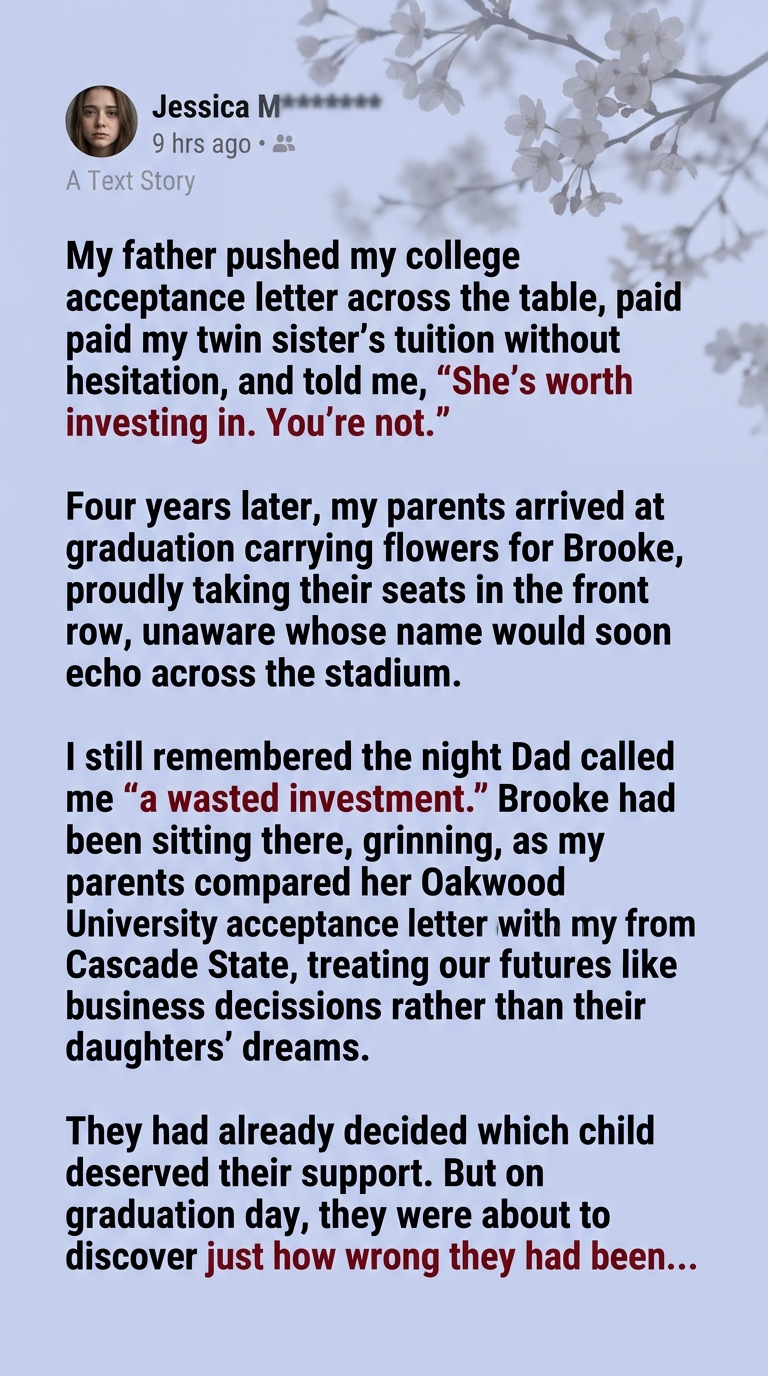
The night my father pushed my college acceptance letter across the kitchen table, I realized that my parents had already chosen which daughter mattered more.
My twin sister, Brooke, sat beside him, holding her acceptance letter from Oakwood University. She had been accepted into its business program, and my parents were celebrating as if she had just been appointed CEO of the family.
My letter was from Cascade State University. It offered me admission to its engineering program, along with a partial academic scholarship.
I was proud of it.
At least, I had been until my father looked at both letters and laughed.
“Oakwood is a real opportunity,” he said, tapping Brooke’s letter. “That’s an investment worth making.”
Then he looked at mine.
“You’re going to Cascade State? That’s what you chose?”
“It’s a strong engineering program,” I explained. “And I received a scholarship. I can cover part of the cost with that.”
My mother barely looked up from her phone.
“Your sister has always had a clearer direction,” she said. “We don’t want to waste money on something that might not work out.”
I felt my face grow hot.
“We’re twins,” I said quietly. “Why are you treating us differently?”
My father leaned back in his chair.
“Because not every child is worth the same investment.”
Brooke smiled into her glass.
Then he delivered the sentence I would remember for years.
“She’s worth investing in. You’re not.”
Nobody corrected him.
Nobody told him he was wrong.
I folded my acceptance letter, thanked them for considering it, and went upstairs.
That night, I cried until my pillow was wet.
But the next morning, I made a decision.
If my family believed my future wasn’t worth investing in, I would build it without them.
I accepted Cascade State’s offer.
I took out student loans, applied for every scholarship I could find, and worked evenings at the university library. During summers, I took internships, sometimes sleeping only five hours a night because I couldn’t afford to fall behind.
Brooke’s experience was completely different.
My parents paid her tuition, bought her a new laptop, covered her apartment, and sent her money whenever she needed it.
They posted photographs of her campus life and bragged about her achievements at family gatherings.
When relatives asked about me, my mother usually said, “She’s still figuring things out.”
I stopped correcting her.
I had more important things to do.
During my second year, I joined a research team working on low-cost water purification systems. The project began as a small assignment, but I became fascinated by the possibility of bringing clean water to communities that couldn’t afford expensive infrastructure.
My professor, Dr. Elena Morris, noticed how much time I spent in the laboratory.
One afternoon, she pulled me aside.
“Have you considered applying for the university’s undergraduate research fellowship?”
“I don’t think I have the qualifications,” I admitted.
She smiled.
“You’re already doing the work. Why shouldn’t you apply?”
I did.
And I won.
The fellowship covered my remaining tuition and gave me access to a research facility I had only dreamed of using.
For the first time, I wasn’t just surviving college.
I was building something.
By my final year, my team had developed a compact filtration system designed for communities with unreliable access to clean water. We tested it in several locations, improved its efficiency, and presented our findings at regional engineering conferences.
The project attracted attention from a nonprofit organization that funded practical water-access solutions.
They offered our team a development grant.
It wasn’t a fortune, and it wasn’t a personal prize. But it meant our research could continue beyond graduation.
Meanwhile, Brooke had changed majors twice.
She had struggled through several semesters, taken a leave of absence, and eventually returned to finish her degree. My parents continued supporting her, insisting that she simply needed more time.
I never mocked her for it.
I knew how difficult college could be.
But I couldn’t ignore the difference in how our parents described our struggles.
When Brooke changed direction, they called her brave.
When I worked three jobs and nearly failed a course because I was exhausted, they called me unfocused.
I learned not to expect fairness from people who had already decided what I was worth.
Then graduation day arrived.
My parents called me the week before.
“Brooke is graduating too,” my mother announced. “We’ll be there early to get good seats for her.”
I paused.
“That’s nice.”
“Are you graduating in the morning or afternoon?” she asked.
“Morning.”
“Oh. We’ll try to make it.”
They didn’t ask what degree I was receiving.
They didn’t ask about my research.
They didn’t ask whether I had earned any honors.
They simply said goodbye.
I told myself I didn’t care.
But when I walked across campus on graduation morning, wearing my gown and carrying my cap, I couldn’t help looking toward the stadium entrance.
There they were.
My father carried a bouquet of white roses. My mother held a camera. Brooke stood between them in a beautiful dress, smiling as they searched for seats.
They found places in the front row.
I watched my father point toward the stage.
“That’s where Brooke will walk,” he said proudly.
I looked away before they noticed me.
My classmates gathered around me, congratulating me and taking photographs. Dr. Morris came over and straightened the gold honor cord around my neck.
“Ready?” she asked.
I nodded.
Then the ceremony began.
Names were announced one by one. Students crossed the stage, shook hands, and collected their diplomas.
My parents clapped loudly when Brooke’s name was called.
My mother stood up to take photographs.
My father whistled.
I watched them celebrate her.
And for a moment, I was that eighteen-year-old girl again, sitting at the kitchen table with an acceptance letter in front of her, wondering why she wasn’t enough.
Then the dean returned to the microphone.
“Before we conclude today’s ceremony, we have a special announcement.”
The stadium quieted.
“This year’s University Medal for Academic Excellence is awarded to a graduating student who has demonstrated exceptional achievement in engineering, research, and community impact.”
My heart began pounding.
The dean continued.
“The recipient has maintained one of the highest academic records in the graduating class while leading a research project that has secured external funding for continued development.”
I heard Dr. Morris whisper behind me.
“That’s you.”
The dean looked down at the card.
“Please join me in congratulating our recipient, the founder of the Cascade Clean Water Initiative…”
He paused.
Then he announced my full name.
For a second, I couldn’t move.
Then the stadium erupted.
My classmates stood. My research team cheered. Dr. Morris applauded so loudly that I could hear her over the crowd.
I walked toward the stage.
And that’s when I saw my parents.
My mother had stopped clapping.
My father was staring at the program in his hand, trying to find my name.
Brooke looked from him to me.
I climbed the steps and shook the dean’s hand.
He presented me with the university medal and a certificate recognizing my research contribution.
Then he announced that the nonprofit grant would support the next phase of our filtration project, including further testing and development with partner communities.
The applause grew louder.
I looked toward the front row.
My father was standing now.
He wasn’t smiling.
He was simply staring.
After the ceremony, my parents hurried toward me.
My mother reached me first.
“Oh, sweetheart!” she exclaimed, holding out her arms. “Why didn’t you tell us you were receiving such an important award?”
I looked at her.
“I did tell you about the research project.”
She blinked.
“Well, you never said it would become this.”
My father stepped forward.
“That was impressive,” he said. “You should have told us you were doing all this.”
I almost laughed.
“I tried.”
He looked uncomfortable.
Then he glanced at the medal.
“So, what’s next? Are you planning to work for a big engineering company? We could introduce you to some people.”
There it was.
The familiar tone.
The sudden interest.
The assumption that now my future might be useful to them.
Before I could answer, Brooke stepped closer.
“Congratulations,” she said softly.
I looked at her.
“Thank you.”
She glanced at our parents and then back at me.
“I knew you were working hard, but I didn’t know it was this big.”
I nodded.
“I didn’t know either when I started.”
My father cleared his throat.
“We should all go somewhere to celebrate. Dinner is on us.”
I studied his face.
Four years earlier, he had told me I wasn’t worth investing in.
Now he wanted to celebrate the results.
“Thank you,” I said. “But I’ve already made plans with my research team and professors. They’re the people who supported me when I needed it.”
My mother looked hurt.
“We’re your parents.”
“Yes,” I replied. “You are.”
My father lowered his voice.
“Don’t hold a grudge forever. We were trying to make the best decision for both of you.”
I looked directly at him.
“You didn’t just make different financial decisions. You told me I wasn’t worth investing in. You made sure I understood that my dreams mattered less than Brooke’s.”
He opened his mouth, but I continued.
“I didn’t need you to pay for everything. I needed you to believe I was worth supporting. Even when I struggled, you could have encouraged me. You could have asked how I was doing. But you didn’t.”
My mother looked down.
Brooke’s eyes filled with tears.
“I should have said something that night,” she whispered.
I turned toward her.
“Yes. You should have.”
She nodded.
“I was happy you weren’t getting the same support because it made me feel special. I knew it was wrong, but I didn’t want to lose that attention. I’m sorry.”
It was the first honest thing anyone in my family had said about that night.
I didn’t immediately forgive her.
But I appreciated that she finally acknowledged it.
My father looked at the medal again.
“Well, you proved us wrong.”
I shook my head.
“No, Dad. I didn’t spend four years trying to prove you wrong.”
He frowned.
“Then what were you trying to do?”
I looked toward my research team, who were waiting beside the stadium steps.
“I was trying to prove to myself that your opinion wasn’t the limit of my future.”
Then I walked away.
That evening, my team took me to dinner. We laughed, shared stories, and celebrated the work that had brought us there.
For the first time in years, I didn’t feel like I was waiting for my parents to recognize me.
A few weeks later, my father sent me a message.
He wrote that he had been thinking about what I said. He admitted that he had confused financial support with a prediction of success, and that he had treated Brooke’s path as more valuable simply because it matched what he understood.
He didn’t ask for money or favors.
He didn’t ask me to introduce him to anyone.
He simply apologized.
I read the message several times before replying.
I told him I appreciated the apology, but rebuilding our relationship would take more than one message. I needed consistency, not another speech.
He agreed.
Brooke and I began speaking more often. Our relationship wasn’t magically repaired, but we started getting to know each other as adults instead of competing for our parents’ approval.
A year later, I returned to Cascade State to help present the next phase of our water filtration project.
The work was still difficult. Funding was never guaranteed, and the system needed more testing before it could be deployed widely.
But we were making progress.
After the presentation, I stood outside the engineering building and looked at the campus where I had once arrived with a scholarship letter, a suitcase, and almost no support.
I remembered my father’s words.
“She’s worth investing in. You’re not.”
For years, I thought the most satisfying moment would be watching him regret saying them.
But standing there, I realized something better.
I no longer needed his regret to feel successful.
My parents had once decided which daughter deserved an investment.
They had never understood that my worth was not something they could calculate.
And the greatest thing I earned at Cascade State wasn’t the medal, the grant, or even the degree.
It was the knowledge that I could build a future without waiting for anyone to give me permission.
My father once called me a wasted investment. Four years later, the entire stadium stood to applaud the daughter he had refused to believe in.