My Retired Husband Withdrew $300 Every Tuesday—Then I Found Him at a Motel With a Woman From Our Wedding
When my husband Richard retired, I thought our lives would finally become peaceful.
We had been married for 38 years. Our children were grown, the mortgage was nearly paid off, and we had enough retirement savings to live comfortably if we were careful.
Richard had always been a hardworking man.
He spent most of his adult life in construction management, often leaving before sunrise and returning after dark. Retirement was supposed to give him time to relax.
Instead, after three months of watching television and complaining about being bored, he announced he was volunteering at a local food pantry.
I laughed.
“So, after 40 years of work, you’ve decided you need another boss?”
He smiled.
“Someone has to keep me out of trouble.”
Every Tuesday, he left around eight in the morning and returned sometime after three.
He always looked exhausted, but happy.
Sometimes he talked about families who needed groceries. Sometimes he mentioned elderly people who couldn’t afford fresh food.
I was proud of him.
Then I noticed something strange.
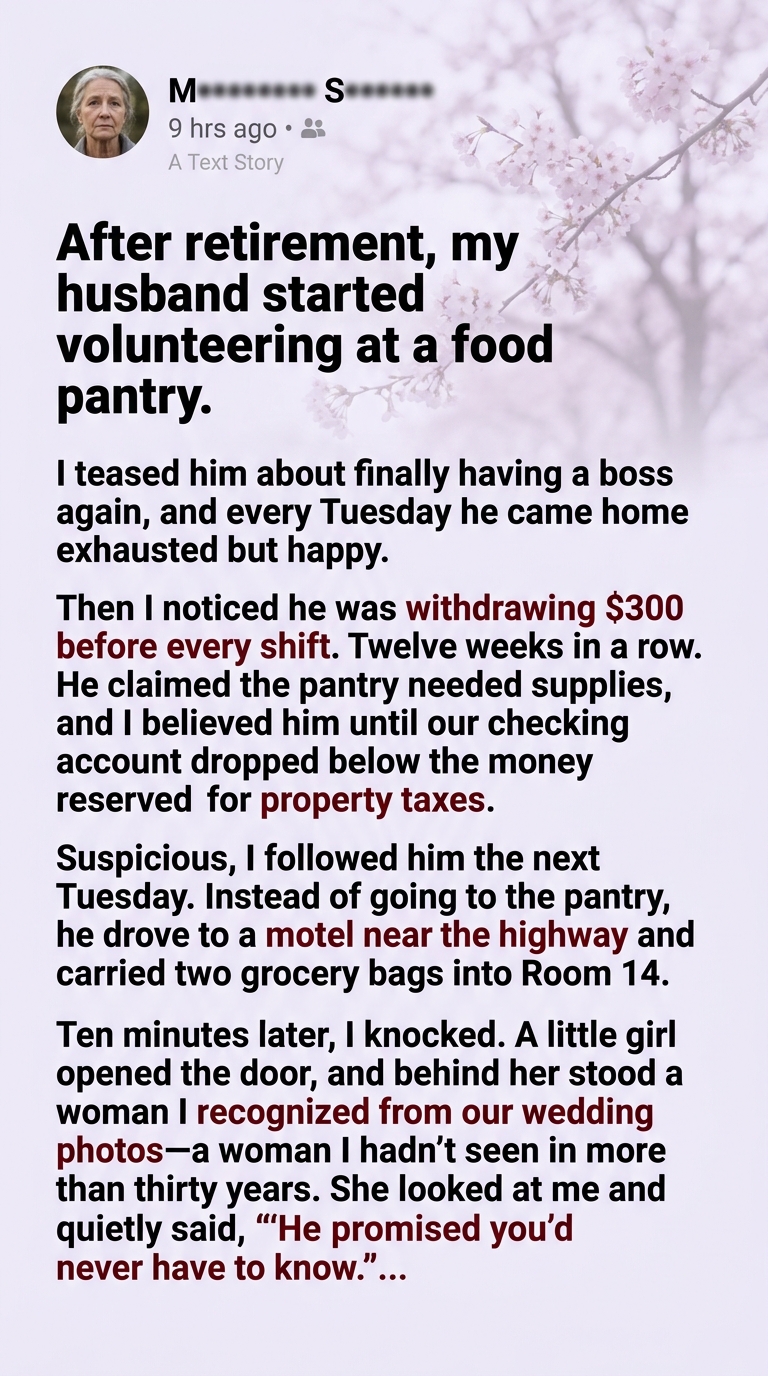
Every Tuesday morning, before leaving, Richard withdrew $300 from our checking account.
At first, I assumed he was buying supplies for the pantry.
But after four weeks, I asked him about it.
“Why do you need $300 every Tuesday?”
He barely looked up from his coffee.
“Food pantry expenses. Sometimes we need things that aren’t donated.”
I accepted the explanation.
But the withdrawals continued.
Five weeks.
Eight weeks.
Twelve weeks.
By then, he had withdrawn $3,600.
I checked our account one evening and felt my stomach tighten.
Our property tax money was supposed to be sitting in a separate portion of our checking balance. We had agreed not to touch it until the bill arrived.
Now the account was getting dangerously low.
I confronted him.
“Richard, we need to talk about the money.”
He sighed.
“It’s for the pantry.”
“You’ve spent $3,600 in three months. What exactly are you buying?”
“Food, toiletries, things people need.”
“Then show me the receipts.”
He stared at me.
“Do you really need receipts for charity?”
That answer bothered me.
I wasn’t questioning his generosity.
I was questioning why he was spending our retirement money without discussing it.
He promised he would be more careful.
The following Tuesday, I decided to find out what was happening.
I told him I had an appointment, waited until he drove away, and followed him from a distance.
He didn’t turn toward the food pantry.
He drove past it.
Then he took the highway exit and entered a small motel near the edge of town.
I parked across the road.
I watched him get out, open the trunk, and remove two grocery bags.
He walked toward Room 14.
I waited.
Ten minutes passed.
Then fifteen.
My hands were trembling.
Finally, I crossed the parking lot and knocked.
A little girl opened the door.
She looked about seven years old.
Behind her stood a woman.
The moment I saw her, I felt as though I had stepped backward in time.
Her name was Elaine.
She had been at our wedding 38 years earlier.
She was one of Richard’s closest friends before we married. She had even helped me choose my wedding dress.
But I hadn’t seen her in more than 30 years.
She looked older, thinner, and exhausted.
She stared at me.
Then she quietly said:
“He promised you’d never have to know.”
I couldn’t speak.
Richard appeared behind her.
His face went completely white.
“Margaret?”
I looked at him.
“Who is she?”
The little girl stepped behind Elaine.
Richard put the grocery bags down.
“Let me explain.”
I laughed, although there was nothing funny about it.
“You’ve been taking $300 every Tuesday, telling me you’re volunteering at a food pantry, and bringing groceries to a motel. I think you’ve had enough time to explain.”
Elaine stepped aside.
“Come in,” she said quietly.
I didn’t want to.
But I needed answers.
The room was small.
There was one bed, a little table, a refrigerator, and several plastic storage containers stacked against the wall.
The girl was holding a stuffed rabbit.
Richard introduced her as Sophie.
Then Elaine told me the truth.
Sophie was his granddaughter.
Not through our children.
Through a daughter Richard had never told me about.
Her name was Rachel.
I stared at him.
“You have another daughter?”
He nodded.
Then Elaine began explaining.
Before Richard met me, he had been engaged to a woman named Rachel’s mother, Elaine.
They had been young, barely out of their twenties, and had planned to get married.
But Richard’s construction career had taken off, and he had accepted a job in another state.
They argued about where to live and whether to start a family.
Eventually, Richard left.
Elaine discovered she was pregnant shortly afterward.
She tried contacting him, but he had already moved and changed phone numbers.
She eventually sent a letter to his parents.
Richard’s father received it but never gave it to him.
Instead, he told Elaine that Richard had moved on and wanted no involvement.
Richard said he didn’t learn about the pregnancy until years later.
By then, Elaine had married someone else.
Her husband raised Rachel as his own.
Richard eventually heard rumors about a daughter but never knew whether they were true.
Then, 31 years after our wedding, he received a message from Elaine.
Her husband had died.
Rachel had also died unexpectedly the previous year.
She had left behind a little girl named Sophie.
Sophie had no father involved in her life, and Elaine was struggling to raise her.
Richard had agreed to help.
At first, he sent money.
Then he started visiting.
The Tuesday trips had become their routine.
I looked at Sophie.
She was watching us silently.
“Does she know who you are?” I asked.
Richard nodded.
“She knows I’m her grandfather.”
I turned toward him.
“And you thought I should never know?”
He looked down.
“I was afraid.”
“Of what?”
“Of losing you. Of what you’d think. Of everything changing.”
I stared at him.
“You have been secretly visiting your former fiancée and a little girl for three months, and you think the problem is what I might think?”
Elaine finally spoke.
“He didn’t come here because of me.”
I looked at her.
“He came because Sophie needed help. I didn’t ask him to lie to you.”
Richard shook his head.
“She wasn’t involved in the money. I wanted to make sure they had food and somewhere safe to stay.”
I looked around the room again.
“Why are you living in a motel?”
Elaine explained that she had been renting a small apartment, but the building had been sold and the new owner had ended her tenancy through the proper process.
She had been staying at the motel temporarily while trying to find another place.
She was working part-time, but her income wasn’t enough to cover a deposit, rent, and childcare.
Richard had been helping with groceries, motel costs, and transportation.
I understood why he wanted to help.
I did not understand why he had hidden it.
Then Richard told me something else.
Rachel had died after a sudden medical emergency.
Before she passed away, she had asked Elaine to make sure Sophie knew about her father’s family.
Elaine had found an old photograph of Richard and Rachel’s mother from before our wedding.
She had contacted him because she thought Sophie deserved to know her grandfather.
Richard had been overwhelmed.
He wanted to help, but he had no idea how to introduce this entire history into our marriage.
So he had chosen secrecy.
And every Tuesday, he withdrew $300.
I sat down.
I felt angry, betrayed, and strangely heartbroken for the little girl standing near the bed.
I looked at Richard.
“How much have you spent?”
He admitted that the $3,600 in cash withdrawals wasn’t the full amount.
He had also paid some expenses using his personal savings.
I asked whether he had used any retirement accounts or credit cards.
He said no.
But I told him we would review everything.
Then I looked at Sophie.
“Have you eaten today?”
She nodded.
Richard had brought sandwiches, fruit, milk, and cereal.
I felt my anger shift.
This child had lost her mother.
She was living in a motel.
And the two adults in the room were arguing about a secret she hadn’t created.
I asked Elaine whether Sophie had a safe place to stay that night.
Elaine said they had paid for the room through the weekend.
I told her I wasn’t making any promises about money until Richard and I had a conversation, but I didn’t want Sophie worrying about food or shelter.
I bought them dinner that evening.
Then I drove home separately.
Richard came home later.
We sat at the kitchen table until almost midnight.
I asked him to tell me everything from the beginning.
He did.
He explained that he had first met Elaine again about four months earlier.
He had recognized her immediately at a grocery store.
She had been with Sophie.
They spoke briefly, and Elaine eventually told him about Rachel.
He took a DNA test, which confirmed he was Sophie’s biological grandfather.
I was stunned.
“Why didn’t you tell me then?”
He rubbed his eyes.
“I thought I’d tell you after I understood what was happening.”
“And then?”
“Then I was afraid you’d think I had been unfaithful.”
I shook my head.
“Richard, you don’t get to make that decision for me.”
He nodded.
“I know.”
I asked whether he still had feelings for Elaine.
He looked directly at me.
“No. I haven’t loved her romantically in decades. But she is the mother of my daughter, and Sophie is my granddaughter.”
I believed that part.
But trust had been damaged.
I told him we needed complete honesty from that moment forward.
We would review our finances together.
No more unexplained withdrawals.
No more secret visits.
And no more pretending that a family problem didn’t exist because it was uncomfortable.
The following morning, I called our financial adviser.
We reviewed our accounts and confirmed that the $3,600 had come from our shared checking account.
Richard also showed me the payments he had made from his personal savings.
We agreed on a budget for helping Sophie and Elaine.
But we made one thing clear: the help would be temporary while Elaine worked with a housing counselor to find stable accommodation.
I also contacted a local family support organization to ask about housing assistance and childcare resources.
Within several weeks, Elaine found a small apartment.
Richard helped with the deposit, and I agreed to contribute a modest amount from our own savings after we reviewed our budget.
We also arranged for Sophie to have a proper bedroom and a stable school routine.
I didn’t suddenly become her grandmother in every emotional sense.
That relationship would take time.
But I started seeing her on weekends.
At first, she barely spoke to me.
Then one Saturday, she brought me a drawing.
It showed three people standing in front of a house.
One was a little girl.
One was an older man.
The third had gray hair and a red sweater.
“That’s you,” she said.
I smiled.
“I’m the one in the red sweater?”
She nodded.
“Grandma Margaret.”
I had to turn away for a moment.
Richard and I also began attending marriage counseling.
The counselor helped us understand that his fear of losing me had become an excuse for hiding the truth.
I told him I could accept complicated family history.
I could accept helping someone from his past.
I could even accept having a granddaughter I had never known about.
What I could not accept was being deliberately excluded from decisions that affected our shared finances and our marriage.
Richard apologized repeatedly.
It took time before I believed he understood the damage.
A year later, things were different.
Elaine had stable housing.
Sophie was doing well in school and had started playing soccer.
Richard still spent time with her, but I knew where he was going and why.
We also had a family photograph taken.
It included me, Richard, Elaine, and Sophie.
It wasn’t a picture of a perfect family.
It was a picture of people who had finally stopped pretending the past didn’t exist.
One afternoon, I asked Richard whether he regretted telling me.
He shook his head.
“I regret not telling you sooner.”
I looked at him.
“So do I.”
Then I told him something I had learned.
I wasn’t angry because he had a granddaughter.
I was angry because he had decided I couldn’t handle the truth.
The $300 withdrawals had nearly emptied the money we needed for property taxes.
But the real cost was the trust he had spent 38 years building with me.
We were still working to rebuild it.
And that was something no amount of money could fix overnight.
I had followed my husband expecting to catch him having an affair.
Instead, I discovered a granddaughter who needed a family.
But I also discovered that love and secrecy are not the same thing.
Richard had every right to help his granddaughter.
He did not have the right to make me a stranger in my own marriage.
And from that Tuesday forward, we agreed that whatever complicated history our family carried, we would face it together—not behind a motel door, one secret $300 withdrawal at a time.