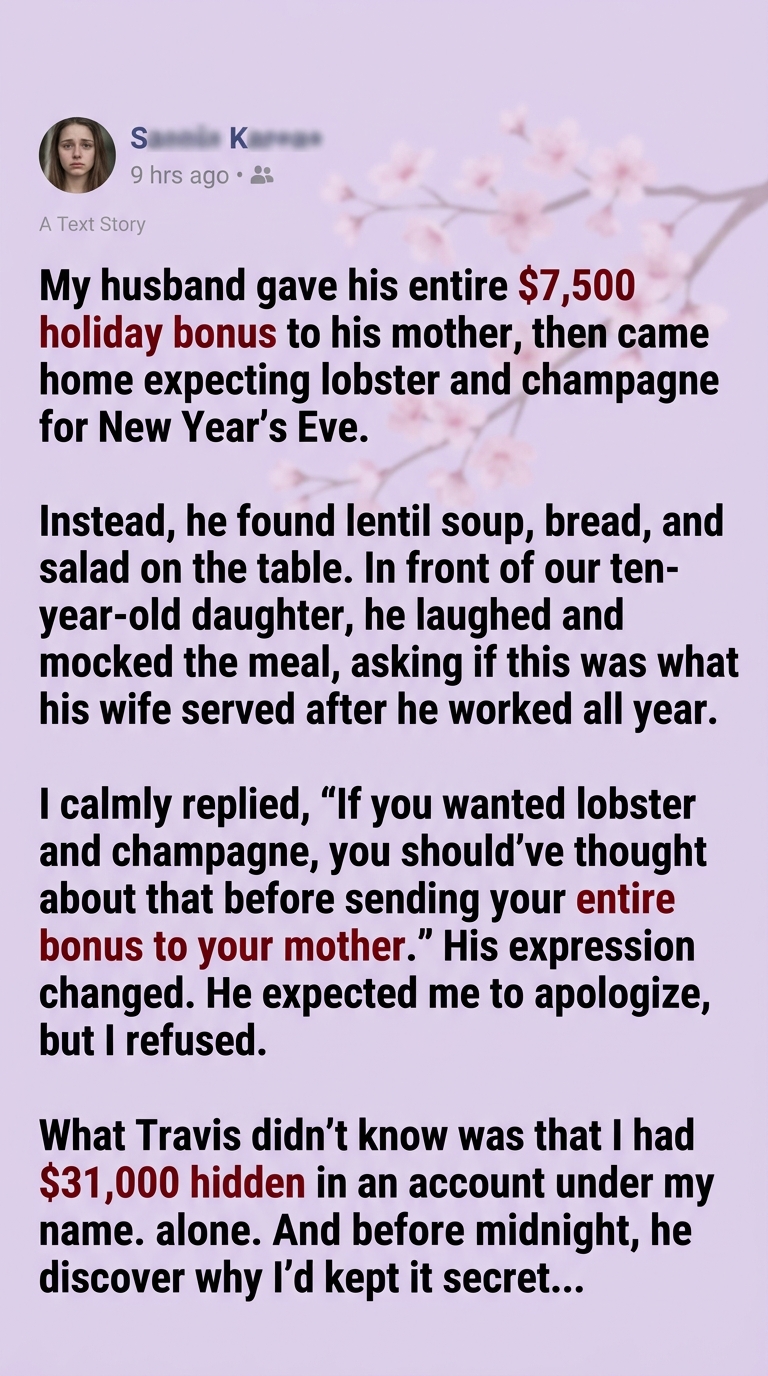
MY HUSBAND GAVE HIS MOTHER HIS ENTIRE $7,500 BONUS—THEN DEMANDED LOBSTER FOR NEW YEAR’S EVE. HE NEVER EXPECTED WHAT I REVEALED AT MIDNIGHT.
My husband, Travis, came home on New Year’s Eve expecting a celebration.
He had spent the afternoon at his mother’s house, where he had proudly handed her his entire $7,500 holiday bonus.
Not part of it.
Every penny.
He hadn’t discussed it with me.
He hadn’t asked whether we could afford it.
And he hadn’t considered that our mortgage payment, our daughter’s school expenses, and several overdue household bills were still waiting.
But he expected lobster and champagne when he walked through our front door.
Instead, he found lentil soup, fresh bread, and a simple salad.
Our ten-year-old daughter, Sophie, was helping me arrange the napkins.
Travis stared at the table.
Then he laughed.
“Seriously? This is New Year’s Eve?”
I looked up from the kitchen counter.
“Dinner’s ready.”
He picked up his spoon as though it offended him.
“I work all year, bring home a bonus, and this is what my wife serves me? Lentils?”
Sophie stopped smiling.
“Daddy, I helped make the bread.”
Travis barely glanced at her.
“Well, maybe next year Mommy can afford something better.”
I put down the serving dish.
“If you wanted lobster and champagne, you should’ve thought about that before sending your entire bonus to your mother.”
His expression changed immediately.
“Excuse me?”
“You heard me.”
“That was my money.”
“And these are our household expenses.”
He pushed his chair back.
“Mom needed it.”
“Then we should have discussed how much we could help.”
Travis folded his arms.
“I don’t need permission to help my own mother.”
“No,” I replied. “But you do need to stop expecting me to cover every bill while you make decisions that affect all three of us.”
He laughed bitterly.
“Here we go. Another lecture about money.”
I looked toward Sophie.
“Sweetheart, why don’t you take your bread into the living room and choose a movie for later?”
She hesitated.
“Are you and Daddy fighting?”
I knelt beside her.
“We’re having a disagreement about grown-up responsibilities. It isn’t your job to fix it.”
She nodded and walked away.
Then I turned back to Travis.
“We need to talk.”
He rolled his eyes.
“About what? Your soup?”
“No. About the $31,000.”
He froze.
“What $31,000?”
I pulled out a chair.
“The money I’ve been saving in an account under my name.”
For several seconds, he didn’t move.
Then his face darkened.
“You have thirty-one thousand dollars hidden from me?”
“Yes.”
“And you’re serving me lentils?”
I looked at him steadily.
“That’s exactly why I didn’t tell you.”
Three years earlier, I had begun putting money aside.
It started after Travis gave his mother $4,000 from our emergency fund without asking me.
At the time, our refrigerator had broken, and Sophie needed dental treatment.
When I questioned him, he accused me of being selfish.
“She’s my mother. She sacrificed everything for me.”
I had never objected to helping his mother, Elaine.
But Elaine wasn’t struggling to buy groceries or pay for medication.
She owned her home outright, received retirement income, and frequently took expensive trips with her friends.
The $4,000 had gone toward renovating her guest bathroom.
Travis told me afterward.
Not before.
That was the beginning.
Over the following years, he paid for Elaine’s new furniture, contributed toward a vacation, and covered several large expenses without discussing them with me.
Meanwhile, I handled the household budget.
I paid the utilities, managed groceries, bought Sophie’s school supplies, and quietly covered shortfalls when Travis spent more than we could afford.
I also worked full-time.
But whenever I asked him to plan our finances together, he said I was controlling.
So I started protecting myself.
I opened a savings account in my own name and began depositing money from my freelance bookkeeping work.
I kept records of every payment, expense, and tax obligation.
Some months, I saved $200.
Other months, I saved more.
After three years, the balance reached $31,000.
It wasn’t vacation money.
It wasn’t money I had taken from our joint accounts.
It was the emergency fund I had built because I no longer trusted Travis to protect our family’s financial stability.
I explained this to him.
He stared at me.
“So you’ve been lying to me for three years.”
“I’ve been saving money from my work because I was afraid we’d have nothing left when something went wrong.”
“That’s still lying.”
I nodded slowly.
“Keeping the account secret damaged our trust. I’m not pretending otherwise. But you need to understand why I felt I couldn’t safely discuss money with you.”
He shook his head.
“Unbelievable.”
Then he said something that made everything clear.
“Well, if you have thirty-one thousand dollars, there’s no reason you couldn’t have bought lobster.”
I stared at him.
“That money is for emergencies, Travis. Not expensive dinners.”
He stood up.
“Fine. Then transfer some of it to our joint account. We have bills to pay.”
I felt my chest tighten.
“We had money for those bills until you gave away your bonus.”
“Mom needed help!”
“With what?”
He looked away.
I asked again.
“What emergency required all $7,500?”
He hesitated.
Then he said, “She wanted to help my sister with a down payment on a new car.”
I couldn’t believe what I was hearing.
His sister, Brittany, was thirty-four years old, employed, and already driving a relatively new SUV.
“You gave your mother our entire holiday bonus so Brittany could buy another car?”
Travis became defensive.
“It’s not like that.”
“Then explain it.”
He rubbed his forehead.
“Mom said Brittany had been having a difficult year. She wanted to surprise her.”
I sat back.
For months, I had been telling Travis that our emergency savings were inadequate and that we needed to address several outstanding bills.
He had dismissed those concerns.
But when Elaine wanted to help Brittany buy a car, he immediately transferred $7,500.
I looked at him.
“You didn’t give your mother money for an emergency. You gave her money because she asked.”
He didn’t answer.
That evening, I didn’t transfer a cent.
Instead, after Sophie had gone to bed, I opened my laptop and showed Travis our household budget.
The mortgage.
Utilities.
Insurance.
Groceries.
Sophie’s school expenses.
The repairs we had postponed.
The credit card balance that had grown because we were covering expenses without a proper emergency fund.
I had organized everything into a spreadsheet.
Travis stared at the numbers.
“I didn’t realize we were this close to the edge.”
I looked at him.
“I’ve been telling you for two years.”
He rubbed his face.
“Why didn’t you show me this before?”
“I did. You said I was exaggerating.”
For the first time that evening, he had nothing to say.
At eleven thirty, his phone rang.
It was Elaine.
Travis answered on speakerphone.
“Happy New Year, sweetheart!” she said cheerfully. “Brittany is so excited. We’re going to the dealership next week.”
I looked at Travis.
He looked at the spreadsheet.
Then he said, “Mom, we need to talk about the bonus.”
Elaine’s tone changed.
“What about it?”
“We have bills that need to be paid. I shouldn’t have transferred the entire amount without discussing it with my wife.”
There was silence.
Then Elaine said, “Don’t tell me she’s complaining again.”
Travis glanced at me.
“She isn’t the problem, Mom. I made a decision without checking whether we could afford it.”
Elaine sighed loudly.
“After everything I’ve done for you, you’re asking for your money back?”
Travis swallowed.
“I’m asking whether you still have it.”
“Yes, but I promised Brittany.”
“Then please don’t spend it yet. We need to work this out.”
Elaine ended the call.
At eleven fifty-eight, Travis and I sat at opposite ends of the sofa.
The television showed crowds gathering for the countdown.
I could hear Sophie moving in her bedroom.
Travis looked at me.
“Are you planning to leave me?”
I didn’t answer immediately.
Then I said, “I’m planning to make sure Sophie and I are financially secure. Whether our marriage survives depends on whether we can rebuild trust.”
He stared at the floor.
“Does that mean you’re keeping the account?”
“Yes. And I’m going to get independent financial and legal advice so we both understand our rights and responsibilities.”
He nodded slowly.
“I guess I can’t blame you for wanting to protect yourself.”
I looked at him.
“I’m not trying to punish you. I’m trying to stop living one unexpected expense away from disaster.”
Midnight arrived.
Fireworks flashed across the television.
Sophie came running into the room in her pajamas.
“Happy New Year!”
We hugged her.
For a moment, the tension disappeared.
Then she looked at the dining table.
“Can we have more bread?”
I laughed through tears.
“Of course, sweetheart.”
The next morning, Travis called Elaine again.
He explained that he had made a mistake and asked her to return the bonus before it was spent.
She was furious.
She accused me of turning him against his family.
But after several difficult conversations, she agreed to return $5,000. She had already used part of the money to settle one of Brittany’s expenses.
Travis accepted responsibility for the remaining amount.
He also agreed that future large gifts to relatives would require a discussion between us first.
We arranged an appointment with a financial counselor and began reviewing our budget together.
I didn’t immediately close my separate savings account.
I didn’t hand over the $31,000.
And I didn’t pretend one apology erased years of financial conflict.
But Travis began taking steps he had resisted for a long time.
He stopped automatically agreeing to his mother’s requests.
He helped create a household emergency fund.
He began contributing consistently toward our shared expenses.
Most importantly, he stopped treating my concerns as complaints.
Our marriage still needed work.
We began couples counseling, where I acknowledged that keeping the savings secret had also created a breach of trust. Travis acknowledged that his repeated unilateral financial decisions had made me feel unsafe.
We didn’t solve everything overnight.
But we finally began talking about money as partners instead of opponents.
A few months later, Travis surprised me by making dinner.
Nothing fancy.
Just lentil soup, bread, and salad.
I looked at the table and smiled.
“What’s the occasion?”
He pulled out my chair.
“I wanted to make something that reminded me of the night I finally understood what you were trying to tell me.”
I sat down.
He reached across the table.
“I thought being a good son meant saying yes whenever Mom needed something. I forgot that being a good husband and father means showing up for the family I built too.”
I squeezed his hand.
For the first time in a long time, I felt that he was listening.
That New Year’s Eve, I hadn’t served lentil soup to humiliate my husband.
I had served the dinner we could responsibly afford.
The $31,000 wasn’t proof that I didn’t love him.
It was proof that I had been frightened of what would happen if I stopped holding everything together.
And as the new year began, I realized something important.
A marriage cannot survive on one person’s sacrifices while the other makes promises with money they don’t have.
Love requires generosity.
But it also requires responsibility.
And sometimes the most important New Year’s resolution isn’t spending more.
It’s finally learning to protect what matters most.