MY HUSBAND SECRETLY BOUGHT A DUPLEX—AND HIS MOTHER WAS HIDING WHO LIVED IN THE OTHER UNIT
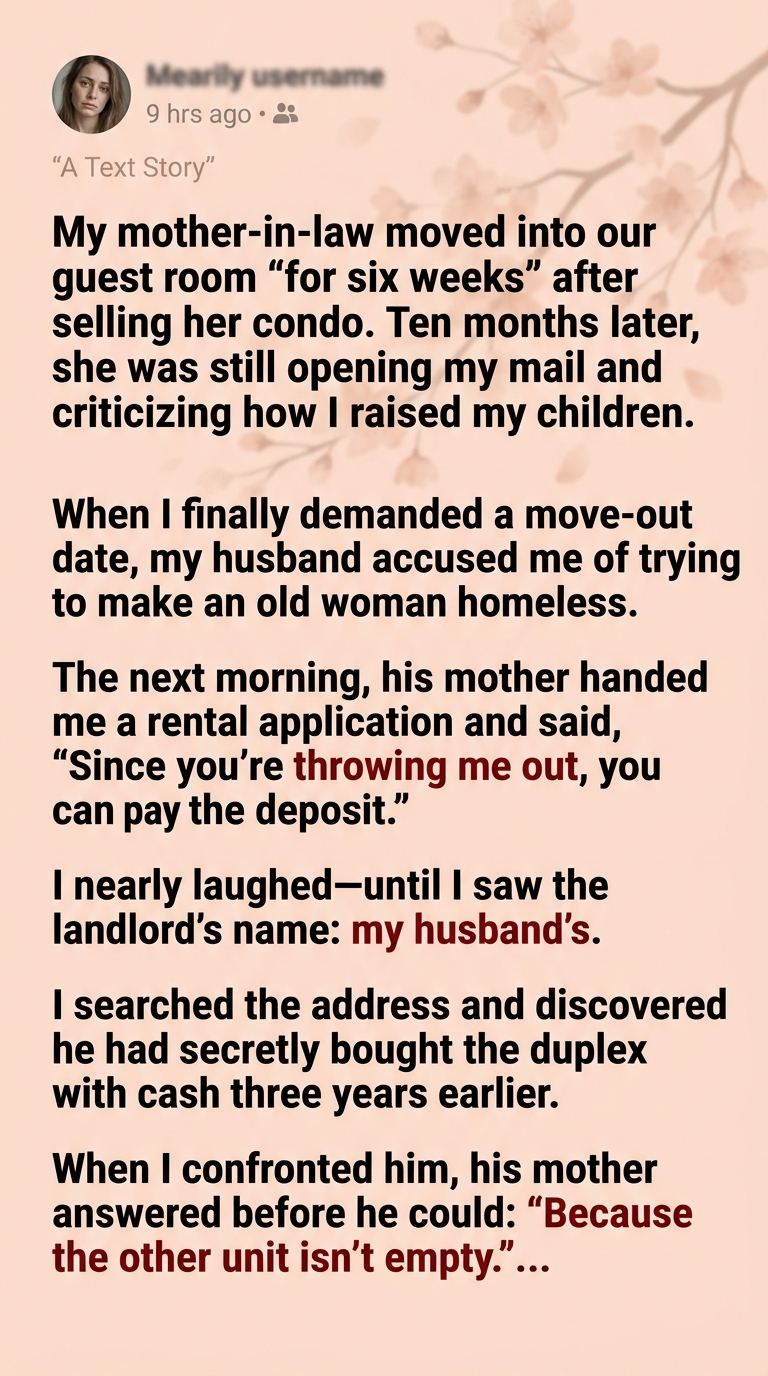
My mother-in-law, Margaret, moved into our guest room with two suitcases and a promise.
“Six weeks,” she said. “Just until I find somewhere smaller.”
She had sold her condo, and my husband, Daniel, insisted we should help her. I agreed because I believed six weeks was a reasonable amount of time to support family.
But six weeks became three months. Three months became ten.
By then, Margaret had made herself comfortable in every corner of our home. She opened our mail, questioned our grocery bills, rearranged my kitchen, and criticized nearly every decision I made as a mother.
If I let the children have dessert, I was spoiling them. If I sent them to bed early, I was too strict. If I corrected them, she would wait until I left the room and tell them Grandma understood them better.
Whenever I complained, Daniel gave me the same answer.
“She’s getting older. Please be patient.”
I tried. I really did.
But one evening, after Margaret opened a bank statement addressed to me and questioned a purchase in front of our children, I finally reached my limit.
“We need to agree on a move-out date,” I told Daniel. “I can’t keep living like this.”
He stared at me as if I’d said something unforgivable.
“She’s my mother. Are you seriously trying to make an old woman homeless?”
“I agreed to six weeks, Daniel. Not forever.”
He walked away without answering.
The next morning, Margaret entered the kitchen carrying a folder.
“Since you’re throwing me out,” she said, placing it beside my coffee, “you can pay the deposit.”
I opened the folder.
It was a rental application for a two-bedroom duplex.
The landlord’s name was Daniel’s.
I read it twice.
“Why is my husband’s name on this?”
Margaret’s expression changed.
“Ask him.”
I searched the address online. The property records showed that Daniel had purchased the duplex three years earlier, long before his mother sold her condo. The purchase had been made through a company registered in his name, and the public record showed no mortgage.
He had paid cash.
I waited until Daniel came home and placed the application on the dining table.
“You own this duplex?”
He stopped walking.
“Where did you get that?”
“Your mother handed me a rental application. Your name is on it. Why didn’t you tell me?”
He rubbed his forehead.
“It was an investment. I didn’t think it mattered.”
“You bought an entire property and never mentioned it to your wife?”
Before he could answer, Margaret spoke from the doorway.
“Because the other unit isn’t empty.”
The room went silent.
I turned toward her.
“What does that mean?”
She looked at Daniel, then back at me.
“It means your husband has been paying for someone to live in the other apartment. Someone he visits.”
My stomach tightened.
Daniel immediately stepped forward.
“Mom, stop.”
But Margaret had already opened the folder again. Inside was a printed lease, a series of utility statements, and a photograph of a woman standing outside the duplex with a little girl.
The woman was named Rebecca.
I recognized her.
She was Daniel’s former girlfriend.
The child in the photograph looked about six years old.
I looked at my husband.
“Who is she?”
Daniel sat down slowly.
“Rebecca contacted me three years ago. She was struggling financially. She had a daughter, and she needed somewhere safe to stay. I bought the duplex and rented her the other unit below market price.”
“Why didn’t you tell me?”
“Because I knew you’d be upset.”
“That’s not an answer.”
He finally admitted that Rebecca’s daughter might be his. They had briefly reconnected before Daniel and I got married, and he had never told me that Rebecca was pregnant. He said he had questioned the timing for years but had avoided finding out because he was afraid of what it would mean for our marriage.
Margaret had known about Rebecca and the child from the beginning.
She had encouraged Daniel to keep the arrangement secret. When she sold her condo, she had already planned to move into our guest room so she could be close to the duplex and help Rebecca with childcare.
The six-week stay had never been the real plan.
“You let me believe you needed temporary help,” I said to Margaret. “You knew all along.”
She crossed her arms.
“I was protecting my granddaughter.”
“And what about my children? What about the family you were asking me to support while you were hiding another one?”
For once, she had no answer.
Daniel tried to explain that he had paid for the duplex with money from an inheritance and that he had never intended to leave me or our children. But that only made the secrecy worse. He had made a major financial decision, hidden a possible child, and allowed his mother to move into our home under false pretenses.
I told him I needed space.
The following week, I spoke privately with a family lawyer and a financial adviser. I gathered our account statements, property records, tax documents, and the lease. I wanted to understand what belonged to our household, what had been purchased with separate funds, and whether any shared money had been used without my knowledge.
I also made one thing clear: the little girl was not responsible for the adults’ decisions.
A few weeks later, Daniel arranged a paternity test through the proper legal process. The result confirmed that the child was his daughter.
Her name was Lily.
I felt a complicated mixture of anger and sadness. A little girl had spent years growing up without knowing the truth about her father, while I had been living in a marriage built around a secret.
Daniel said he wanted to be part of Lily’s life. I told him he could pursue that responsibility, but not by continuing to deceive me.
We began counseling, and our lawyers worked through the financial questions separately. I did not agree to move Rebecca or Lily into our home, and I did not agree to let Margaret manage our family arrangements.
Margaret eventually moved into the duplex’s available unit, but only after Daniel provided a proper written rental agreement and we established clear boundaries. She was no longer allowed to use our home as a place to monitor Rebecca’s life or criticize my parenting.
Daniel and I did not suddenly become a happy couple again. Trust takes longer to rebuild than it takes to destroy.
He began spending time with Lily through an arrangement that respected her needs and the legal process. I focused on protecting my children’s stability and deciding what kind of marriage, if any, we could still have.
One evening, Daniel asked me whether I could ever forgive him.
I looked at him and said, “I don’t know. But I do know that forgiveness cannot be another secret you expect me to keep.”
For the first time, he didn’t argue.
I had once thought the biggest problem was a mother-in-law who refused to leave our guest room.
Now I understood the real problem.
She had only been occupying the room.
My husband had been keeping an entire other life.