The Forty-Eighth Envelope
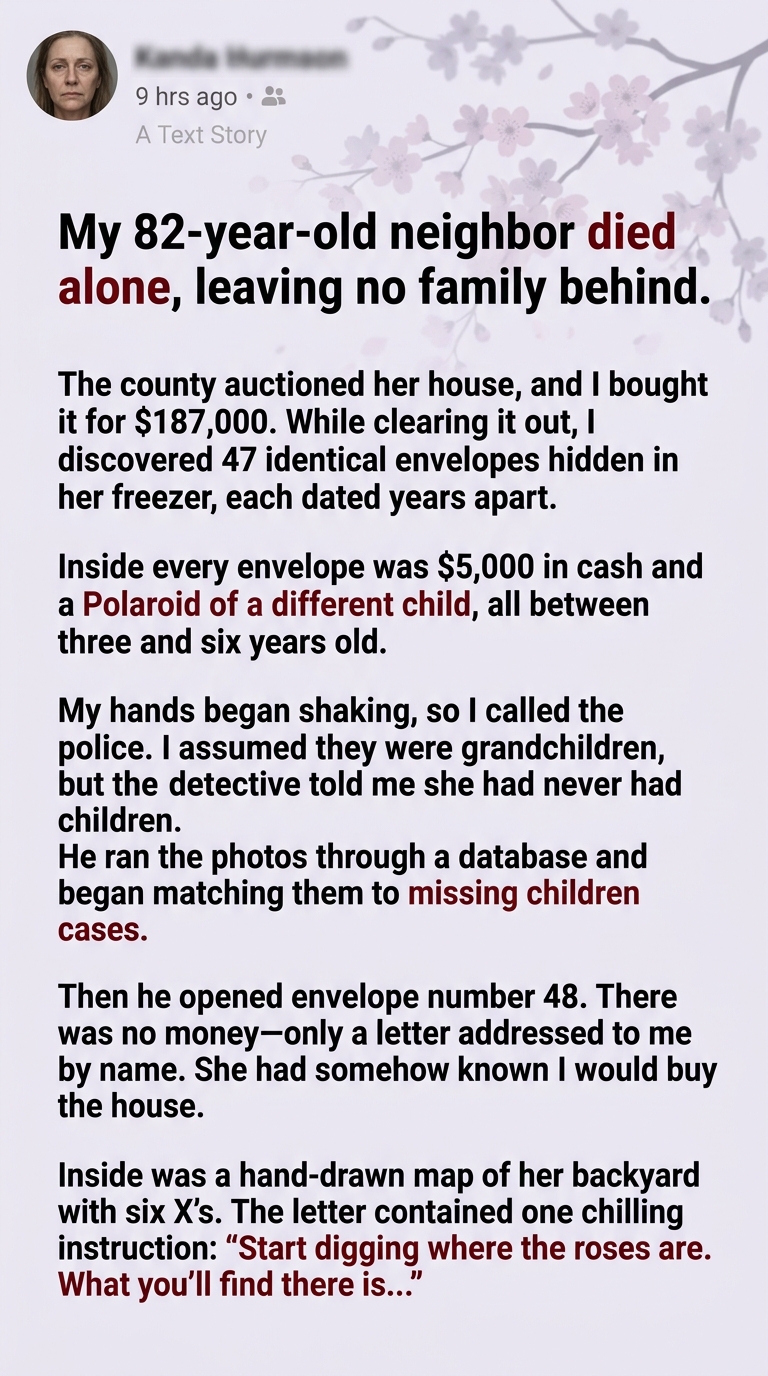
My 82-year-old neighbor died alone, leaving no family behind.
Her name was Eleanor Whitmore. She had lived in the little white house at the end of my street for nearly forty years. She rarely spoke to anyone, never hosted visitors, and spent most afternoons tending the roses in her backyard.
When she died, the county handled her estate. No relatives came forward, and eventually the house went to auction.
I bought it for $187,000.
I thought I was getting a quiet little property with an old-fashioned garden.
I had no idea I was buying the final chapter of someone else’s nightmare.
Three weeks after closing, I began clearing the house.
The kitchen was surprisingly clean. The bedroom furniture was covered with sheets, and the closets contained neatly folded clothes. Eleanor had apparently lived a very organized life.
Then I opened the freezer.
Behind several old containers and a thick layer of frost, I found a cardboard box wrapped in plastic.
Inside were envelopes.
Forty-seven of them.
They were identical, each sealed with yellowed tape and marked with a date. Some were from the 1980s. Others were from the 1990s and early 2000s.
I opened the first one.
Inside was $5,000 in cash.
Beneath the money was a Polaroid photograph of a little girl, perhaps four years old, standing beside a playground slide.
I opened another.
Another $5,000.
Another child.
A little boy with dark hair, sitting on a red tricycle.
The third showed a toddler wearing a yellow sweater.
I opened five more.
Every envelope contained exactly $5,000 and a photograph of a different child, all apparently between three and six years old.
My hands began shaking.
Why would an elderly woman keep photographs of forty-seven children with thousands of dollars hidden in her freezer?
I called the police.
Detective Samuel Reed arrived with another officer. He examined the envelopes without touching the photographs directly.
“Did you know Eleanor well?” he asked.
“Not really. She lived next door. We exchanged greetings occasionally.”
“Did she have children?”
“Not that I know of.”
He looked at me.
“She didn’t. We checked her records when she died.”
That made the discovery even stranger.
The detective photographed each envelope, documented the cash, and arranged for the evidence to be transferred to the appropriate investigators.
He also asked me not to share the photographs online.
“These may involve missing children,” he explained. “We need to protect their identities and avoid contaminating any investigation.”
Over the next several days, investigators began examining the photographs.
Some showed children in places that could be identified. Others had dates, handwritten notes, or tiny details that helped establish when and where they were taken.
A specialist compared the images with historical missing-child records.
Then the first match came back.
A boy named Michael Turner had disappeared from a shopping center in Ohio in 1987.
The photograph in Eleanor’s envelope showed him wearing the same blue jacket he had been wearing on the day he vanished.
The second match involved a little girl who had disappeared from a campground in Pennsylvania.
The third photograph was connected to a missing-child report from another state.
The detective returned to my house.
“These aren’t random pictures,” he said. “We have reason to believe Eleanor was connected to a series of child disappearances.”
I felt sick.
“Was she taking them?”
“We don’t know yet.”
“Then why did she have all this money?”
He didn’t answer.
Instead, he asked whether I had found anything else.
I told him about the cardboard box.
“Forty-seven envelopes,” I said. “There was one more, wasn’t there?”
He looked at me.
I hadn’t mentioned that.
I reached into my pocket and pulled out the final envelope.
It was hidden beneath the cardboard lining of the box.
Number 48.
Unlike the others, it contained no money and no photograph.
Only a letter.
My name was written across the front.
Not just my first name.
My full name.
I stared at it.
“How did she know I would buy the house?”
Detective Reed carefully took the envelope.
“We’ll need to examine this before you read it.”
I agreed.
The letter was photographed, documented, and opened under the supervision of the investigators.
Inside was a single sheet of paper.
The handwriting was shaky but clear.
It began:
To the person who owns this house after me,
If you are reading this, then I was right about one thing. Someone eventually bought the property, and someone eventually found the envelopes.
I don’t know who you are. I only know the county would sell the house after I died, and the person who bought it would eventually clear the freezer.
Please don’t stop reading.
Then came the sentence that made the detective sit forward.
Start digging where the roses are.
Below it was a hand-drawn map of the backyard.
Six X’s marked six different locations.
At the bottom, Eleanor had written:
What you’ll find there is the reason I kept every photograph.
The detective looked at me.
“Did you disturb the garden?”
“No. Not yet.”
He folded the map carefully.
“Then nobody goes into that backyard until we have a search team.”
The following morning, investigators arrived with equipment and a forensic team.
The first X was beneath a large rosebush near the back fence.
They dug carefully.
About two feet down, they found a small metal box.
Inside were old identification cards, folded newspaper clippings, and a collection of children’s drawings.
There was no body.
The second location contained another metal box.
This one held medical records, school photographs, and several letters addressed to Eleanor.
The third contained a collection of passports and documents bearing different names.
By the fourth location, Detective Reed had stopped speaking casually.
The evidence suggested Eleanor had not simply collected photographs.
She had been keeping records of children who had disappeared—and of the people who had later found them.
The fifth location contained a small waterproof container.
Inside were letters from a woman named Margaret Bell.
The earliest was dated 1986.
Eleanor, I know what you did was wrong, but you cannot keep telling yourself you were saving them. Their parents are still searching. You have to help us.
Another letter, dated six years later, read:
I found the family. The little boy is alive. His name is Michael now. Please tell me where the others are.
I looked at Detective Reed.
“Who was Margaret?”
He didn’t answer immediately.
He asked his team to examine the handwriting and identify the return address.
Then he opened the sixth location.
It contained a metal document case wrapped in several layers of plastic.
Inside were dozens of handwritten records.
Names.
Dates.
Locations.
Descriptions of children.
And, beside many entries, a second name.
Some of the children had been reported missing.
Others had been listed as unidentified minors in different states.
Several entries included the words:
Returned safely.
I couldn’t understand.
“Was Eleanor rescuing them?”
The detective studied the pages.
“That’s what we’re trying to determine.”
He turned to the last section.
There were forty-seven entries.
Each corresponded to one of the envelopes.
But the final page was different.
It contained six names, each with an address and a short note.
The first name was Michael Turner.
The boy whose photograph had matched the 1987 disappearance.
Beside his name, Eleanor had written:
Found alive. Family located. Money for treatment and relocation.
The second entry was also marked:
Found alive.
The third:
Found alive.
The fourth:
Not returned. Contact lost.
The fifth:
Still searching.
The sixth had a name I recognized.
It was Margaret Bell.
Detective Reed immediately requested a search for her.
Two days later, investigators located her in a small town in Michigan.
She was seventy-nine years old.
When the detective showed her the letter, she began crying.
Margaret explained that she and Eleanor had worked together at a private children’s shelter decades earlier.
Eleanor had been responsible for intake records and temporary placements. Margaret had been a social worker.
At first, they believed they were helping children whose parents were unable to care for them.
But gradually, Margaret noticed irregularities.
Some children had no proper documentation. Others arrived under names that didn’t match their records. Several were moved without the required legal approvals.
Margaret discovered that a private network was arranging illegal placements and falsifying records to make children appear abandoned or unclaimed.
Some children had been taken from their families.
Others had been moved through the system using fabricated identities.
Eleanor had been involved.
Not as a helpless bystander.
She had helped create records that concealed where some children had gone.
But years later, something changed.
According to Margaret, Eleanor discovered that one of the children she had helped place was actually a missing child whose family was still searching.
She panicked.
She contacted Margaret and admitted what had happened.
Margaret wanted her to go to the police immediately.
Eleanor refused.
She was afraid of prison. She was afraid of the people involved. And she knew that admitting the truth could expose every child whose records had been altered.
For years, she kept copies of the photographs and records.
She also began helping families locate children whenever she could.
The $5,000 in each envelope wasn’t payment for the photographs.
It was money Eleanor had set aside for the children and their families.
Some envelopes included funds for medical treatment, travel, counseling, or legal assistance after a child was found.
But the photographs did not prove that every child had been recovered.
Some remained missing.
Others had been located but never reunited with their families.
The money was an attempt to make amends.
It did not erase what she had done.
Detective Reed returned to my house that evening.
“There’s something else you should know,” he said.
He showed me a copy of the final page in Eleanor’s notebook.
It contained a paragraph addressed to whoever found the forty-eighth envelope.
I cannot undo what I helped happen. I spent most of my life telling myself that keeping the records was enough. It wasn’t.
The six marks in the garden are not graves. They are places where I hid the original evidence after I learned the people who once controlled the records were searching for it.
The truth is buried there. Please give it to someone who can use it.
I looked at the map again.
The six X’s weren’t burial sites.
They were evidence caches.
And Eleanor had deliberately left instructions for someone to find them.
But why had she written my name?
Detective Reed had an answer.
Eleanor had left a separate instruction with her estate attorney.
Several years before her death, she had asked that the person who eventually purchased the house be given the forty-eighth envelope.
She hadn’t known who would buy it.
She had simply arranged for the attorney to insert the buyer’s name after the sale was completed.
My name had been added after I purchased the property.
She hadn’t predicted me.
She had planned for someone.
And she had wanted that person to deliver the evidence.
The investigation continued for months.
Authorities identified several people connected to the illegal placement network. Some had died. Others were located and questioned.
The recovered documents helped investigators reopen missing-child cases that had been inactive for decades.
The first confirmed reunion came six months later.
Michael Turner, now in his forties, met his biological sister for the first time.
His family had never stopped searching.
He had grown up under a different name, believing his parents had abandoned him.
When investigators explained what had happened, he asked to see the photograph from Eleanor’s envelope.
He stared at it for a long time.
Then he said, “I don’t remember that day. But I remember looking for my mother.”
I cried when Detective Reed told me.
Not every case ended happily.
Some children had died. Some families had passed away before the truth emerged. Some records were too incomplete to establish exactly what had happened.
But the evidence gave many families answers they had been denied for decades.
Margaret later sent me a letter.
She thanked me for not throwing away the envelopes or disturbing the garden.
She also wrote something I never forgot:
Eleanor spent her final years trying to repair the damage she helped create. She was not innocent. But she finally understood that the truth belonged to the children, not to her.
I still live in that house.
I kept the roses.
Every spring, they bloom along the back fence, covering the places where those six metal boxes were buried.
People sometimes ask why I didn’t tear out the old garden and start over.
I tell them the truth.
Because those roses remind me that secrets can remain hidden for decades, but they don’t disappear.
And sometimes, the person who leaves you a house also leaves you a responsibility.
I paid $187,000 for Eleanor’s property.
But what I found inside it was worth far more than money.
Forty-seven photographs.
Forty-seven stories.
And one final letter that finally gave the missing children a chance to be heard.