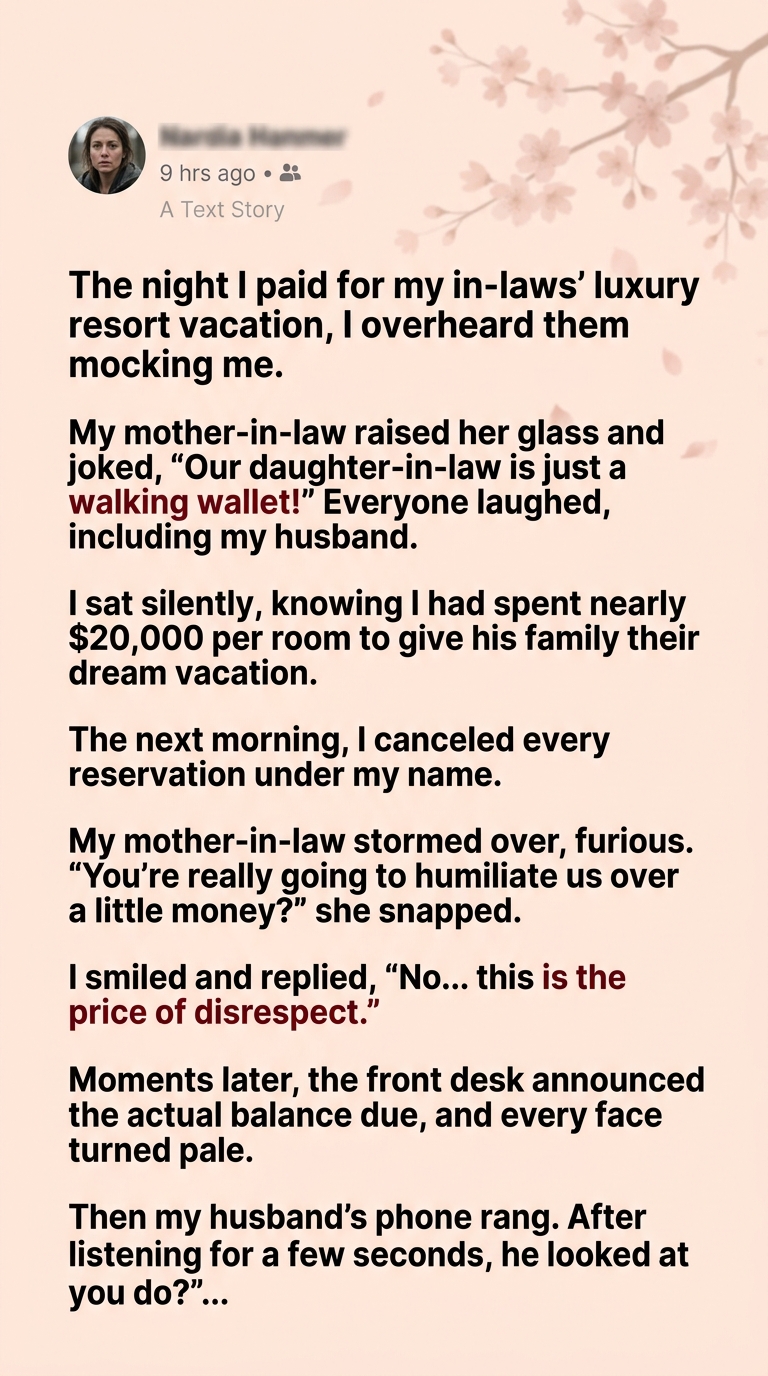
MY IN-LAWS CALLED ME A WALKING WALLET—SO I CANCELED THEIR $20,000-A-ROOM VACATION
The night I paid for my in-laws’ luxury resort vacation, I overheard them mocking me.
We were sitting in a private beachfront restaurant at a five-star resort. There were twelve family members around the table, expensive champagne in every glass, and a spectacular sunset behind us.
I had booked the entire vacation.
Three luxury villas, private transportation, ocean-view suites, spa packages, and a week of activities.
Each room had cost nearly $20,000.
I had paid the deposits and guaranteed the remaining reservations with my credit card because my husband, Michael, said his family had dreamed of this vacation for years.
I wanted to make them happy.
Apparently, that made me an easy target.
Halfway through dinner, my mother-in-law, Patricia, raised her champagne glass.
“Everyone should thank our wonderful daughter-in-law,” she announced.
I smiled.
Then she continued.
“She may not be the most exciting person at the table, but she’s certainly useful. Our daughter-in-law is just a walking wallet!”
Everyone laughed.
My sister-in-law nearly spilled her drink.
My father-in-law shook his head, smiling.
And my husband laughed louder than anyone.
I sat quietly.
I remembered the months I had spent arranging the vacation. I remembered the extra projects I had taken at work, the money I had saved, and the personal plans I had postponed.
I had spent almost $60,000 on a vacation intended to bring his family together.
And they were laughing at me.
Michael leaned toward me.
“Don’t be so sensitive. Mom is joking.”
I looked at him.
“Do you think it’s funny?”
He shrugged.
“Come on. Everyone knows you can afford it.”
That was when something inside me changed.
I didn’t argue.
I didn’t make a scene.
I simply finished dinner and went to my room.
At 6:30 the following morning, I called the resort’s reservations department.
I asked them to review every booking guaranteed under my name and explain which reservations could still be canceled, what deposits were refundable, and what charges had already become nonrefundable.
Some arrangements had cancellation deadlines. Others had already incurred costs.
I instructed the resort to cancel the reservations that remained eligible for cancellation and to remove my payment guarantee from any future charges where the contract allowed it.
I did not authorize any new expenses.
I also asked for an itemized statement of what had already been paid and what remained outstanding.
By breakfast, the family had begun noticing that something was wrong.
Patricia approached me near the pool.
“Why is the resort saying our reservations have changed?”
I took a sip of coffee.
“I canceled the reservations I was paying for.”
Her face turned red.
“You can’t do that! We invited everyone!”
“You invited everyone?”
She hesitated.
“Well, Michael arranged it.”
I looked toward my husband.
“Did you arrange it?”
He looked uncomfortable.
“Sarah, can we talk privately?”
Patricia stepped closer.
“You’re really going to humiliate us over a little money?”
I smiled.
“No. This is the price of disrespect.”
She stared at me.
“You’re ruining the whole vacation!”
I placed my coffee cup down.
“I paid for a vacation so your family could enjoy it. I didn’t pay to become the family’s entertainment.”
At that moment, the front desk manager approached with a folder.
“Mr. and Mrs. Carter, may we speak with you about the outstanding account?”
Everyone turned.
The manager explained that the reservations had been made under several different names, but many of the charges had been guaranteed by my card.
The resort had received deposits, but the remaining balances were still due for the accommodations and services the family wanted to keep.
The guests would need to decide which rooms and packages they intended to pay for themselves.
Patricia looked at the manager.
“But our daughter-in-law is paying!”
The manager politely replied, “Mrs. Carter has withdrawn her payment guarantee for the eligible future charges. We can provide each guest with an updated statement.”
The total remaining balance was substantial.
The family had assumed the entire vacation was free.
Now they were being asked to decide whether they could afford to continue.
Several faces turned pale.
My sister-in-law immediately began asking about cheaper rooms.
My father-in-law quietly opened his banking app.
Patricia turned toward Michael.
“Tell her to fix this!”
Michael’s phone rang.
He looked at the screen and stepped away to answer.
I watched his expression change.
First confusion.
Then disbelief.
Then panic.
He returned a few seconds later.
“What did you do?” he whispered.
I looked at him.
“What are you talking about?”
He showed me the phone.
It was a call from his business partner.
Apparently, Michael had used the vacation as part of a financial arrangement with his family. He had told them that I was covering the entire expense, including additional services, and had promised his brother that the resort would provide a private business meeting space for a potential investment presentation.
But there was more.
Michael had also told his family that I had agreed to pay for an additional celebration dinner and several expensive excursions.
I had never approved those expenses.
His brother had already invited potential business contacts, assuming the arrangements were guaranteed.
Now the resort was asking for payment before confirming the additional services.
Michael had promised things using money that wasn’t his.
I stared at him.
“You told them I agreed to pay for all of that?”
He lowered his voice.
“I thought you would be okay with it.”
“You thought wrong.”
Patricia overheard us.
“Michael, what is she talking about?”
He didn’t answer.
I finally understood why the family had been so comfortable mocking me. They had been told that my money was available whenever they wanted it.
Michael had made me sound less like his wife and more like an unlimited source of funding.
I asked him to come with me to the lobby.
There, I told him exactly what I expected.
No more expenses under my name without my written permission.
No more promises made using my money.
And no more pretending that disrespect was harmless family humor.
Michael tried to apologize.
He said he had only wanted his family to enjoy themselves.
I reminded him that he had laughed when his mother called me a walking wallet.
“You didn’t just let them disrespect me,” I said. “You taught them that they could.”
For the rest of the morning, the family had to make decisions.
Some guests paid for their own rooms. Others chose less expensive accommodations nearby. The planned business dinner was postponed, and several excursions were canceled.
Patricia was furious.
She accused me of destroying a family holiday.
I told her I had simply stopped paying for one.
Later that afternoon, Michael approached me alone.
“Can we please go back to how things were?”
I shook my head.
“Things were only comfortable for you because I kept paying for everything.”
He admitted that he had enjoyed being seen as the son who could provide an extravagant vacation, even though I had funded it. He had allowed his family to believe he was responsible for the arrangements.
That admission hurt more than the original joke.
I returned home two days later.
Michael stayed behind to help his family settle the remaining bills.
Over the next few weeks, we reviewed our finances and separated the expenses that belonged to each of us. I also spoke with an attorney about our shared financial arrangements and made sure my payment accounts were no longer being used as guarantees without my consent.
Michael eventually apologized to me in front of his family.
Patricia never gave a sincere apology for the walking-wallet comment, but she stopped making requests for money.
Our marriage entered a difficult period. I told Michael that rebuilding trust would require more than a few kind words. He needed to stop treating my financial success as something his family was automatically entitled to.
I also made one permanent decision.
I would never again pay for something simply because I was afraid someone might think I wasn’t generous.
Generosity is a choice.
It is not an obligation.
And respect should never depend on how much money someone is willing to spend.
The vacation was supposed to be a gift to my husband’s family.
Instead, it became the first time they learned that my kindness had limits.