My Brother Accused Me of Wanting Mom’s Inheritance—Then I Revealed Where Her Money Went
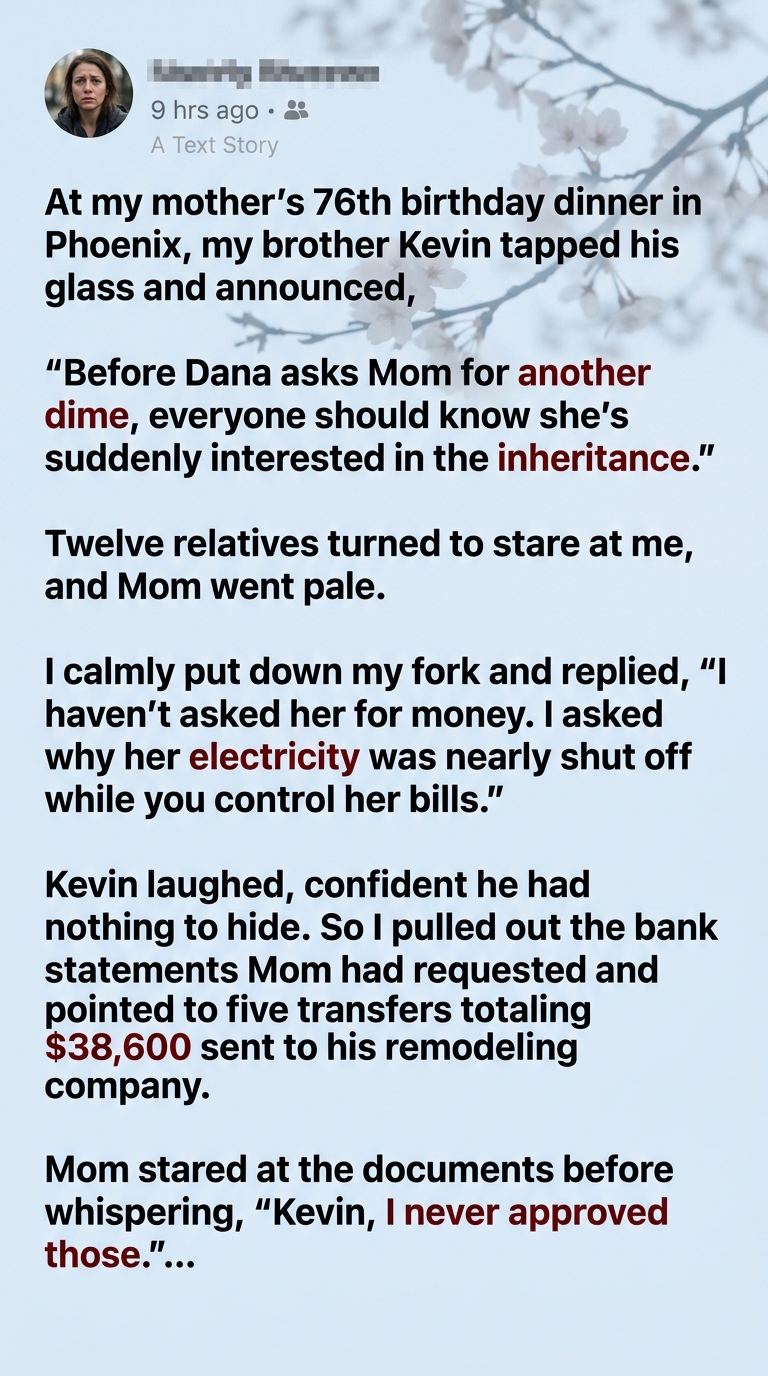
At my mother’s seventy-sixth birthday dinner in Phoenix, my brother Kevin tapped his glass with a spoon.
The restaurant fell quiet.
He stood at the end of the table, smiling like he was about to give a toast.
“Before Dana asks Mom for another dime, everyone should know she’s suddenly interested in the inheritance.”
Twelve relatives turned toward me.
My aunt stopped chewing. My cousin lowered her glass. My mother, Margaret, went pale.
I was holding my fork when Kevin looked directly at me.
“Some people only show up when they think there’s money involved.”
I slowly put down my fork.
“I haven’t asked Mom for money,” I said. “I asked why her electricity was nearly shut off while you control her bills.”
His smile disappeared for half a second.
Then he laughed.
“Here we go. Dana always has to make everything about herself.”
I reached into my handbag and took out a folder.
“Actually, Kevin, I think we should talk about these.”
Inside were bank statements my mother had specifically requested after discovering an unpaid electricity notice in her kitchen drawer. She had asked me to help her understand her accounts because she couldn’t remember making certain withdrawals.
I placed the first page on the table.
Five transfers.
Five separate payments.
All sent to Kevin’s remodeling company.
The total was $38,600.
My mother stared at the figures.
“Kevin,” she whispered, “I never approved those.”
For the first time that evening, my brother had nothing to say.
But to understand why that moment mattered, you need to know how we got there.
My mother had always been careful with money.
My father, Robert, worked for thirty-four years as an electrician. He and Mom saved for retirement, paid off their house, and built a modest investment account. They weren’t wealthy, but they had enough to live comfortably.
When Dad died four years earlier, Mom struggled with the paperwork.
She could manage groceries, appointments, and everyday expenses, but insurance forms and bank statements overwhelmed her.
Kevin offered to help.
He lived twenty minutes away. He had a remodeling company and liked to tell everyone he was good with numbers.
I lived farther away and worked full-time, so I appreciated that he was willing to handle the routine financial tasks.
At first, everything seemed fine.
He arranged automatic payments, helped Mom renew her insurance, and took her to the bank when she needed assistance.
Then small problems started appearing.
A utility bill was late.
Her pharmacy called about an overdue balance.
She mentioned that her grocery budget seemed tighter than before.
Whenever I asked Kevin about it, he had an explanation.
“The bank changed something.”
“Mom keeps forgetting what she’s spent.”
“She’s buying too much online.”
I didn’t want to accuse my brother without evidence.
But one Thursday afternoon, Mom called me.
“Dana, sweetheart, I got a notice from the electric company. They say I have until Monday to pay before they disconnect the service.”
I was confused.
Her retirement income was deposited regularly, and her electricity bill was usually less than two hundred dollars.
“Did you tell Kevin?”
“He said he’d take care of it.”
“Did he?”
She paused.
“I don’t know. He gets annoyed when I ask.”
That sentence stayed with me.
The following morning, I drove to Phoenix.
Mom’s kitchen was cluttered with unopened envelopes. There were insurance notices, bank letters, and bills she had stacked beside the microwave.
I sat with her and went through everything.
The electricity bill wasn’t the only problem.
Her homeowner’s insurance had a late-payment warning. A medical bill had gone unpaid for three months. Her checking account balance was much lower than she expected.
I asked whether Kevin had been using her account to pay for anything besides her household expenses.
“He said he was organizing everything,” she replied. “I thought he was taking care of it.”
I didn’t want to scare her.
I suggested we contact the bank together and request statements for the previous twelve months.
Mom agreed.
At the bank, we learned that Kevin had been helping with online bill payments and transfers under an arrangement Mom had authorized. However, the bank could not tell us whether every individual transaction had been properly approved.
We requested copies of the records and asked about the safest way to restrict access while we reviewed them.
A few days later, the statements arrived.
I spread them across Mom’s dining table.
There were five transfers to Kevin’s remodeling company.
The first was $4,800.
The second was $7,200.
The third was $9,500.
The fourth was $6,100.
The fifth was $11,000.
Total: $38,600.
The descriptions were vague.
“Home repairs.”
“Materials.”
“Property maintenance.”
But Mom’s house hadn’t undergone any major renovations.
I asked her whether Kevin had completed work worth that amount.
She shook her head.
“He replaced the kitchen faucet last year. He fixed the fence. That’s all I remember.”
I called Kevin.
He answered casually.
“What’s up?”
“I’m looking at five transfers from Mom’s account to your company.”
A pause.
“Okay?”
“What were they for?”
“Repairs. I told you I was handling things.”
“Can you send invoices?”
He sighed.
“Dana, I’m not going to spend my afternoon explaining every little thing to you.”
“It’s $38,600, Kevin.”
“Mom knows what she’s doing. She approved it.”
“Mom says she didn’t.”
He laughed.
“Mom forgets things. That’s why I help her.”
I looked at her sitting across the table.
She was listening.
“Then send the invoices,” I repeated.
He hung up.
Over the next two weeks, I tried to obtain a clear accounting.
Kevin sent one invoice for $2,300, describing kitchen and exterior repairs. It contained no detailed breakdown of materials or labor.
He claimed the remaining transfers were for other work, but he couldn’t provide dated work orders, receipts, or proof that the money had been spent on Mom’s property.
I contacted an attorney who worked with older adults and financial disputes.
She explained that the records raised legitimate questions, but we needed to avoid jumping to conclusions. The transfers might represent authorized loans, reimbursements, or payments for work. We needed evidence of what Mom had agreed to and what services had actually been provided.
She recommended that Mom revoke any unnecessary access, establish direct oversight of her accounts, and request a formal review of the disputed transactions.
Mom agreed.
We contacted the bank, changed her online banking credentials, reviewed authorized users, and arranged for her bills to be paid directly from her account. We also asked the bank’s fraud department to examine the transfers.
Kevin found out.
He called me furious.
“You’re trying to make me look like a thief!”
“I haven’t called you anything.”
“You went behind my back.”
“It’s Mom’s account, Kevin. She has every right to know where her money went.”
He accused me of manipulating her.
Then he said something that made my stomach turn.
“You’re going to regret turning the family against me.”
I told him the family didn’t need to be involved.
He disagreed.
That’s why, six weeks later, at Mom’s birthday dinner, he decided to make me the villain in front of everyone.
And that’s why I had brought the statements.
Back at the restaurant, Kevin finally reached for the folder.
“These numbers don’t prove anything,” he said.
“No,” I replied. “They prove money left Mom’s account and went to your company. That’s why we’re asking for invoices and authorization records.”
He looked at Mom.
“Tell them you gave me permission.”
Mom’s hands trembled.
“I gave you permission to pay my bills,” she said. “I didn’t give you permission to take thirty-eight thousand dollars.”
Kevin shook his head.
“You told me to handle the house.”
“I asked you to fix the fence.”
“You don’t remember everything.”
Mom looked down at the papers again.
Then she lifted her head.
“I remember not asking you for five payments.”
The table went silent.
My aunt Patricia reached for Mom’s hand.
Kevin tried to change the subject.
“I’m your son. I’ve spent years helping you. Nobody appreciates what I’ve done.”
Mom’s voice was quiet but firm.
“Helping me doesn’t mean you can keep me from knowing what happens to my money.”
He pushed his chair back.
“You’re all making a terrible mistake.”
He left the restaurant before dessert.
I stayed with Mom.
She was embarrassed and hurt, but she wasn’t crying. She kept looking at the folder as if she were seeing her financial life for the first time.
“I trusted him,” she said.
“I know.”
“He’s my son.”
“I know that, too.”
She squeezed my hand.
“Thank you for not letting me ignore this.”
The bank’s review took several weeks.
The investigators found that the five transfers had been initiated through the online access Kevin had been helping manage. The records did not establish that Mom had personally approved each payment.
A closer examination also revealed that the invoices Kevin eventually provided did not match the dates or amounts of several transfers. Some described work that had never been completed. Others contained duplicate charges for materials.
Kevin initially insisted everything was legitimate.
Then the bank requested supporting documentation, and Mom’s attorney sent a formal demand for an accounting.
Kevin returned part of the money, claiming it was an advance for work he had intended to complete.
But he couldn’t explain the remaining balance.
Mom’s attorney helped her submit a report to the appropriate authorities. The matter was investigated as a potential case of financial exploitation and misappropriation. Kevin was given an opportunity to respond, and the evidence was reviewed through the proper process.
The family was divided.
Some relatives said Kevin had made mistakes but didn’t deserve to be treated like a criminal.
Others insisted Mom should forgive him because he was her son.
I refused to argue.
This wasn’t about punishing Kevin for being imperfect.
It was about making sure our mother could pay her electricity bill without wondering whether her own money was safe.
Eventually, Kevin signed a repayment agreement after negotiations through the attorneys. He agreed to return the disputed funds over time, with the amount subject to final reconciliation of the documented work and payments.
The legal investigation continued separately.
Mom also made changes to her financial arrangements. She chose a professional fiduciary to help with complex paperwork, kept direct control over her bank accounts, and arranged for two trusted people to receive copies of important financial notices.
She didn’t give me control of her inheritance.
She didn’t give anyone control of it.
That was her decision.
Months later, I visited her on a Sunday afternoon.
Her electricity was working. Her insurance was current. Her bills were organized in a blue folder on the kitchen counter.
She was sitting at the table, looking through photographs of Dad.
“Do you think your father would be disappointed in Kevin?” she asked.
I thought carefully.
“I think Dad would want Kevin to make things right. But I don’t think he’d want you to pretend nothing happened.”
Mom nodded.
Then she surprised me.
“I’ve changed my will.”
I didn’t ask what she had changed.
I didn’t want to know.
She smiled gently.
“That’s exactly why I can trust you with this conversation. You haven’t asked me what you’re getting.”
I sat beside her.
“Mom, I don’t need to know.”
She reached across the table and held my hand.
“I spent too long thinking that keeping peace meant staying quiet. I won’t do that anymore.”
At her next birthday, Kevin wasn’t invited to make a toast.
He was invited to attend if he could respect her boundaries.
He came.
He sat at the far end of the table, barely speaking. Mom greeted him politely, but she didn’t hand him her bank statements or ask him to manage anything.
Their relationship remained strained.
Perhaps it would heal one day. Perhaps it wouldn’t.
But Mom no longer confused family loyalty with unquestioning trust.
And I learned something, too.
Kevin had stood in front of twelve relatives and accused me of wanting our mother’s inheritance.
He expected me to defend my character.
Instead, I defended her right to know what happened to her money.
Because the real inheritance wasn’t the house, the savings, or whatever might someday be divided between us.
It was the responsibility to protect the woman who had spent her entire life protecting us.
And I wasn’t going to let anyone turn that responsibility into a secret bank account.