MY SON WANTED HIS DAUGHTER BACK AFTER FOUR YEARS—BUT SHE WAS THE LITTLE GIRL WHO CALLED ME MAMA
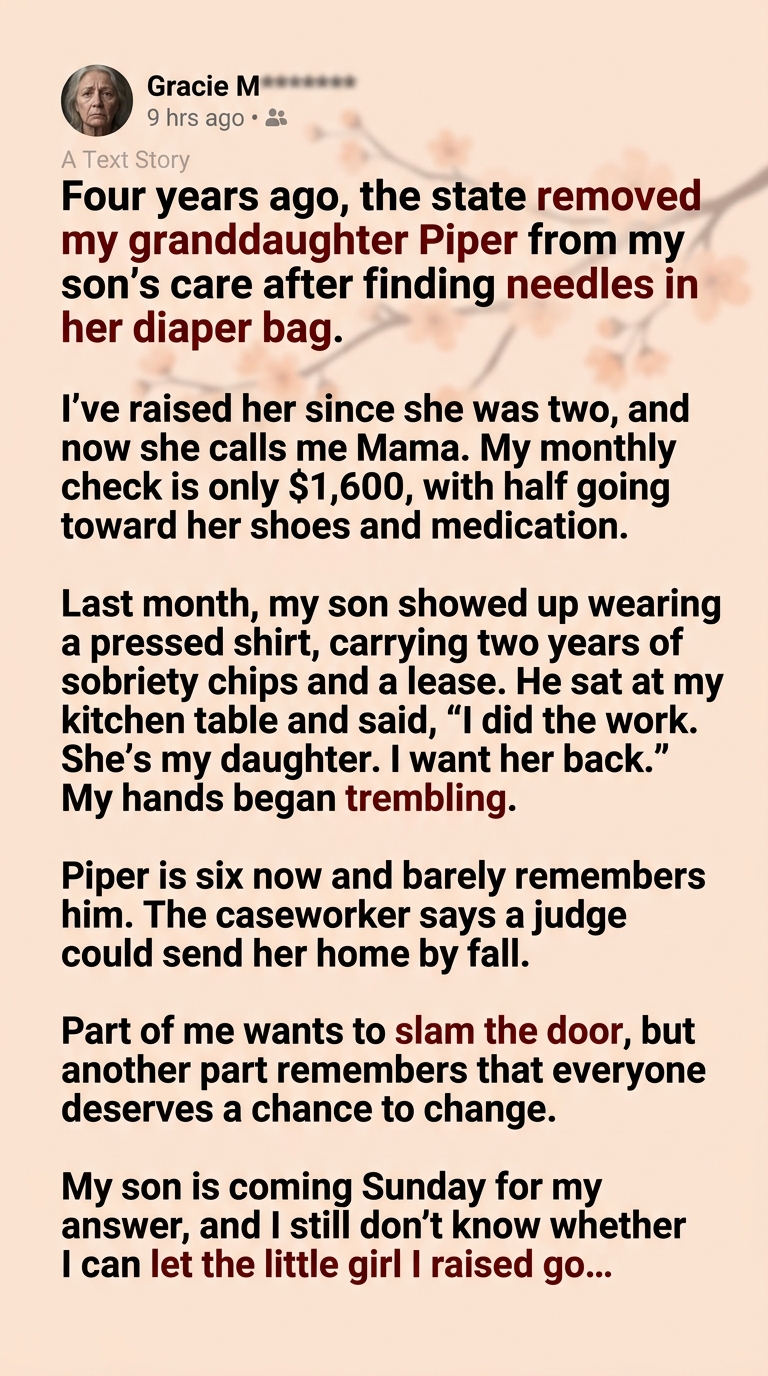
Four years ago, the state removed my granddaughter Piper from my son’s care.
She was only two years old.
The social worker found needles inside her diaper bag, and my son was arrested after authorities discovered drugs in his apartment.
I still remember the day I picked Piper up.
She was wearing a pink sweater, holding a stuffed rabbit, and crying because she didn’t understand why everyone was suddenly taking her somewhere else.
I promised her one thing.
“Grandma is here, sweetheart. You’re going to be safe.”
I raised my son, Michael, and I loved him. But I knew I couldn’t let his addiction put another child in danger.
So I took Piper home.
Four years passed.
Piper is six now.
She calls me Mama.
I pack her school lunches, braid her hair, attend parent-teacher meetings, and sit beside her whenever she wakes from a nightmare.
My monthly check is only $1,600. Nearly half goes toward her shoes, medication, school expenses, and other necessities.
I’ve sold furniture, skipped vacations, and learned how to stretch groceries.
But I never regretted taking her in.
Then last month, Michael appeared at my front door.
I barely recognized him.
His shirt was pressed, his hair was neatly trimmed, and he looked healthier than I had seen him in years.
He carried a folder and a small collection of sobriety chips.
“Mom, can we talk?”
I let him inside.
He sat at my kitchen table and placed the folder in front of me.
Inside were documents showing that he had completed a recovery program, attended counseling, maintained employment, and secured a lease for a small apartment.
He also had two years of sobriety chips.
Then he looked at me.
“I did the work. She’s my daughter. I want her back.”
My hands began trembling.
I looked at the little boy in the photographs on the refrigerator, except he wasn’t a boy anymore. He was a grown man asking for the child I had raised.
“Michael, Piper barely remembers living with you.”
“I know.”
“She calls me Mama.”
His eyes filled with tears.
“I know that too.”
He lowered his head.
“I don’t expect her to forget what you’ve done. I just want the chance to be her father.”
I didn’t answer.
The caseworker had already told me that a judge could consider reunification by fall if Michael continued meeting the requirements of his recovery and parenting plan.
But I was terrified.
What if he relapsed?
What if Piper remembered the promises and then had to experience another disappointment?
And what if I refused him a chance even after he had genuinely changed?
That Sunday, Michael came back for my answer.
I had spent the entire week thinking about what to say.
When he arrived, Piper was in the living room drawing pictures.
She looked up.
“Grandma, Daddy is here!”
Michael smiled.
“Hi, sweetheart.”
She ran toward him and showed him her drawing.
It was a picture of three people standing beside a house.
One was tall, one was small, and one had gray hair.
“That’s me, Mama, and Daddy,” she explained.
I looked at the drawing.
Michael looked at it too.
His eyes filled.
He sat on the floor and asked her about the colors. He didn’t demand a hug. He didn’t ask her to call him Dad. He simply listened.
After a while, Piper went back to her crayons.
Michael and I sat at the kitchen table again.
“I want to tell you something,” I said.
He nodded.
“I believe you’ve worked hard. I can see that. But two years of sobriety doesn’t erase four years of fear and instability.”
“I understand.”
“And Piper isn’t a prize you earn by completing a program. She’s a little girl who needs to feel safe.”
He looked down.
“I know, Mom.”
I took a deep breath.
“I won’t agree to an immediate move back. But I won’t stand in the way of a properly supervised reunification plan either.”
His shoulders dropped.
“What does that mean?”
“It means we let the caseworker, the therapist, and the court decide what is safe and appropriate. We start slowly. You visit regularly. You attend parenting sessions. You show up when you say you will. And if the professionals believe overnight visits are appropriate later, we consider them.”
He nodded.
I continued.
“Piper doesn’t lose her home because you want to become her father again. She needs to know that she will never be abandoned.”
Michael began crying.
“I don’t want her to go through that again.”
“Then prove it through your actions, not just your promises.”
For the first time, he didn’t argue.
Over the next several months, we followed the reunification plan.
Michael attended every scheduled visit.
At first, Piper was shy around him. She called him Michael because that was the name she remembered hearing adults use.
He never corrected her.
He brought books, played with her toys, and learned which foods she liked. He attended family counseling and continued his recovery meetings.
There were difficult moments.
One afternoon, Piper became upset when Michael had to leave.
“Is Daddy going away again?”
Michael knelt beside her.
“I have to go home tonight, sweetheart. But I’m coming back on Saturday.”
She looked at me.
“Will he really come back, Mama?”
I swallowed.
“We’ll see him on Saturday, honey.”
And Michael did come back.
Saturday after Saturday.
The caseworker documented his attendance, his continued participation in treatment, and his progress in parenting sessions.
His apartment was reviewed, and he completed the required safety preparations.
The therapist also helped Piper understand that she could love her father without having to stop loving me.
That was important.
One evening, she climbed into my lap and asked:
“If I live with Daddy someday, can I still call you Mama?”
I kissed her forehead.
“Of course, sweetheart. Nobody can take that away.”
She thought about it.
“Can I still sleep here sometimes?”
I smiled through my tears.
“We’ll work out what’s best for you, with the grown-ups who are helping us.”
By the time fall arrived, the judge reviewed the progress reports and heard from the caseworker and therapist.
The court approved a gradual transition, with continued oversight and scheduled contact with me.
Piper would begin spending longer periods at Michael’s apartment before any permanent change in placement.
It wasn’t an overnight goodbye.
It was a careful process designed around her needs.
On the first overnight visit, Piper packed her stuffed rabbit, pajamas, and favorite picture book.
She hugged me at the door.
“I’m going to Daddy’s house, Mama.”
“I know, sweetheart.”
“Will you be here when I come back?”
I bent down and held her tightly.
“Always.”
Michael stood nearby.
He looked at me.
“Thank you for not giving up on me.”
I shook my head.
“Don’t thank me yet. Keep showing up for her.”
He nodded.
And he did.
The transition continued gradually. Piper eventually became comfortable spending more time with her father, while maintaining a close relationship with me.
I still worried.
I still missed the sound of her little feet running down the hallway every morning.
But I began to understand that loving her didn’t mean I had to keep her from having a relationship with her father.
It meant making sure that relationship was safe.
One afternoon, Michael brought her back after a weekend visit.
Piper ran into my arms.
“Mama! Daddy made pancakes!”
I laughed.
“Were they good?”
She shook her head.
“They were a little burned.”
Michael laughed from the doorway.
“I’m still learning.”
I looked at him.
For the first time in four years, I saw a father trying to become someone his daughter could depend on.
I didn’t know exactly what the future would bring.
But I knew one thing.
I had not raised Piper to belong to me.
I had raised her to be loved, protected, and secure.
And if her father could genuinely provide those things too, then my job was not to hold her back.
It was to make sure she never had to choose between the people who loved her.
Sometimes being a mother means holding a child’s hand.
And sometimes it means loving her enough to let her take a careful step toward someone who is finally learning how to be a parent.