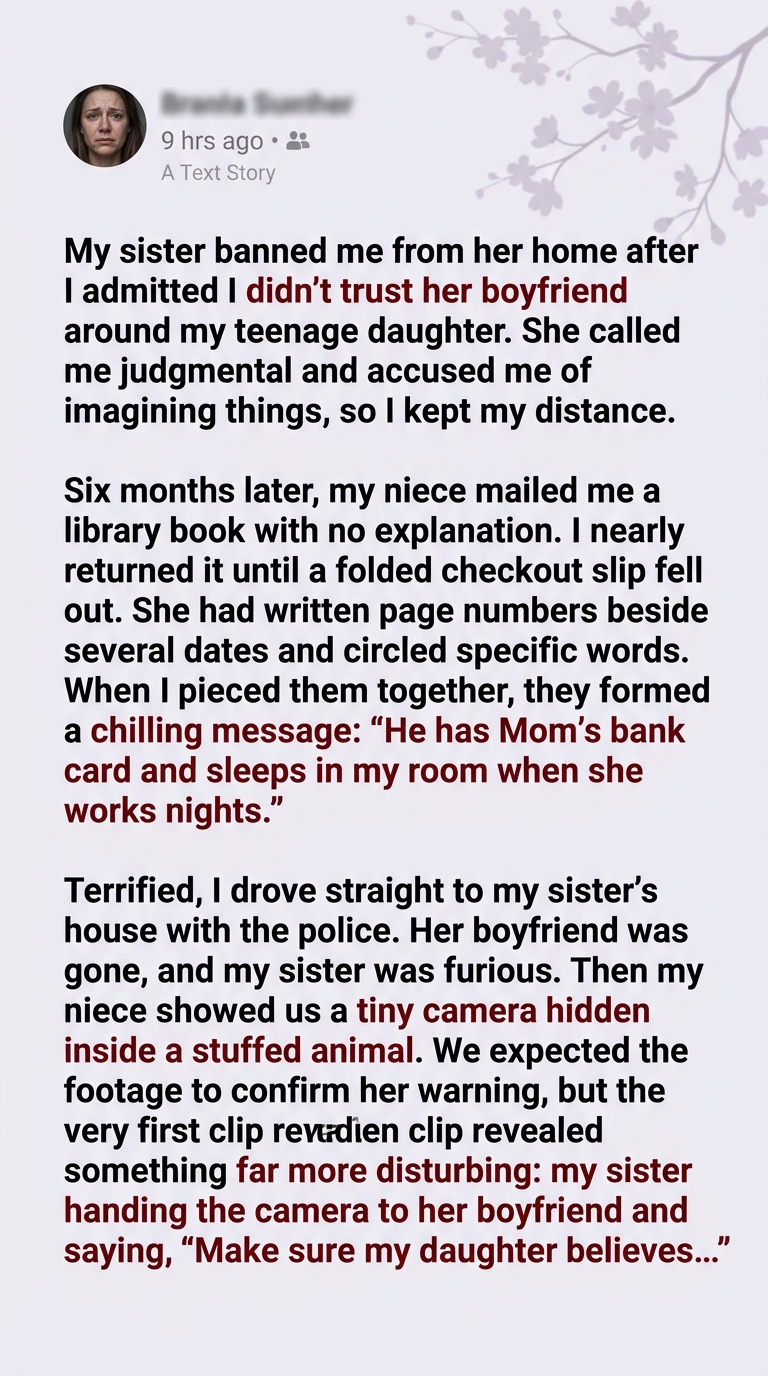
MY NIECE SENT ME A LIBRARY BOOK WITH A SECRET MESSAGE. I RUSHED TO HER HOUSE WITH THE POLICE—BUT THE FIRST VIDEO CLIP REVEALED MY SISTER’S OWN PLAN.
I never thought a library book could become the most frightening thing I’d ever received.
Six months earlier, my sister, Laura, had banned me from her house.
The argument started when I told her I wasn’t comfortable with her boyfriend, Brian, being around my teenage daughter.
I hadn’t accused him of a crime. I simply said some of his behavior made me uneasy, and I wanted clearer boundaries whenever our children were together.
Laura exploded.
“You’re judgmental. You’re always imagining the worst about people.”
She accused me of trying to ruin her relationship and said I was no longer welcome in her home.
I didn’t argue.
I loved my sister, but my daughter’s safety came first.
So I kept my distance.
I still sent birthday cards to my niece, Emma, and occasionally checked in through messages. But Laura usually answered for her.
Emma was fifteen, quiet, and thoughtful. She had always been close to me.
Six months passed.
Then, one Tuesday afternoon, a package arrived.
Inside was a library book.
There was no letter, no explanation, and no return address beyond the library label.
I almost put it aside to return it.
But when I opened the cover, a folded checkout slip fell onto the table.
It contained several dates and page numbers.
Beside each number, Emma had circled a particular word.
At first, I thought it was some kind of school assignment.
Then I followed the instructions.
The selected words formed a sentence:
“HE HAS MOM’S BANK CARD AND SLEEPS IN MY ROOM WHEN SHE WORKS NIGHTS.”
I read it again.
Then again.
My hands went cold.
I immediately called Emma’s phone.
No answer.
I tried Laura.
She answered after several rings.
“Why are you calling?”
“Is Emma okay?”
“She’s fine. Don’t start.”
“I received something from her.”
Laura went silent.
“What did she send you?”
“A library book.”
Her voice became sharp.
“Return it. She doesn’t need you filling her head with nonsense.”
Then she hung up.
I knew something was wrong.
I called the police and explained that I had received a message from a minor suggesting possible financial exploitation and an unsafe sleeping arrangement involving an adult.
I showed them the book and the coded checkout slip.
An officer advised me not to confront anyone alone or disturb anything that might be evidence.
When I explained that I was concerned Emma might be in immediate danger, they agreed to accompany me to the house to check on her welfare.
I drove behind their vehicle.
When we arrived, Brian’s car was gone.
Laura opened the door looking furious.
“What is this? Why are the police here?”
The officers explained that they needed to speak with Emma privately.
Laura protested, saying I had been spreading lies and interfering in her family.
Then Emma appeared at the top of the stairs.
She looked pale.
When she saw me, her eyes filled with tears.
“Can I show you something?” she asked.
One of the officers gently told her she could speak freely.
Emma went upstairs and returned carrying a stuffed rabbit.
It was old, with one floppy ear and a small stitched smile.
She held it tightly.
“There’s something inside.”
She carefully opened a small seam near the rabbit’s back.
Inside was a tiny camera.
I stared at it.
“Emma, where did this come from?”
She looked at her mother.
Laura’s expression changed.
“I don’t know what she’s talking about,” she said.
Emma explained that she had discovered the camera several days earlier. She had initially thought it was a toy accessory, but when she noticed the small lens, she became frightened.
She had found the library book and used the checkout slip to send me a message because she didn’t know who she could trust.
The officers took possession of the device and arranged for the footage to be reviewed properly.
I assumed the first recording would show Brian entering Emma’s bedroom.
I was wrong.
The first clip showed Laura sitting at the kitchen table with Brian.
The camera had apparently been placed in the rabbit before Emma discovered it.
Laura was holding the device.
She turned it over in her hand and said:
“Make sure my daughter believes this is just a normal toy. If she finds out what it really is, she’ll start asking questions.”
Brian laughed.
“She already thinks I’m weird.”
Laura leaned closer.
“Then make sure she doesn’t tell anyone what she sees. I can’t have her talking to her aunt again.”
I felt sick.
But the clip continued.
Laura placed the rabbit inside a shopping bag.
Then she handed Brian a bank card.
“Use this one,” she said. “The account has enough for the bills. Just don’t let her see the statements.”
Brian asked whether Emma knew about the card.
Laura shook her head.
“She doesn’t know anything about the money.”
The recording ended.
The officers exchanged a look.
This wasn’t simply a case of a teenager misunderstanding an uncomfortable household situation.
There were serious questions about the camera, the bank card, and why Laura had been so determined to keep Emma away from me.
The officers secured the device and began documenting the evidence.
They also arranged for Emma to speak with a trained child-protection professional in a private setting.
Laura started shouting.
“You’re twisting everything! That camera was for her safety!”
An officer asked why she had told Brian to make sure Emma believed it was a normal toy.
Laura couldn’t give a clear answer.
Then Emma finally spoke.
“Mom, why did you give him my room?”
Laura turned toward her.
“What are you talking about?”
Emma began crying.
She explained that when Laura worked night shifts, Brian sometimes slept in her bedroom. He told her it was because the spare room was being used for storage.
At first, Emma had believed him.
But she became uncomfortable when he began entering the room while she was changing clothes or trying to sleep.
She had asked her mother to make him stop.
Laura had dismissed her concerns and told her she was being dramatic.
Emma said Brian also had access to a bank card that had been kept in a drawer in the kitchen. She believed it belonged to her mother, but she had seen him use it to withdraw cash.
She had started worrying that money was disappearing from the account.
That was why she had included the bank card in her secret message.
The officers immediately treated the situation as a safeguarding concern.
They arranged for Emma to stay somewhere safe while the allegations were assessed.
I offered to take her, but the officers explained that any temporary placement needed to follow the appropriate child-protection process.
After speaking with the relevant professionals, Emma was allowed to stay with me temporarily under an agreed safety arrangement.
She packed a small bag.
Before leaving, she turned toward her mother.
“Why didn’t you believe me?”
Laura began crying.
“I was trying to keep my relationship together.”
Emma shook her head.
“You were supposed to keep me safe.”
Those words silenced the room.
Over the next several weeks, investigators reviewed the camera footage, financial records, and statements from everyone involved.
The bank confirmed suspicious transactions on the account. Some withdrawals had been made using the card Brian had been given access to, and the bank began its own review.
The camera footage also raised serious questions about who had placed the device, why it had been positioned where it could record private family spaces, and whether any additional recordings existed.
The authorities handled the device as evidence and arranged for the appropriate specialist review.
Brian was located and questioned. He denied wrongdoing, but the investigation continued.
Laura initially insisted that she had done nothing wrong.
Later, however, she admitted that she had given Brian access to the account because he claimed he needed money to cover household expenses.
She also acknowledged that she had allowed him to use Emma’s bedroom when she was working nights, despite Emma’s objections.
When I asked why she had ignored her daughter’s fear, Laura broke down.
She said Brian had convinced her that Emma was trying to destroy their relationship because she wanted her mother to remain single.
Laura had believed him.
She had chosen to defend her boyfriend rather than listen to her child.
That didn’t excuse what happened.
But it explained how the situation had continued for so long.
Emma began counseling and gradually returned to her normal routine.
For a while, she couldn’t sleep without checking the bedroom door.
She kept the stuffed rabbit on a shelf, but she didn’t want it near her bed.
I never pressured her to talk about anything she wasn’t ready to discuss.
One evening, several weeks later, she sat beside me on the sofa.
“Do you think Mom will ever believe me?”
I took her hand.
“I hope she learns to listen. But you don’t have to put yourself in danger waiting for that to happen.”
She leaned against my shoulder.
“I was scared you wouldn’t understand the book.”
I kissed her forehead.
“I understood enough to come.”
Laura eventually began attending counseling and cooperating with the family professionals. Rebuilding trust with Emma would take time, and no one promised that their relationship would return to what it had been.
As for me, I stopped wondering whether I had been too judgmental six months earlier.
I had been right to take my concerns seriously.
But the most important thing wasn’t proving that I had been right.
It was that Emma had found a way to ask for help, and someone had finally listened.
I still think about that library book.
A child had used page numbers, dates, and circled words because she was afraid to write a direct message.
She had hidden her fear inside a book because she thought the adults around her might not believe her.
And the first video clip revealed something I never expected.
The person who should have protected her had helped create the very situation she was trying to escape.
A child should never have to become a detective just to make the adults in her life believe that she feels unsafe.