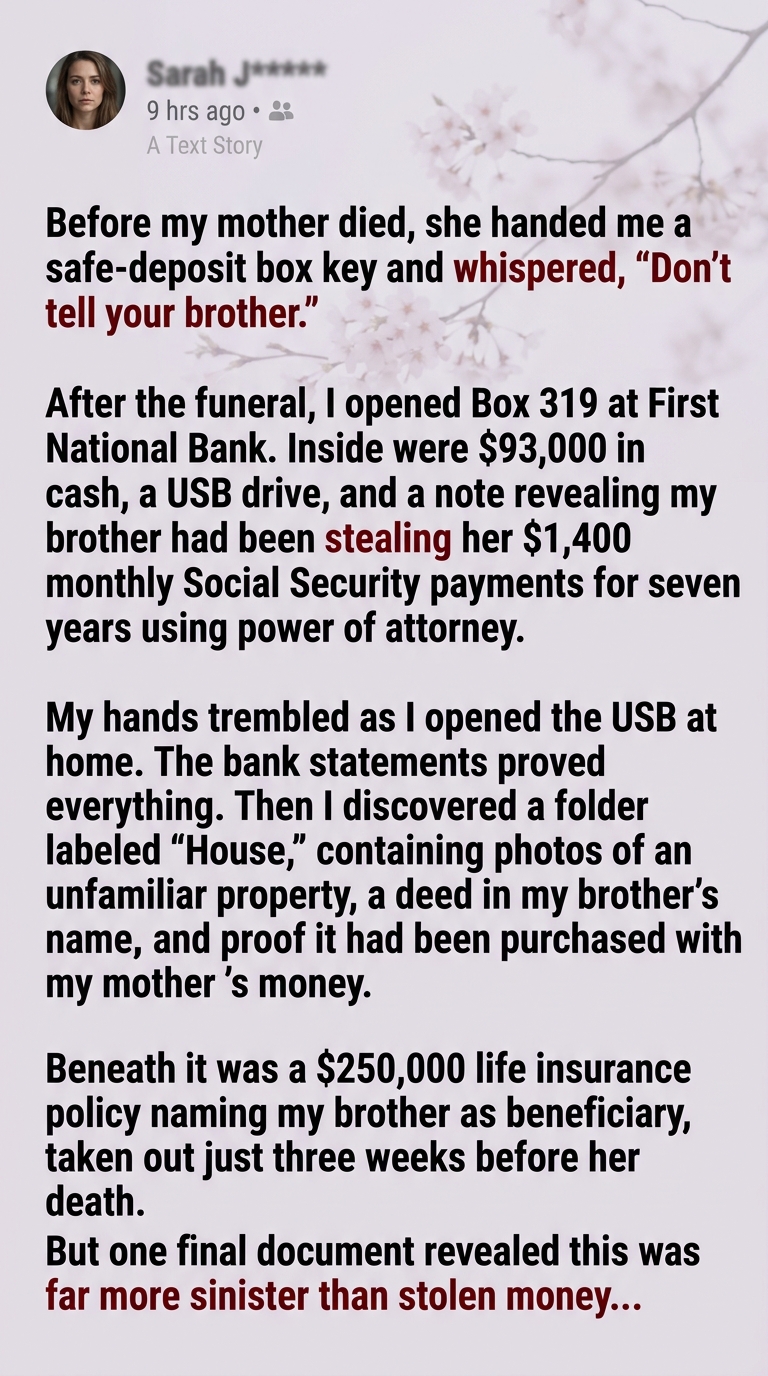
MY MOTHER GAVE ME A SAFE-DEPOSIT KEY BEFORE SHE DIED. INSIDE BOX 319, I FOUND $93,000, PROOF MY BROTHER HAD STOLEN HER BENEFITS, AND A DOCUMENT THAT MADE ME QUESTION HOW SHE DIED.
Three days before my mother died, she called me into her bedroom.
She looked unusually serious.
Her hands were trembling as she reached beneath her pillow and pulled out a small envelope.
Inside was a key.
“Safe-deposit box 319,” she whispered. “First National Bank.”
I looked at her.
“What is it, Mom?”
She closed my fingers around the key.
“Don’t tell your brother.”
I wanted to ask more, but she looked exhausted.
“Promise me,” she said.
I promised.
My mother died three days later.
At the funeral, my older brother, Michael, stood beside me and accepted condolences as if he had been the devoted son who had handled everything.
He had been living near Mom for several years. He held her power of attorney and managed many of her financial affairs.
He always told me she needed help with her money because she was getting older.
I believed him.
I had no reason to suspect what was happening behind closed doors.
A week after the funeral, I went to First National Bank.
I presented the key and the required identification. After the bank verified the box arrangement and my authority to access it, an employee escorted me into the private room.
Box 319 was smaller than I expected.
Inside were three things.
A bundle of cash.
A USB drive.
And a handwritten envelope with my name on it.
I counted the cash twice.
Ninety-three thousand dollars.
My hands began shaking.
Then I opened the envelope.
Mom had written:
“If you’re reading this, I wasn’t able to explain everything myself. Michael has been handling my money, but he has not been honest with you. Please look at the records before you believe anything he says.”
I sat down.
I couldn’t understand what I was reading.
I placed everything back in the box and took it home.
That evening, I connected the USB drive to an old laptop.
It contained folders organized by year.
Inside were bank statements, copies of Social Security deposits, account transfers, and handwritten notes.
I started with the oldest records.
My mother received approximately $1,400 each month in Social Security benefits.
But the statements showed that, for years, the money had been transferred out of her account shortly after it arrived.
Some transfers went to Michael’s personal account.
Others went to accounts I didn’t recognize.
I opened the spreadsheet Mom had prepared.
The total was devastating.
For seven years, Michael had controlled money that should have been used for her living expenses and care.
I called the bank the following morning.
After verifying my identity and explaining that I had discovered records suggesting financial exploitation, I asked what steps were available to preserve the documents and report the activity.
The representative advised me to speak with the appropriate fraud department and law enforcement.
I also contacted an attorney.
He warned me not to move the cash or alter any documents until we understood the legal situation.
Then I opened another folder.
It was labeled:
HOUSE.
Inside were photographs of an unfamiliar property.
It was a large two-story house with a white fence, a stone driveway, and a landscaped garden.
I had never seen it before.
The deed listed Michael as the owner.
I opened the closing statement.
The purchase had been funded through transfers from an account connected to my mother.
I stared at the figures.
She had been living modestly, worrying about grocery prices and delaying repairs to her own home.
Meanwhile, her money had helped purchase a property for my brother.
But there was something else.
At the bottom of the folder was an insurance document.
A $250,000 life insurance policy.
Michael was named as the beneficiary.
The policy had been taken out just three weeks before Mom died.
I felt sick.
I checked the application date.
Then I checked the signature.
It looked like my mother’s.
But I remembered how weak her hands had become during her final months.
The signature was unusually steady.
I called my attorney immediately.
He told me that the existence of a life insurance policy did not, by itself, prove wrongdoing. We needed to establish who applied for it, whether Mom had consented, who paid the premiums, and whether the policy was valid.
He asked me to continue reviewing the USB for any related correspondence.
That was when I discovered the final folder.
It was labeled:
READ LAST.
Inside was a document titled:
AUTHORIZATION AND MEDICAL INFORMATION.
I opened it.
My mother’s name appeared at the top.
It was a document purporting to authorize Michael to communicate with her medical providers and make certain decisions if she became unable to do so.
But the final page contained a handwritten note from Mom.
“Michael told me this was only to help with my insurance and bank accounts. I did not understand that he could make medical decisions for me.”
I stopped breathing for a moment.
Then I noticed a second page.
It was a copy of a hospital discharge summary from the week before her death.
The document showed that Mom had been evaluated after a sudden episode of severe weakness.
The doctor had recommended further investigation and close monitoring.
But the notes indicated that she had left the hospital earlier than recommended.
There was also a handwritten entry:
“Patient’s son reports that she wishes to return home. Follow-up arrangements discussed.”
My stomach tightened.
I remembered Michael telling me that Mom had refused further treatment because she wanted to spend her remaining days at home.
But I had never heard that she had been advised to stay for additional evaluation.
I turned to the final page.
It was a letter Mom had written.
“Michael told me I couldn’t afford to keep going to the hospital. He said my money was gone and I should stop worrying about bills. I believed him because he had my accounts.”
I began crying.
Then I read the last paragraph.
“I am afraid he is making decisions for me because he wants the money to remain his. I don’t know what he has done with the house money. I don’t know why he took out the insurance. I am afraid to confront him because he gets angry when I ask questions. If something happens to me, please don’t assume everything was done properly.”
I put the letter down.
The final document wasn’t proof that Michael had caused my mother’s death.
But it raised a much more serious possibility: that he had used financial control to influence her medical decisions and prevent her from receiving care she might have wanted.
I called my attorney.
This time, he told me we needed to act immediately.
He arranged for copies of the documents to be preserved and advised me to report the suspected financial exploitation and possible misuse of the medical authorization.
I contacted the authorities and provided the records.
They opened an investigation.
Michael called me that evening.
“Where have you been?” he asked. “I’ve been trying to reach you.”
“I’ve been reviewing Mom’s records.”
He went quiet.
“What records?”
“The bank statements. The house documents. The insurance policy.”
His voice became sharp.
“You had no right to go through her private things.”
“She gave me the key.”
“She was confused near the end. You know that.”
I held the phone tightly.
“Then explain why her Social Security money went into your accounts for seven years.”
He started shouting.
“That money was for taking care of her! I was the one who lived nearby. I paid for things. You have no idea what it cost.”
“Then show me the receipts.”
He didn’t answer.
I asked about the house.
He claimed it was a legitimate investment and that Mom had wanted him to have it.
I asked about the insurance policy.
He said it was none of my business.
Then I asked the question I had been afraid to ask.
“Why did Mom write that she was afraid you were making medical decisions because of money?”
There was a long silence.
Finally, he said:
“She was confused. You shouldn’t believe everything she wrote.”
I ended the call.
The investigation took months.
Financial investigators traced the transfers from Mom’s account and examined the purchase of the house.
The records showed that a substantial portion of the purchase funds had come from accounts holding my mother’s money.
Investigators also questioned Michael about the Social Security deposits and the authority he had been given under the power-of-attorney arrangement.
The insurance application was reviewed separately. Investigators examined the signature, the application process, and the circumstances under which the policy had been issued.
The medical records were also reviewed.
They did not establish that Michael had caused Mom’s death. But they raised concerns about whether her wishes and medical interests had been properly respected when he was involved in arranging her care.
Eventually, the financial investigation found that Michael had used money from Mom’s accounts for personal expenses without proper authorization.
He was required to account for the funds, and the matter proceeded through the appropriate legal channels.
The house was subject to a separate legal review because the purchase funds were disputed. The insurance company also investigated the policy’s application and validity.
Michael tried to contact me several times.
At first, he blamed me for destroying the family.
Then he accused me of being jealous.
Finally, he sent a message saying:
“Mom would never have wanted us fighting over money.”
I stared at the message.
He was right about one thing.
Mom would never have wanted us fighting over money.
But she also wouldn’t have wanted her savings taken, her medical concerns ignored, or her final wishes dismissed.
I didn’t want revenge.
I wanted the truth.
Several months later, I returned to the bank and collected the remaining contents of Box 319 after the legal authorities confirmed what could be released.
I still had the original envelope Mom had written.
I read it again.
“Don’t tell your brother.”
Now I understood why she had whispered those words.
She wasn’t trying to divide her children.
She was trying to protect the truth long enough for someone to find it.
I went to her grave that weekend.
I brought her favorite flowers and sat quietly.
“I found everything, Mom,” I whispered. “I’m sorry I didn’t know what was happening.”
I thought about the $93,000.
It was money she had managed to save despite everything.
But it wasn’t the most important thing she had left behind.
The most important thing was her written account of what she had experienced.
Her voice had been ignored while she was alive.
This time, I made sure it was heard.
And I learned something I will never forget:
A power of attorney is supposed to protect someone who needs help. It should never become a weapon against the person who trusted you with it.