My Uncle Left Me His House—But the Secret Under Storage Unit 47 Was Worth Even More
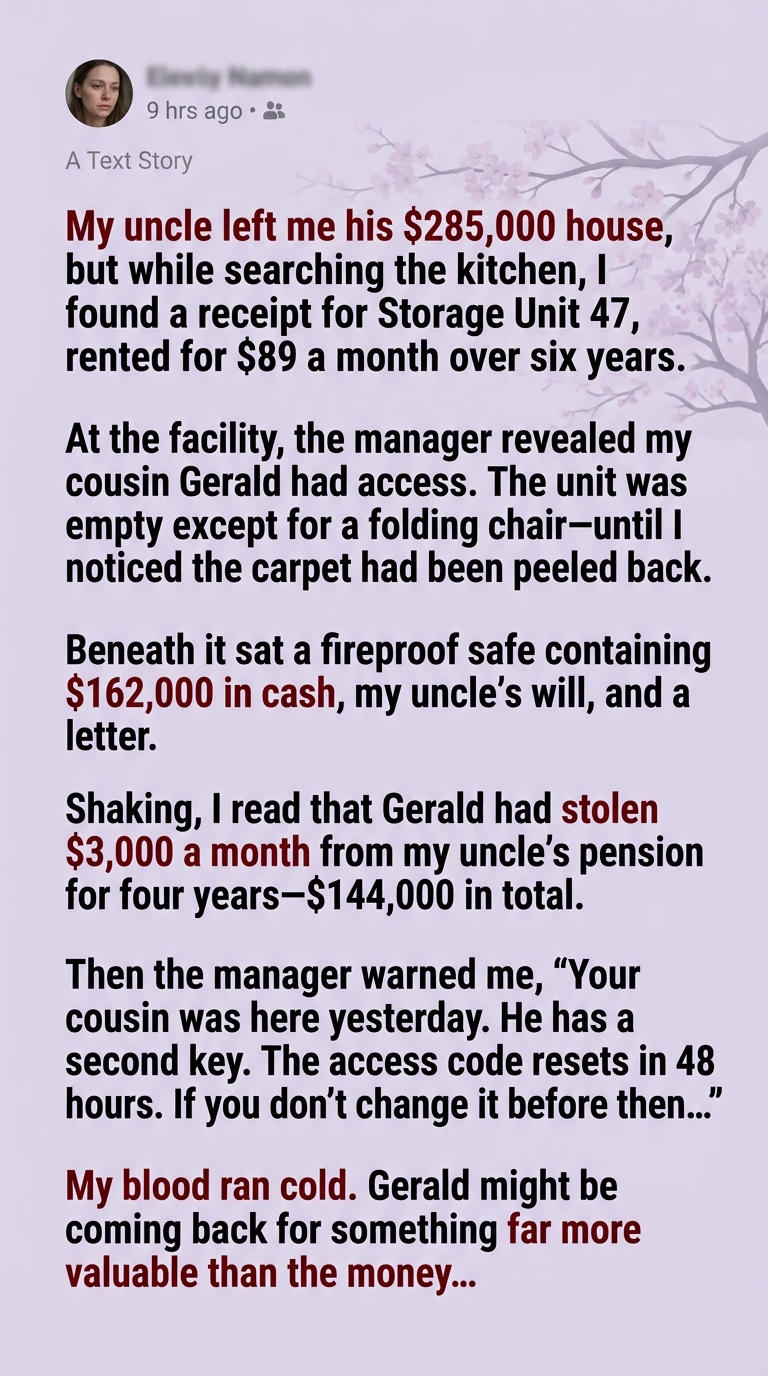
My uncle left me his $285,000 house, but while searching the kitchen, I found a receipt for Storage Unit 47, rented for $89 a month over six years.
At first, I thought it was an ordinary storage bill.
Then I noticed the name on the account.
My uncle’s.
And beneath it, written in a different hand, were the words: AUTHORIZED ACCESS: GERALD HAYES.
Gerald was my cousin.
He had always been close to my uncle, or at least that was what everyone believed. He visited regularly, handled errands, and supposedly helped with bills whenever my uncle needed assistance.
I had no reason to suspect him.
Until I drove to the storage facility.
My uncle, Arthur, had died three weeks earlier at the age of seventy-eight. He had never married, and I was the closest thing he had to a child. When I was young, he taught me how to repair a bicycle, how to balance a checkbook, and how to recognize when someone was telling me only half the truth.
He was quiet, careful with money, and fiercely independent.
His house was modest but valuable, sitting on a pleasant street with a large garden and a detached workshop. The estate attorney had informed me that Uncle Arthur’s valid will left the property to me.
Gerald hadn’t attended the meeting.
He had simply said he was too busy.
That should have been my first warning.
I found the storage receipt inside a kitchen drawer beneath several old appliance manuals. The rental dates went back six years, with automatic monthly payments of $89.
I called the facility.
The manager confirmed the unit was still active and that Gerald was listed as an authorized user.
“Can I inspect it?” I asked.
“Only if you’re authorized under the account or provide the required estate documentation,” he explained.
I brought the death certificate, the executor’s paperwork, and identification. After reviewing everything, the manager, a man named Martin, agreed to accompany me.
He looked uncomfortable as we walked down the corridor.
“Your cousin was here yesterday,” he said.
“Gerald?”
“Yes. He asked whether the access code would change after your uncle’s death.”
I stopped walking.
“What did you tell him?”
“That we follow the account’s legal procedures. I didn’t give him anything.”
Martin unlocked the unit.
It was almost completely empty.
There was a folding chair in the middle of the floor, a dusty cardboard box in the corner, and a faint smell of old carpet.
I looked around.
“That’s it?”
Martin shrugged.
“That’s all that’s been stored here for as long as I can remember.”
Something bothered me.
The carpet looked uneven near the back wall.
I crouched and touched it. One edge had been carefully lifted and placed back down.
“Can you help me move this?”
Martin hesitated.
Then he nodded.
We pulled back the carpet.
Beneath it was a rectangular metal panel.
And beneath that panel was a fireproof safe.
My hands began to shake.
The safe had a combination lock and a small envelope taped to the top.
My uncle’s handwriting was unmistakable.
For whoever finds this. Do not trust Gerald with the contents.
Martin stepped back.
“I think you should call the police before opening that.”
He was right.
I photographed everything, contacted the estate attorney, and asked her to arrange for the discovery to be documented. She advised me not to move the safe or attempt to access it until the proper procedures were followed.
The next morning, an estate representative and a locksmith attended the facility. After documenting the safe and confirming the necessary authority, it was opened.
Inside were bundles of cash, neatly organized and wrapped in paper bands.
We counted it under supervision.
$162,000.
There was also a sealed envelope, a copy of my uncle’s will, and a thick folder containing bank statements, pension records, and handwritten notes.
I opened the envelope.
The letter began:
To the person who found this,
If you’re reading these words, I am probably no longer able to explain what happened myself.
I kept the money here because I no longer trusted the people who had access to my accounts.
I swallowed hard.
Then I read the next paragraph.
Gerald has been taking $3,000 from my pension every month. I discovered it four years ago. At first, I thought it was a banking error. Then I found the transfers.
I stared at the page.
Three thousand dollars a month.
For four years.
A total of $144,000.
My uncle had written that Gerald had convinced him to allow assistance with online banking after he developed arthritis in his hands. At first, Gerald helped pay bills and organize statements.
Then unexplained transfers began appearing.
When Uncle Arthur confronted him, Gerald claimed the money was repayment for loans my uncle had supposedly promised to forgive.
But there were no loan agreements.
No signed acknowledgments.
No convincing records of the alleged debts.
My uncle had started keeping copies of every statement.
The letter continued:
I don’t know whether Gerald thinks I’m too old to understand what’s happening, or whether he simply believes nobody will question him. I know what I saw.
I tried asking him to stop. He told me I was becoming forgetful and that I should be grateful he was helping me.
My eyes burned.
Then came the sentence that made me put the letter down.
I left the house to you because you never treated me like an obligation. I left the documents because I want someone to know what happened. Do not let Gerald convince you that the money was his.
At the bottom, my uncle had written:
There is one more thing. The cash is not the most important part of this safe. Look inside the blue folder.
I reached for the folder.
Inside was a second document.
It was a signed statement prepared with the assistance of an attorney several months before my uncle died. It explained that the money in the safe was his personal property and that he intended it to pass through his estate.
Behind it was a sealed envelope marked:
THE ORIGINAL WILL AND THE RECORD OF MY FINAL WISHES.
The document was not a different will, as I first feared. It was a certified copy of the estate documents, accompanied by a letter from the attorney confirming the version that had been properly executed and deposited with the appropriate records.
I finally understood why my uncle had hidden the safe.
He wasn’t just protecting money.
He was protecting evidence.
Then Martin appeared in the doorway.
His face had gone pale.
“There’s something else you need to know.”
I looked up.
“What’s wrong?”
He lowered his voice.
“Your cousin was here yesterday. He has a second key. The access code resets in forty-eight hours. If you don’t change the access arrangements before then…”
He didn’t finish.
My blood ran cold.
Gerald knew the unit existed.
He had visited it the day before.
And now he knew I had found the safe.
I called my attorney immediately.
She contacted the storage facility and requested that access be restricted while the estate’s authority and ownership of the contents were verified.
The facility agreed to preserve access logs and secure the unit under its procedures.
We also contacted law enforcement to report the suspected pension theft and preserve the financial evidence.
I wanted to believe Gerald would simply disappear.
Instead, he called me that evening.
“Hey,” he said casually. “I heard you’ve been going through Uncle Arthur’s things.”
“Some of them.”
“Did you find anything interesting?”
I stared at the letter.
“Why?”
He laughed.
“Just asking. Uncle Arthur kept a lot of junk. Don’t get carried away thinking everything in that house is valuable.”
“Did you know about Storage Unit 47?”
Silence.
Then he said, “He had a storage unit?”
“You were listed as an authorized user.”
A pause.
“Oh, that. I helped him with a few things.”
“Did you know there was a safe underneath the carpet?”
His breathing changed.
“What safe?”
I said nothing.
“Listen,” he continued, “your uncle wasn’t always thinking clearly. He sometimes forgot what he had agreed to. If you found cash, you need to understand that some of it might have been intended for me.”
“Do you have any documents proving that?”
“Claire, don’t start.”
“I’m asking a simple question.”
He hung up.
I looked at my attorney.
She had been listening on speakerphone.
“Don’t contact him again about the money,” she said. “We have enough to justify preserving the records. Let the investigation proceed.”
The next day, Gerald arrived at my uncle’s house.
I wasn’t there, but the neighbor called to tell me he had been standing near the driveway, looking through the windows.
When I returned with my attorney, he was waiting by the front door.
“You need to stop making this into a criminal investigation,” he said.
“I didn’t take money from Uncle Arthur’s pension.”
“He wanted me to have it.”
“Then why are there four years of unexplained transfers?”
Gerald’s face tightened.
“He was helping me. I had financial problems.”
“Then why did you tell him the money was repayment for loans?”
He looked away.
My attorney stepped forward.
“Mr. Hayes, any further discussion about the disputed transfers should take place through the appropriate legal representatives.”
Gerald ignored her.
“You’re getting the house, aren’t you? You have the house. You have the cash. What more do you want?”
I looked at him.
“The truth.”
He scoffed.
“You always thought you were better than me.”
“No. Uncle Arthur trusted me to protect what he left behind. That’s what I’m doing.”
Gerald stepped closer.
“You don’t know what you’re dealing with.”
My attorney immediately told him to step back.
He finally turned and walked away.
But before getting into his car, he looked over his shoulder.
“You’re going to regret this.”
The investigation took months.
The bank records showed that the $3,000 monthly transfers had gone into accounts controlled by Gerald or used for his personal expenses.
There were no credible loan documents supporting his explanation.
Investigators also found messages in which Gerald had discussed Uncle Arthur’s pension payments and referred to the money as something he could “take before anyone notices.”
The storage facility’s access logs confirmed his visits.
More importantly, the original financial records matched the dates and amounts recorded in my uncle’s letter.
The $144,000 wasn’t an estimate.
It was supported by bank transactions.
Gerald initially denied taking anything. Later, confronted with the records, he admitted receiving the transfers but claimed they were gifts.
The estate’s legal team challenged that explanation.
The matter eventually resulted in a negotiated restitution agreement, with Gerald agreeing to repay a substantial portion of the disputed funds under a formal payment schedule. The remaining issues were addressed through the appropriate legal proceedings.
He also lost access to my uncle’s remaining accounts.
The $162,000 found in the safe was inventoried and transferred into the estate process. After the estate’s obligations were settled, the funds were distributed according to my uncle’s valid will.
The house remained mine.
But the money wasn’t what stayed with me.
It was the letter.
Six months later, I stood in the kitchen of my uncle’s house.
The yellow curtains were still hanging above the sink. His old coffee mug remained beside the stove. I had repaired the loose cabinet door he had complained about for years.
I was going through the last drawer when I found a small photograph.
It showed Uncle Arthur sitting in his garden with me when I was twelve.
On the back, he had written:
You always noticed the things other people walked past.
I sat down and cried.
For years, I had thought my uncle was simply getting older and becoming more private.
I hadn’t understood that he was frightened.
He had tried to protect himself without creating a family scandal. He had saved records, documented transfers, and hidden evidence because he wasn’t sure anyone would believe him.
I wished he had told me sooner.
I wished I had noticed.
But I couldn’t change those years.
I could only honor what he had asked me to do.
The following spring, I turned his detached workshop into a small community space where older residents could get help organizing bills, reviewing suspicious financial requests, and finding independent legal or financial guidance.
I named it Arthur’s Workshop.
On the wall, I placed a framed copy of his final letter.
Not the entire letter.
Just one sentence:
Never let someone convince you that your memory, your money, or your voice belongs to them.
Sometimes I think about Gerald standing in Storage Unit 47, believing he still had control over everything hidden beneath that carpet.
He had a second key.
He had the access code.
He even knew the safe existed.
But he never understood the most important thing my uncle had left behind.
It wasn’t the cash.
It was the evidence.
And this time, someone finally listened.