My Husband Married My Sister in Vegas—But Their Biggest Betrayal Was Waiting at My Front Gate
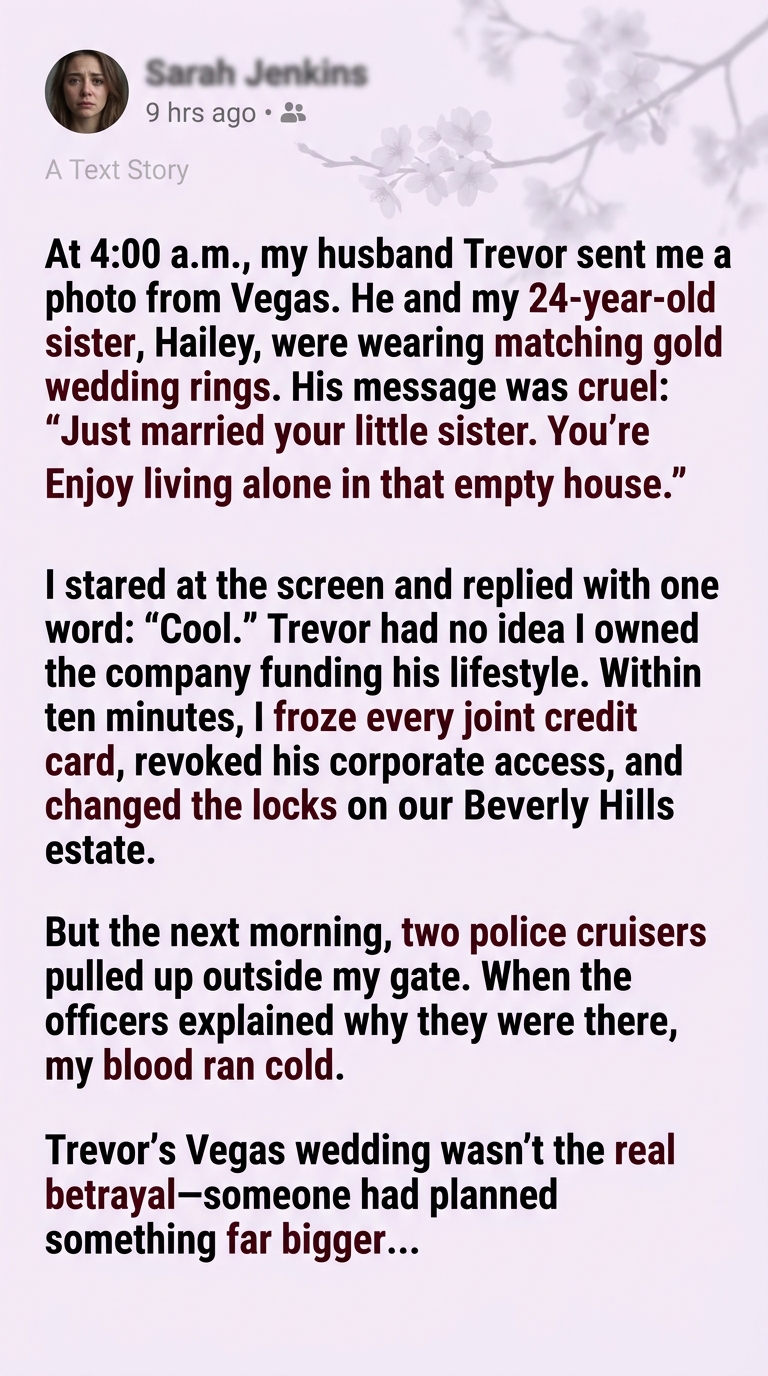
At 4:00 a.m., my husband Trevor sent me a photo from Vegas.
He and my twenty-four-year-old sister, Hailey, were wearing matching gold wedding rings.
His message was even worse.
“Just married your little sister. You’re pathetic. Enjoy living alone in that empty house.”
I stared at the screen for almost a minute.
Then I typed one word.
“Cool.”
Trevor had no idea I owned the company funding his lifestyle.
He had no idea the Beverly Hills estate he called his home was owned by my holding company.
And he certainly didn’t know that his access to our corporate accounts depended on a position he had never actually earned.
Within ten minutes, I froze the joint credit cards, contacted our financial controller, suspended Trevor’s company credentials, and instructed our property manager to secure the estate according to the ownership and occupancy agreements.
I didn’t scream.
I didn’t call Hailey.
I didn’t even cry.
I simply started protecting what belonged to me.
But the next morning, two police cruisers pulled up outside my gate.
When the officers explained why they were there, my blood ran cold.
Trevor’s Vegas wedding wasn’t the real betrayal.
Someone had planned something far bigger.
My name is Claire Bennett. I’m thirty-nine, and for eleven years I had been married to Trevor Hayes.
When we met, Trevor was charming, ambitious, and endlessly enthusiastic about my business.
I had founded Bennett Hospitality Group with a small investment and a single boutique hotel project. Over the next decade, the company expanded into luxury property management, private resorts, and commercial developments.
Trevor joined the company after we married.
He didn’t have much experience in hospitality, but I wanted him to feel included. I gave him a senior executive position, a generous salary, and responsibility for business development.
He loved the title.
He loved the company car.
He loved the expense account.
Most of all, he loved telling people that he was building an empire.
What he rarely mentioned was that I had built the company before he arrived.
The Beverly Hills estate was purchased through a holding company I controlled. Our financial arrangements were documented, and Trevor had permission to use several corporate benefits while he remained employed.
I thought we were building a life together.
Apparently, he thought he was entitled to everything I owned.
Hailey was my younger sister.
She had always been the more outgoing one. She was beautiful, impulsive, and used to getting attention.
I had helped her financially more times than I could count.
I paid for her university expenses, helped with her first apartment, and even gave her a job in the company’s marketing department when she struggled to find work.
Trevor often joked that Hailey was the fun sister.
I never thought much of it.
Looking back, I should have.
The Vegas photograph arrived at 4:00 a.m.
Trevor was wearing a white shirt with the top buttons undone. Hailey stood beside him in a short ivory dress.
Both held up their left hands.
Matching gold rings.
Behind them was a neon sign that read:
JUST MARRIED.
I enlarged the image.
Hailey was smiling.
Trevor looked directly into the camera.
Then I read his message again.
“Just married your little sister. You’re pathetic. Enjoy living alone in that empty house.”
I didn’t recognize the man in that message.
Or perhaps I had simply refused to recognize him for years.
I opened my laptop.
First, I contacted our chief financial officer, Daniel Price.
“Daniel, I need an immediate review of Trevor’s corporate access and outstanding expenses.”
He answered after the second ring.
“Is everything okay?”
“No. But I need you to stay calm and follow the company’s procedures.”
I forwarded him the photograph.
There was a long silence.
“Claire, I’m sorry.”
“Thank you. Please suspend his company credentials pending review, preserve all account records, and freeze any company cards he is authorized to use. Don’t touch any personal accounts without the proper authority.”
“Understood.”
Next, I contacted our bank to suspend the joint credit cards that were legally under my control.
Then I called the estate’s property manager.
I explained that Trevor had informed me he was leaving the marriage and asked that access arrangements be reviewed under the property’s legal ownership and occupancy documents.
I did not ask anyone to throw his belongings outside or lock him out without due process.
I wanted the property secured, not a legal problem.
Finally, I called my attorney.
By sunrise, I had started a formal review of our marital assets, company accounts, and Trevor’s employment agreement.
I thought the worst part was over.
I was wrong.
At 8:17 the next morning, my security monitor showed two police cruisers outside the front gate.
I walked downstairs and opened the intercom.
“Good morning. Can I help you?”
A male officer stepped forward.
“Are you Claire Bennett?”
“Yes.”
“We need to speak with you regarding a report filed by Trevor Hayes.”
My stomach tightened.
“What kind of report?”
The officer glanced at his notes.
“Mr. Hayes has alleged that you unlawfully removed him from his residence, seized property belonging to him, and accessed accounts without authorization.”
I stared at the screen.
“That’s impossible. I haven’t removed anyone. He is in Las Vegas.”
The officer continued.
“He also claims that you are holding company funds that belong to him.”
I felt my blood run cold.
Because I knew something the officers didn’t.
Trevor had never owned the company.
He had never owned the estate.
And his authority over the corporate accounts had been limited to his employment role.
But that wasn’t the most frightening part.
The officer asked whether I knew that Trevor had reported a possible theft of confidential company documents.
I went still.
“What documents?”
“Financial records and a property acquisition file.”
I turned toward my office.
There was a locked cabinet where I kept original corporate records.
The cabinet was still locked.
But the small security light on the wall was blinking red.
Someone had accessed the office overnight.
I asked the officers to wait while I contacted my attorney.
She arrived less than an hour later.
We provided the property ownership documents, Trevor’s employment agreement, the records of the account restrictions, and evidence that he had been outside California when he sent the message.
The officers explained that they were investigating the competing allegations and needed to establish whether any property had actually been taken or unlawfully accessed.
They weren’t there to decide our divorce.
They were there because Trevor had made a formal report.
My attorney asked whether the officers had a warrant.
They did not.
We cooperated with their questions but did not consent to an unrestricted search of the property.
After reviewing the documents and speaking with Trevor, they left.
But I couldn’t stop thinking about the missing acquisition file.
I went into my office.
The cabinet was still locked.
However, the file inside was missing.
It contained information about a commercial property our company had been negotiating to purchase.
The property was a former private medical facility in West Los Angeles.
We had planned to convert it into a luxury assisted-living residence.
The acquisition was confidential because negotiations were still underway.
Only four people had access to the complete file.
Me.
Daniel, our CFO.
Trevor.
And my sister Hailey.
I called Daniel.
“Did you access the acquisition file?”
“No. Why?”
“It’s missing.”
His voice changed.
“Claire, there’s something else you need to know.”
I sat down.
“What?”
“Three weeks ago, Trevor asked me to prepare a transfer of company funds to a new consulting firm. I refused because the supporting documents didn’t make sense.”
“What consulting firm?”
“Hayes Strategic Partners.”
I closed my eyes.
“That’s Trevor’s name.”
“Exactly. He claimed it was a vendor for the property acquisition. But the company wasn’t properly registered in our approved vendor system, and the invoice didn’t match the services described.”
“Did you tell him no?”
“Yes. He became angry and said you’d approved it verbally.”
“I never approved it.”
“I know. That’s why I documented the request.”
I felt sick.
“Send everything to my attorney.”
Daniel agreed.
Then he added something else.
“Claire, the request was for $2.4 million.”
That afternoon, my attorney and I reviewed the records.
The $2.4 million transfer request had been submitted in two parts.
The first was described as a property advisory payment.
The second was labeled a consulting advance.
Neither had been approved.
But the paperwork contained a signature that looked remarkably like mine.
I stared at it.
“That isn’t my signature.”
My attorney examined the document.
“We’ll need a forensic review. Don’t make assumptions until we know how it was created.”
The next discovery was even more disturbing.
The consulting firm had been incorporated six months earlier.
Its registered contact was Hailey.
My sister.
I looked at the screen.
“Why would she be involved?”
My attorney didn’t answer immediately.
“Let’s find out.”
We reviewed the company’s communications and discovered that Hailey had been sending Trevor confidential property information.
She had also accessed internal marketing files, financial projections, and acquisition schedules.
The emails suggested that Trevor planned to use the stolen information to approach the property seller directly through his new company.
He intended to make a competing offer after learning the confidential maximum price Bennett Hospitality Group was prepared to pay.
If successful, he would have diverted the acquisition opportunity to a company controlled by him and Hailey.
But the documents showed something more.
The property seller had received an offer from Hayes Strategic Partners three days before Trevor’s wedding announcement.
The offer was based on confidential figures from our internal acquisition file.
Trevor and Hailey hadn’t simply decided to get married.
They had been preparing to take a business opportunity worth millions away from my company.
The wedding was a distraction.
The real plan was financial.
I called Hailey.
She answered cheerfully.
“Hey, Claire.”
“Where are you?”
“Vegas. Why?”
“Did you help Trevor establish Hayes Strategic Partners?”
Silence.
Then she laughed nervously.
“What are you talking about?”
“I have the incorporation records.”
“Claire, don’t start.”
“Did you send him our confidential acquisition documents?”
She lowered her voice.
“Trevor said it was his project.”
“It’s my company’s project.”
“You always act like everything belongs to you.”
I stared at the phone.
“Because I built it.”
Hailey sighed.
“Trevor told me you were planning to push him out anyway. He said he deserved something after all those years working for you.”
“He had a salary, bonuses, and company benefits.”
“He said you controlled everything.”
“He was an employee, Hailey. Not the owner.”
She was silent.
Then she said something I will never forget.
“You’ve always had more than enough. You could have shared.”
I felt tears forming, but I kept my voice steady.
“I gave you a job. I paid your tuition. I helped you when you had nowhere to live. And you helped my husband try to steal from me.”
“He loves me.”
“No. He loves what he thinks he can take.”
She hung up.
The following week, our attorneys contacted the property seller and formally notified them that confidential acquisition information might have been misused.
We provided the documents showing the competing offer and requested that they preserve all communications related to the transaction.
Our cybersecurity team conducted a forensic review of company systems.
They identified unauthorized downloads from Trevor’s corporate account and access to files associated with Hailey’s credentials.
The suspicious transfer documents were also sent for forensic examination.
The investigation found evidence that the signature had been copied from an earlier authorization document and placed onto the new transfer request.
Neither I nor the company’s board had approved the payment.
Our lawyers referred the suspected forgery and attempted diversion of funds to the appropriate authorities.
Trevor and Hailey denied wrongdoing.
They claimed they had been developing a legitimate consulting business and that I was retaliating because of the marriage.
But their explanation became difficult to maintain when investigators found messages discussing the plan.
One message from Trevor read:
Once the property closes, she can’t stop us. We’ll have our own company and our own money.
Hailey had replied:
And the wedding makes it official. She’ll never be able to pretend we’re not family.
I read those messages several times.
The wedding had never been about love.
At least, not in the way I had understood it.
The legal proceedings took months.
Trevor’s employment was formally terminated following the company’s investigation and the required procedures.
His access to company systems remained suspended.
The estate’s lawyers handled the occupancy issue separately, and we reached a legally reviewed agreement about his remaining personal belongings.
My attorney also began divorce proceedings.
The police investigation continued into the alleged misuse of confidential records, the attempted transfer, and the disputed signature.
Eventually, the evidence led to formal charges related to the fraudulent financial documents and unauthorized access.
Hailey cooperated with investigators after being confronted with the communications and records.
She admitted helping Trevor establish the consulting company and sending him confidential documents, although she claimed she hadn’t understood the full plan.
Her cooperation became part of the legal process.
Trevor, however, continued insisting that I had orchestrated everything to destroy him.
I stopped reading his messages.
I had spent too many years trying to understand a man who had no interest in being honest with me.
Six months after the Vegas wedding, I received a letter from Hailey.
She wrote that Trevor had told her I was planning to divorce him, sell the company, and leave them both with nothing.
She said she had believed him.
She also admitted that she had been jealous of me for years.
Not because I had a better marriage.
Not because I had more friends.
But because I had built something she couldn’t take credit for.
She apologized.
I read the letter twice.
Then I put it in a drawer.
I wasn’t ready to forgive her.
Perhaps I never would be.
The divorce was finalized the following year.
The company recovered its internal records and strengthened its approval procedures. The proposed $2.4 million transfer was never completed.
The property acquisition was eventually completed by Bennett Hospitality Group under a revised agreement.
I attended the opening of the new residence.
There was a small ceremony, a ribbon, and a gathering of employees who had worked through the difficult months.
Daniel stood beside me.
“You did it,” he said.
I looked around the building.
“No. We did.”
That evening, I returned to the Beverly Hills estate.
The house was quiet.
For the first time in years, I didn’t feel as though I was waiting for someone to come home.
I walked into the kitchen, poured myself a glass of water, and looked at the phone that had started everything.
The photograph from Vegas was still saved.
Trevor and Hailey, smiling in matching rings.
I didn’t delete it.
Not because I wanted to remember the humiliation.
But because it reminded me of something important.
The betrayal wasn’t the wedding.
It was the years of preparation behind it.
Trevor had believed that marrying my sister would make him untouchable.
Hailey had believed that helping him would finally give her a share of the life she envied.
Neither understood that I wasn’t going to let betrayal decide the future of my company.
They had sent me a photograph of two people celebrating what they thought was their victory.
I replied with one word.
Cool.
And for once, I meant it.
Because while they were busy planning their new life together, I was already protecting the one I had built.