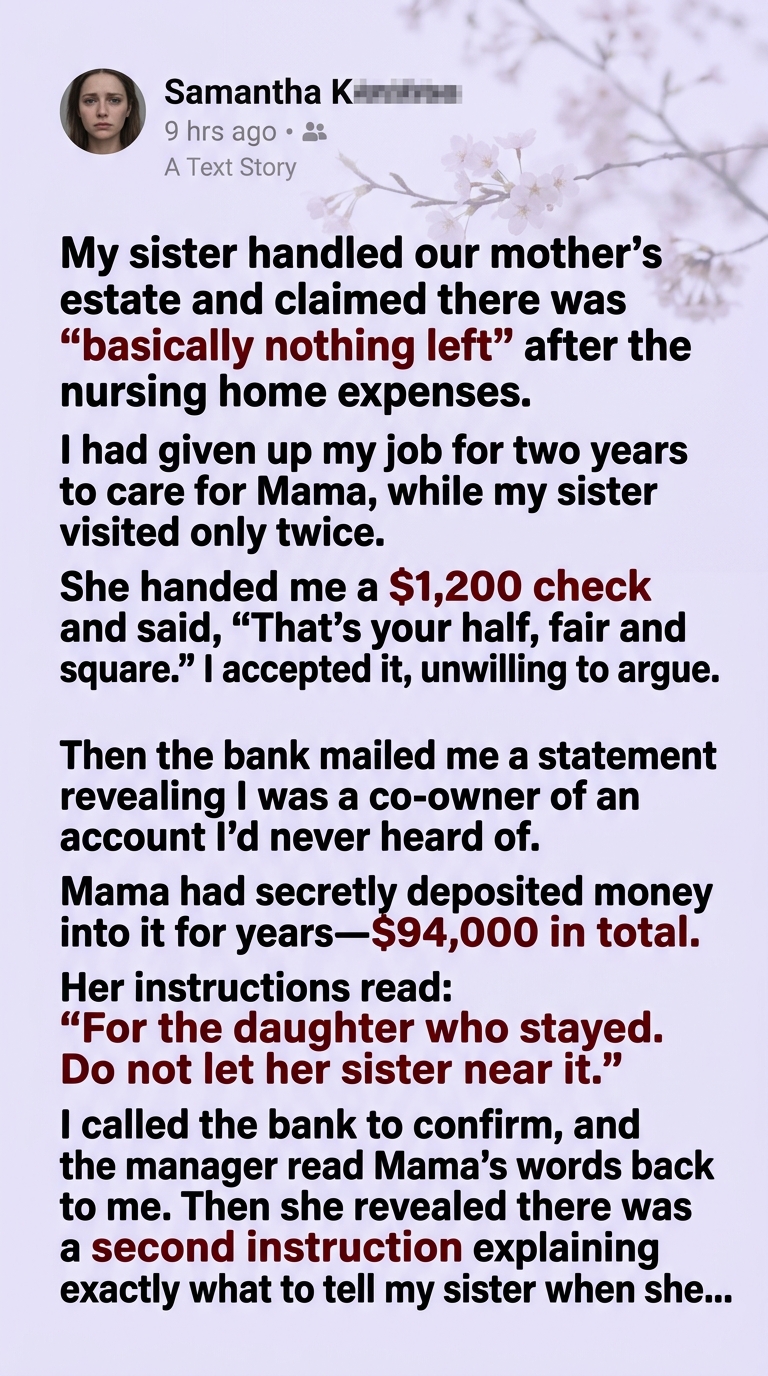
MY SISTER SAID THERE WAS NOTHING LEFT OF MOM’S ESTATE AND HANDED ME $1,200. THEN THE BANK REVEALED THE $94,000 MOM HAD BEEN SAVING FOR ME.
My sister handled our mother’s estate after she passed away.
She told everyone she was doing the difficult work, dealing with the nursing home, paying the bills, and sorting through the paperwork.
I didn’t argue.
For the last two years of Mama’s life, I had given up my job to care for her. I cooked her meals, helped her bathe, drove her to appointments, and sat beside her through the long nights when she couldn’t sleep.
My sister, Vanessa, visited twice.
She always had a reason.
Work was busy. Her children had activities. The drive was inconvenient.
I never asked her to do more. I just wanted Mama to be comfortable.
After the funeral, Vanessa called me to discuss the estate.
She sounded businesslike.
“There was basically nothing left after the nursing home expenses,” she explained. “The house needed repairs, there were medical bills, and everything else went toward final costs.”
I asked whether there were any savings.
She sighed.
“Not really. I went through everything.”
A few days later, she handed me a check for $1,200.
“That’s your half, fair and square.”
I looked at it.
“Half of what?”
“What’s left.”
I wanted to ask for the accounting, but I was exhausted. I had spent two years watching my mother decline, and I didn’t have the energy for another family argument.
So I accepted the check.
I thought that was the end of it.
Then, about two weeks later, a letter arrived from the bank.
It was addressed to me.
I almost threw it away because I didn’t recognize the account number.
But my name was printed clearly beneath the account holder information.
I was listed as a joint owner.
I opened the statement.
The balance was $94,000.
I read the number three times.
I had never heard of this account.
The statement showed that Mama had deposited money into it over several years. Some deposits were small. Others were larger transfers made every few months.
I called the bank immediately.
After verifying my identity, the representative confirmed that I was a joint account holder.
Then she placed me on hold.
A few minutes later, the branch manager came on the line.
“I’m glad you called,” she said. “Your mother left specific instructions regarding this account.”
My hands began to shake.
She read the note aloud.
For the daughter who stayed. Do not let her sister near it.
I covered my mouth.
The manager continued.
“Your mother also left a second instruction. It explains what we’re supposed to tell your sister if she contacts the bank.”
I asked her to read it.
She paused before speaking.
If Vanessa asks about this account, tell her it was established separately from my estate, with my daughter as a joint owner. She has no authority to withdraw from it or change it. Do not disclose my other daughter’s private financial information to her.
I sat silently.
Mama had anticipated this.
She had known that Vanessa might ask questions.
I asked the manager whether the money belonged to me.
She explained that the answer depended on the account agreement, the ownership arrangement, and applicable law. The bank could confirm my status as a joint owner, but it couldn’t make a final determination about every possible estate or inheritance issue.
She advised me to review the original account documents and speak with an estate attorney before moving any money.
I appreciated that she didn’t simply tell me what I wanted to hear.
I asked for copies of the account-opening documents, the deposit history, and Mama’s written instructions.
A few days later, I met with an attorney.
We reviewed everything carefully.
The account had been opened several years earlier, and Mama had added me as a joint owner. The records showed that she had made the deposits herself.
The attorney explained that the account’s legal treatment depended on its terms and the applicable state law. We also needed to make sure none of the funds had been improperly included or excluded from the estate accounting.
But one thing was clear.
Vanessa had no authority to take the money simply because she had handled the estate.
The attorney also recommended obtaining a complete estate accounting before treating the $1,200 check as a final distribution.
I agreed.
Then I called Vanessa.
I didn’t accuse her of stealing anything.
I simply said, “I received a bank statement for an account Mama opened with me. It has $94,000 in it.”
There was silence.
Then she said, “What account?”
I explained that I was a joint owner and that the bank had confirmed Mama left written instructions.
Vanessa’s voice changed.
“That’s impossible. I went through all her accounts.”
“Apparently, you didn’t find this one.”
“Why would she hide ninety-four thousand dollars from me?”
I took a breath.
“She didn’t hide it from you. She made a decision about how she wanted to arrange her money.”
Vanessa became angry.
“I’m her daughter, too!”
“I know.”
“So I deserve half!”
I didn’t respond immediately.
Then I said, “You need to speak with the attorney if you have a legal question. I’m not going to argue about money over the phone.”
She hung up.
The following afternoon, Vanessa contacted the bank.
The branch manager later confirmed that she had asked whether Mama had another account and whether she could access it.
The manager followed the written instructions.
She told Vanessa that she was not an owner and had no authority over the account.
She also explained that the bank could not disclose another customer’s private account information without proper authorization.
Vanessa wasn’t satisfied.
She called me again.
“You had the bank hide money from me!”
“No. Mama opened an account and included me as an owner.”
“She was confused by then!”
That accusation made my stomach tighten.
Mama had been mentally capable when she opened the account. The attorney reviewed the relevant records, including the dates and documentation, and found no immediate reason to conclude that the account had been created improperly.
Still, we followed the proper process rather than relying on assumptions.
Then Vanessa said something that I will never forget.
“You only cared for her because you expected to get something.”
I felt as though she had slapped me.
For two years, I had washed Mama’s clothes, managed her medications, prepared her meals, and stayed awake when she was frightened.
I had missed work opportunities and turned down promotions.
I had done those things because she was my mother.
Not because I expected ninety-four thousand dollars.
I answered quietly.
“I cared for her because she needed me. The money was her decision.”
Vanessa hung up again.
Over the next several weeks, the estate attorney reviewed the account alongside the rest of the estate records. We confirmed the account’s ownership terms and made sure the funds were treated according to the governing documents and law.
The attorney also requested a proper accounting of the estate expenses.
That review showed that the nursing home expenses were real, but some of the amounts Vanessa had described as final estate costs had been paid from a separate account. She was asked to provide supporting receipts and records for the distribution she had calculated.
There was no instant accusation or dramatic courtroom scene.
There was simply paperwork, questions, and a requirement that everything be accounted for.
Eventually, Vanessa acknowledged that she had not included the joint account in her estate summary because she believed it was a private arrangement Mama had made with me.
She still believed she should receive something from it.
But the attorney explained that being a daughter did not automatically make her an owner of every account Mama had opened.
The $94,000 remained subject to the account’s legal terms.
When everything was finally reviewed, I was able to retain the funds according to the ownership arrangement.
I didn’t celebrate.
I sat at my kitchen table with the bank documents spread out in front of me.
Then I found something else in the envelope the bank had sent.
It was a photocopy of a handwritten note Mama had left with the account records.
It was addressed to me.
My sweet girl,
I know you never asked for anything. That’s one of the reasons I wanted to do this.
You gave up two years of your life to make sure I wasn’t alone. You never made me feel like a burden, even on the days when I couldn’t remember what I had asked you five minutes earlier.
I know your sister has her own life. I don’t want you to spend your days being angry with her.
But I also don’t want you to believe that what you gave was invisible.
This money is not payment for loving me. A daughter should never have to be paid to care for her mother.
It’s something I saved because I wanted you to have a little security after everything you put aside.
Please use it to build a life that belongs to you again.
And don’t feel guilty.
I love you.
I pressed the note against my chest.
For two years, I had watched my mother grow weaker.
I had worried about her medication, her meals, and whether she was comfortable.
I never knew she had been quietly saving money.
She hadn’t told me because she didn’t want me to feel obligated or change the way I cared for her.
She had simply wanted to make sure I had a chance to start over.
I eventually used part of the money to return to school and complete a professional qualification I had postponed while caring for Mama.
I kept the rest in savings.
Vanessa and I haven’t become close again.
We speak occasionally, usually about family matters. She still believes Mama should have divided everything differently.
I no longer try to convince her otherwise.
Mama made her decision.
And I have learned that I don’t need my sister’s approval to accept what my mother chose to leave me.
The $94,000 changed my financial future.
But the handwritten note changed something much deeper.
For years, I wondered whether Mama understood how much I had sacrificed.
Now I know she did.
And when I think about those two years, I no longer remember only the exhaustion.
I remember holding her hand.
I remember her smile when I brought her breakfast.
I remember the quiet afternoons when she would tell me the same story twice.
And I remember that, even when she couldn’t always say it, she knew I was there.
That was worth more than any check.