She Told Me I Belonged in the Back—Then the Captain Made an Announcement
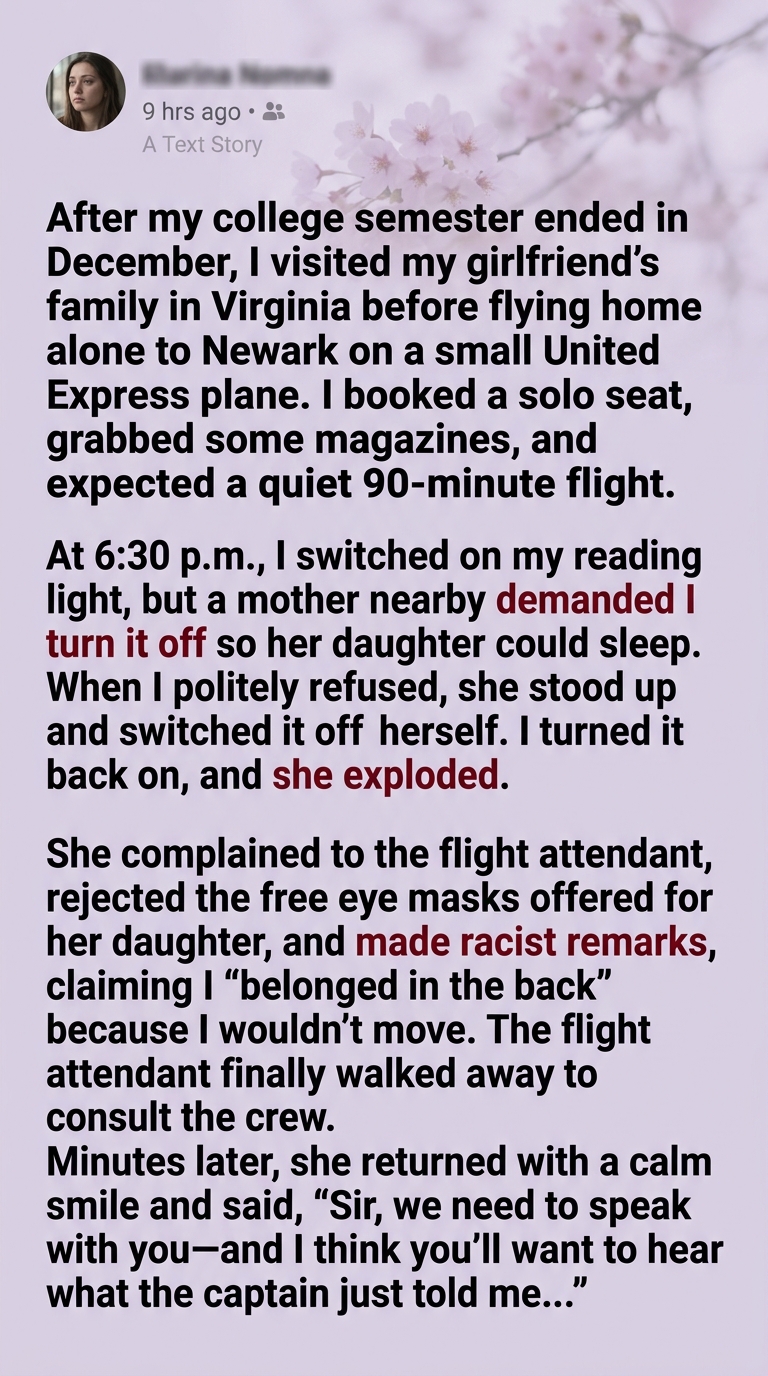
After my college semester ended in December, I visited my girlfriend’s family in Virginia before flying home alone to Newark.
I booked a seat on a small United Express flight, grabbed two magazines, and expected a quiet ninety-minute trip.
I had no idea that one passenger would turn the flight into an experience I would never forget.
I was twenty-one, tired from finals, and looking forward to sleeping in my own bed. My seat was on the right side of the aircraft, a few rows behind a mother traveling with her young daughter.
Everything was normal until 6:30 p.m.
I switched on my reading light and opened a magazine.
A few minutes later, the mother turned around.
“Excuse me. Could you turn that off? My daughter is trying to sleep.”
I glanced toward the little girl. She was leaning against the window with a blanket over her shoulders.
“Of course, I can keep the light pointed down,” I said. “But I’d like to finish reading.”
The woman frowned.
“She needs to sleep.”
“I understand. I’m sorry, but this is my reading light.”
She stared at me as if I had deliberately insulted her.
Then she stood up, reached over the seat, and switched it off.
I sat there for a moment, genuinely surprised.
I turned it back on.
“Please don’t touch my seat controls,” I said calmly.
That was when she exploded.
“Are you serious? You can’t let a little girl sleep?”
“I’m not stopping her from sleeping. I’m just reading.”
She began speaking loudly enough for nearby passengers to hear.
“People like you always have to make everything difficult.”
I tried to return to my magazine.
Then she said something that changed the entire situation.
“You belong in the back. People like you shouldn’t be sitting up here acting important.”
I looked at her.
“What does that mean?”
She rolled her eyes.
“Don’t pretend you don’t understand.”
Her comments became increasingly racist. She made remarks about my appearance and suggested I should move because she didn’t want her daughter sitting near someone like me.
I felt my face grow hot.
I had traveled across the country dozens of times. I had dealt with impatient passengers and delayed flights. But I had never been spoken to like that by someone who seemed convinced she had the right to decide where I belonged.
I pressed the call button.
A flight attendant approached a moment later.
“Is everything okay here?”
The woman immediately began talking over me.
“This man is disturbing my daughter. He’s refusing to turn off his light, and he’s being completely disrespectful.”
The flight attendant listened before turning toward me.
“Sir, can you explain what’s happening?”
I calmly described the situation.
“I turned on my reading light. She asked me to switch it off, and I declined. Then she reached over and turned it off herself. When I turned it back on, she started insulting me and telling me I belonged in the back.”
The flight attendant looked uncomfortable.
She offered the mother a free eye mask for her daughter.
The woman rejected it.
“An eye mask isn’t the point! He needs to move.”
The attendant offered to see whether another seat was available, but the woman refused that suggestion too.
“I paid for this flight. He should be the one moving.”
The flight attendant looked at me.
“Sir, would you be willing to lower the brightness slightly?”
“I already have it pointed down. I haven’t disturbed anyone else.”
She nodded.
“I understand. Please give me a moment.”
She walked toward the front of the aircraft.
The mother leaned into the aisle and muttered another insult.
I decided not to respond.
A few minutes later, the flight attendant returned.
This time, her expression was different.
She approached my row with a calm smile.
“Sir, we need to speak with you—and I think you’ll want to hear what the captain just told me.”
My stomach tightened.
“Am I in trouble?”
“No, sir. Not at all. The captain has been informed of the situation.”
She glanced toward the mother before continuing.
“He reviewed the information we provided and instructed us to document the passenger’s conduct. He also made it clear that no passenger has the authority to switch off another person’s reading light or demand that someone move because of their race.”
The mother immediately interrupted.
“Are you saying I’m the problem?”
The attendant remained professional.
“I’m saying that everyone must follow the crew’s instructions and treat other passengers respectfully.”
Then she added something I hadn’t expected.
“The captain has asked me to make sure you’re comfortable remaining in your assigned seat. You do not need to move.”
I nodded.
“Thank you.”
The woman scoffed.
“This is ridiculous. You’re taking his side?”
The flight attendant didn’t argue.
“Ma’am, I’ve offered you an eye mask and assistance with finding a more suitable arrangement. Those options remain available. However, you cannot reach across another passenger’s seat or make discriminatory comments.”
The woman crossed her arms.
“I want to speak to the captain.”
“I can pass along your request, but he is responsible for the safe operation of the aircraft.”
She then returned to the front.
For several minutes, the cabin was quiet.
I could feel people watching, but nobody said anything.
Then the captain’s voice came over the speaker.
“Good evening, everyone. We appreciate your patience. We ask all passengers to remain seated, respect one another’s personal space, and follow crew instructions. Discriminatory or abusive behavior toward other passengers or crew members will not be tolerated.”
He didn’t identify anyone.
He didn’t need to.
The mother stared straight ahead.
I switched my reading light back to its original setting and continued reading.
For the rest of the flight, she didn’t speak to me.
When we landed in Newark, I gathered my magazines and waited for the aisle to clear.
The flight attendant approached me one final time.
“Sir, I’m sorry that happened. We have documented the incident, and the captain has requested that the report be completed before the crew leaves.”
“Thank you for taking it seriously,” I said.
She nodded.
“You shouldn’t have had to deal with that.”
I stepped into the terminal feeling exhausted but relieved.
I thought that was the end of it.
A few days later, I received a message from the airline’s customer service team acknowledging the report. They asked for additional details, and I provided a factual account of what happened, including the approximate time and the flight information.
I didn’t ask for compensation. I wanted the incident documented and reviewed.
The airline later confirmed that my complaint had been forwarded through its customer relations process. They couldn’t share private details about another passenger, but they assured me the report had been recorded.
I never learned whether the woman faced any additional consequences.
What stayed with me wasn’t the captain’s announcement or the argument over a reading light.
It was the moment she looked at me and decided that my seat, my comfort, and my dignity mattered less than hers.
She had mistaken my refusal to surrender a perfectly ordinary privilege for disrespect.
But I hadn’t demanded special treatment.
I hadn’t asked anyone to move.
I had simply wanted to read my magazine under the light attached to the seat I had paid for.
And that night, the most important thing the crew did wasn’t turn on a reading light.
It was make clear that I belonged exactly where I was.