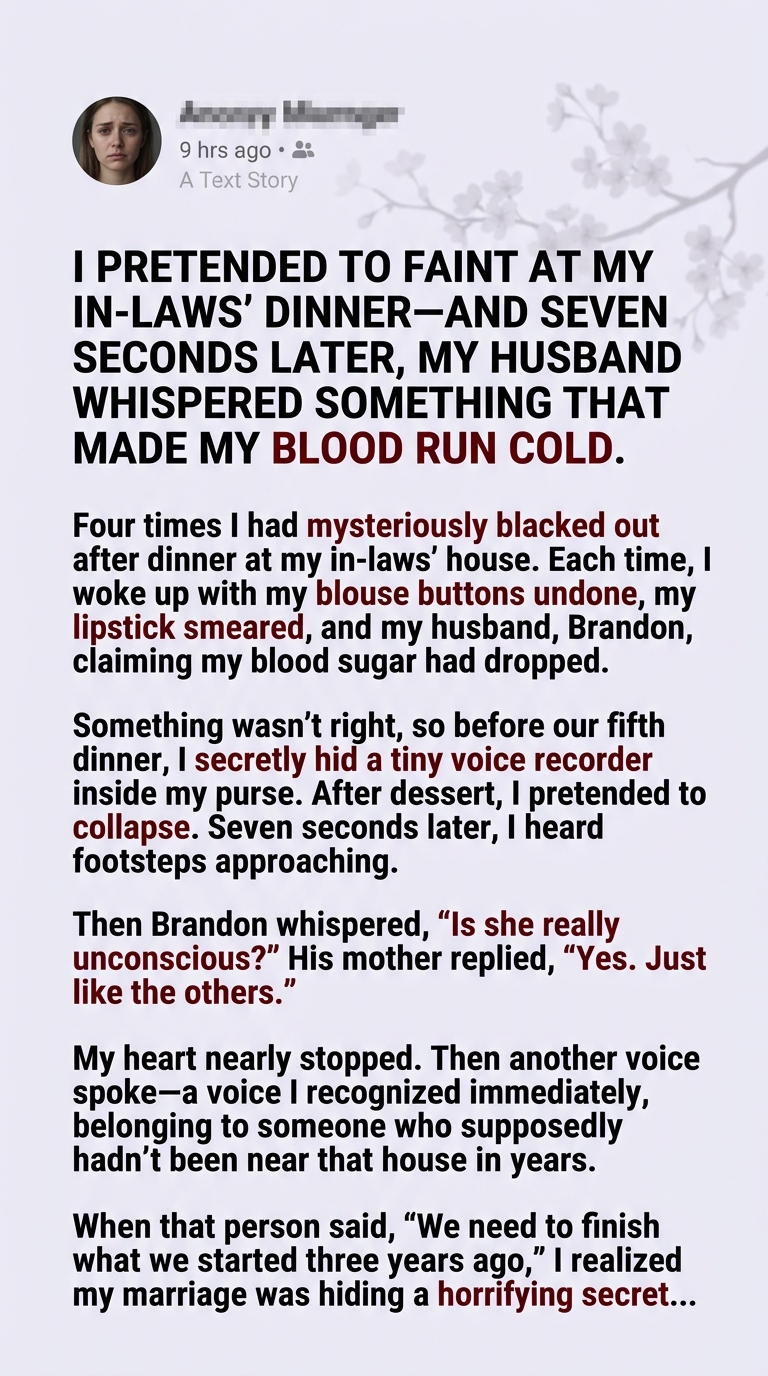
I Pretended to Faint at My In-Laws’ Dinner—Seven Seconds Later, I Heard the Truth That Nearly Destroyed Me
The first time I blacked out at my in-laws’ house, Brandon told me I had low blood sugar.
The second time, he said I was exhausted.
The third time, his mother insisted I needed to eat more before coming over.
By the fourth time, I had started dreading Sunday dinners.
Each episode followed the same pattern. We would eat, laugh, and talk. Then, sometime after dessert, the room would begin to spin. My arms would feel heavy, my words would become tangled, and everything would disappear.
When I woke up, I was usually on the guest bedroom sofa.
My blouse buttons would be undone. My lipstick would be smeared. Sometimes my earrings were missing. Brandon always had an explanation.
“You were sweating, sweetheart. I loosened your clothes so you could breathe.”
His mother, Eleanor, would bring me a glass of water and tell me I was too young to be having these problems.
I believed them because I loved my husband.
But something about the way they watched me after I woke up made my skin crawl.
Brandon never seemed frightened. He never called an ambulance. He never suggested seeing a doctor. He simply waited until I could stand, then drove me home.
The fourth time, I noticed something that changed everything.
When I opened my eyes, Brandon was standing beside the bed, speaking quietly to his mother in the hallway.
“She doesn’t remember anything, does she?” Eleanor asked.
Brandon paused.
“No,” he replied. “She never does.”
I closed my eyes again.
I wanted to ask what they meant, but fear held my tongue.
The following morning, I made an appointment with my doctor. I described the episodes, including the strange confusion and the fact that they happened after meals at one particular house.
My doctor took me seriously. She ordered tests, warned me not to drive if I felt faint, and told me that unexplained blackouts needed proper investigation. She also advised me to seek emergency help if another episode occurred.
But I had another plan.
Before our fifth dinner, I placed a tiny voice recorder inside the lining of my purse. I also told my sister, Rachel, where I would be and arranged to check in with her at a specific time.
I didn’t want to accuse anyone without evidence.
And I didn’t want to be alone if my suspicions were right.
That Sunday, Eleanor welcomed me with her usual warm smile.
“Darling! You look pale. Are you eating properly?”
“I’m fine,” I answered.
Brandon kissed my cheek. “Mom made your favorite.”
Dinner was almost painfully normal.
His father, Richard, talked about the weather. Eleanor complained about her neighbor. Brandon held my hand beneath the table and asked whether I wanted more potatoes.
I watched him carefully.
After dinner, Eleanor served chocolate cake and coffee.
I barely touched mine.
Then, as everyone talked, I let my head fall sideways and slid from my chair.
My body hit the carpet.
I kept my eyes closed and slowed my breathing.
Footsteps approached.
One.
Two.
Three.
Then Brandon spoke.
“Is she really unconscious?”
Eleanor answered immediately.
“Yes. Just like the others.”
My heart slammed against my ribs.
Another voice came from the doorway.
“Good. We need to finish what we started three years ago.”
I recognized that voice.
It belonged to my husband’s older brother, Nathan.
Nathan had supposedly moved overseas three years earlier after a terrible argument with Brandon. We had been told he was living in Singapore. Brandon claimed they barely spoke.
But there he was.
Inside the house.
And he knew exactly what was happening.
Brandon lowered his voice.
“Not here. We agreed we wouldn’t discuss it until she was out.”
Nathan gave a short, bitter laugh.
“You said that last time. And the time before. How many more women are you planning to put through this?”
Eleanor snapped, “Keep your voice down.”
I felt my fingernails digging into my palms.
Women?
Not just me?
Nathan continued.
“She deserves to know what happened to Olivia.”
Olivia.
The name struck me harder than anything else.
Olivia was Brandon’s first wife.
He had told me she died in a car accident three years before we met. He rarely spoke about her, and whenever I asked questions, his expression changed.
I had never met her family.
I had never seen a photograph of her.
I had simply accepted the explanation.
Now, lying on that carpet, I heard Brandon whisper something I would never forget.
“She was supposed to be the last one.”
Eleanor replied, “You said the same thing when Olivia disappeared.”
My stomach twisted.
Then Nathan said, “Olivia didn’t disappear. You know what happened to her.”
I could barely stop myself from opening my eyes.
Brandon stood over me.
“Enough,” he said. “We have a problem. She has started asking questions.”
Nathan answered, “Because she knows something is wrong. You can’t keep doing this.”
Eleanor’s voice became cold.
“Then perhaps we should remind her why she married into this family.”
That was the moment I understood I was not simply dealing with a controlling husband and an overbearing mother-in-law.
I was in danger.
I needed help immediately.
I slowly moved one finger toward my purse, which had fallen near the chair. The recorder was still inside.
My phone was in my coat pocket.
I had to reach it without alerting them.
Then I heard Nathan say something that made my blood run colder.
“Brandon, the woman from three years ago wasn’t an accident. Olivia found the records. She knew what you and your mother had been doing.”
Brandon cursed under his breath.
Eleanor said, “She was never supposed to see those files.”
“What files?” Nathan demanded.
“The medical records. The insurance papers. Everything.”
A chair scraped against the floor.
Brandon whispered, “If she finds out what happened to Olivia, we’re finished.”
I couldn’t stay still any longer.
I needed someone outside that house.
With my eyes still closed, I pressed the emergency shortcut on my phone.
My sister had been waiting for my check-in. When I failed to respond, she had already agreed to contact emergency services.
I heard a notification sound from my purse.
Brandon immediately turned toward it.
“What was that?”
Nobody answered.
Then he crouched beside me.
“Sweetheart?”
His fingers touched my shoulder.
I forced myself to remain limp.
He leaned closer.
“Wake up.”
His voice no longer sounded loving.
It sounded impatient.
Nathan suddenly stepped between us.
“Don’t touch her.”
Brandon stood.
“Move.”
“No. I’ve watched you do this for years. I’m not helping you do it again.”
Eleanor shouted, “You owe this family everything!”
Nathan’s answer was quiet.
“I owed you silence. I don’t owe you another life.”
The front door opened.
A voice called out.
“Police! We need everyone to step away.”
I had never been so relieved to hear strangers speaking.
Brandon jumped backward.
Eleanor began shouting that I had fainted and that everyone was misunderstanding the situation. But the officers separated them and called for medical assistance.
I opened my eyes.
Brandon looked down at me with an expression I had never seen before.
Not concern.
Not love.
Fear.
“Baby,” he said, kneeling beside me. “Tell them you just passed out. You know how this happens.”
I stared at him.
“No,” I whispered. “I know exactly how this happens.”
At the hospital, doctors examined me and began investigating the repeated episodes. They collected samples, reviewed my medication history, and documented my symptoms. The police secured the recorder and the belongings I had brought with me.
I was frightened, confused, and exhausted.
But I was no longer alone.
The recording captured the conversation clearly. It also captured Brandon telling his mother that I had become suspicious and that they needed to deal with the problem.
The investigation uncovered something far worse than I had imagined.
Brandon and Eleanor had been involved in a scheme that targeted women connected to the family.
They had used private medical information, manipulated health appointments, and concealed financial documents. The women were made to appear medically unstable, which helped the family explain away strange incidents and isolate them from people who might question what was happening.
Olivia had discovered the scheme.
She had confronted Brandon shortly before she supposedly died in a single-car accident.
But the accident report contained inconsistencies.
Nathan had been the last family member to see Olivia alive. He had spent years believing that speaking up would only make things worse. He had left the country, but he had never stopped looking into what happened.
When he learned Brandon had married again, he returned.
He had secretly collected documents and contacted an investigator. He had come to dinner that night because he knew Eleanor and Brandon were planning another incident.
He had not known I would pretend to faint.
He had simply decided he would not stay silent anymore.
The investigation did not prove every suspicion immediately. Detectives had to obtain records, interview witnesses, and examine the circumstances surrounding Olivia’s death. But the evidence from my recorder, the medical investigation, and the financial records gave them a serious case to pursue.
The most disturbing discovery came several weeks later.
Olivia had not been the only person whose medical history had been manipulated.
A former family acquaintance named Marissa had reported unexplained episodes years earlier. Her family had been told she was suffering from stress and had voluntarily left town.
She had never been told that her medical records had been accessed without authorization.
When investigators located her, she agreed to speak with them.
Her testimony helped establish a pattern that had been hidden behind the family’s reputation.
Brandon was arrested after investigators gathered sufficient evidence. Eleanor was also charged in connection with the alleged scheme. Their attorneys denied the allegations, and the case moved through the courts.
Nathan gave a full statement.
He also handed over the documents he had collected about Olivia.
I filed for divorce.
It wasn’t a dramatic decision made in one afternoon. It involved lawyers, paperwork, financial disclosures, and months of difficult conversations. But I never considered returning to that marriage.
I changed my phone number, moved into a small apartment, and began working with a counselor to process what had happened.
For a long time, I couldn’t eat dinner without feeling anxious.
I would hear a fork touch a plate and suddenly remember Eleanor’s voice.
“Yes. Just like the others.”
Months later, Nathan contacted me.
He had found something among Olivia’s belongings that he thought I should see.
It was a photograph of Olivia standing beside a younger Nathan at a family celebration. On the back, she had written a sentence:
If something happens to me, don’t let them tell you I was confused.
I read it several times.
Then I cried.
Not because I had known Olivia, but because I finally understood how alone she must have felt when she realized the people closest to her were hiding something terrible.
I placed the photograph in a frame beside my window.
I didn’t do it to remember Brandon.
I did it to remember the woman who had tried to leave the truth behind.
A year after that dinner, the legal proceedings were still part of my life, but they no longer controlled every moment of it. I had returned to work, rebuilt friendships, and learned to trust my own instincts again.
One evening, Rachel invited me over for dinner.
When she asked whether I wanted dessert, I laughed.
It was the first time I had laughed at a dinner table in months.
I looked around at the people who genuinely cared about me.
No hidden agendas. No whispered conversations. No explanations for missing time.
Just a meal, a warm room, and people who wanted me safe.
I had once believed the most frightening thing about marriage was discovering your husband had lied.
I was wrong.
The most frightening thing was discovering how many people had helped him keep the lie alive.
But I had survived long enough to hear the truth.
And this time, when I closed my eyes at the end of dinner, it was because I was finally able to sleep peacefully.