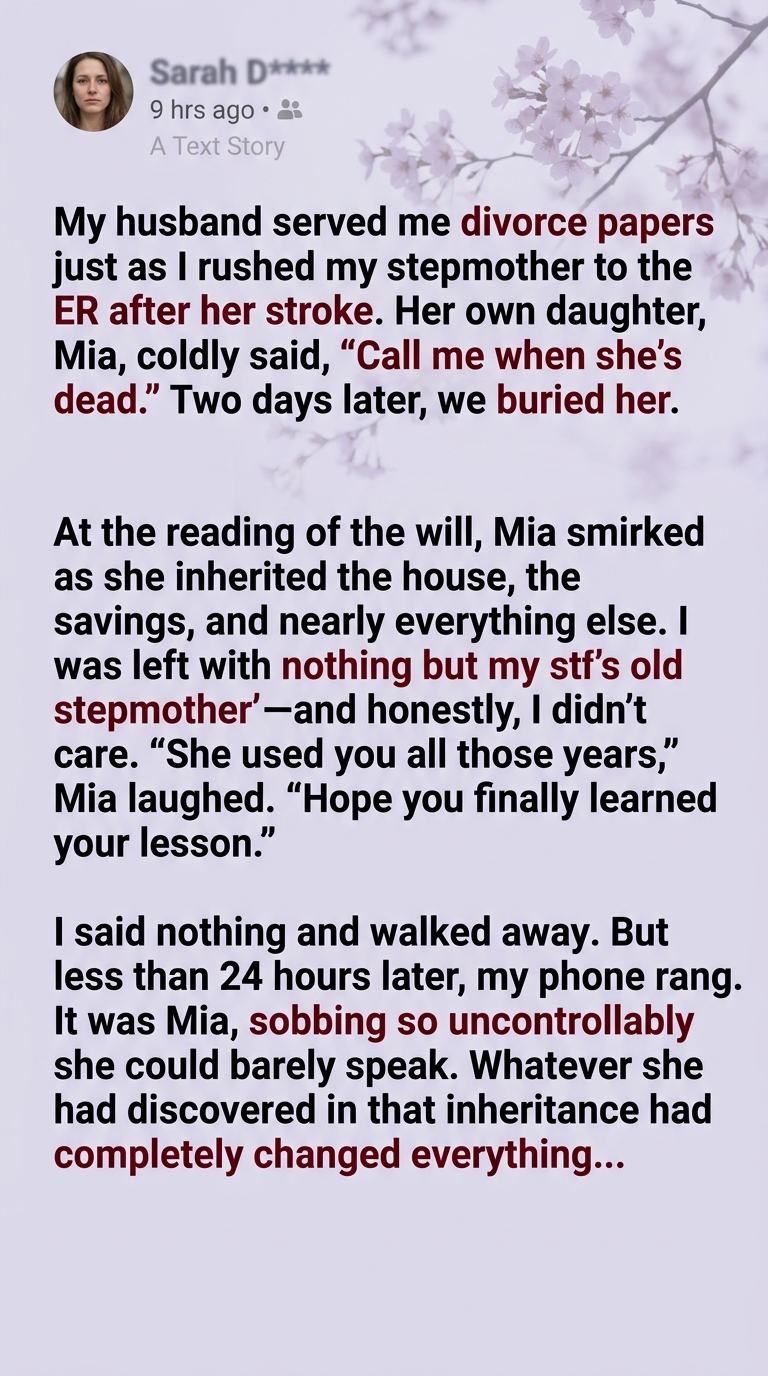
The Inheritance My Stepmother Left Behind
The phone rang at 7:16 the morning after my stepmother’s will was read.
I almost ignored it.
Mia’s name flashed across the screen. My stepsister hadn’t called me once during the two days our mother lay in the hospital. She hadn’t come to the funeral until the last ten minutes, and she had spent the reading of the will smiling like she had just won a lottery.
Now she was calling me.
I answered.
“Claire…” Her voice broke. “Claire, please. You have to come here.”
“What happened?”
She started crying so hard I could barely understand her.
“I opened the box. I found the letters. Oh my God, Claire… What did she do?”
I stood in my kitchen, staring at the twelve houseplants lined along my windowsill. They were the only things my stepmother, Evelyn, had left me.
At least, that was what everyone believed.
To understand why Mia was crying, I have to go back three weeks.
Evelyn had been my stepmother since I was eleven. My father died when I was sixteen, and after that, she became the only parent I had left.
She never tried to replace my mother. She simply showed up.
She attended my school events, helped me apply for college, sat beside me when I was heartbroken, and remembered every birthday even when I was too busy to remember hers.
Mia was her biological daughter. She was five years younger than me and had always believed that being Evelyn’s only biological child meant she deserved more.
When we were younger, I tried to ignore it.
When Mia needed money, Evelyn helped her. When Mia left college, Evelyn paid her rent. When Mia got married and divorced two years later, Evelyn covered the legal bills and gave her a place to stay.
I never complained.
I had a job, a small apartment, and a husband named Daniel. I thought I had built a stable life.
Then Evelyn suffered a stroke.
It happened on a Tuesday afternoon. I was at work when the neighbor called, saying Evelyn had collapsed in her kitchen.
I rushed to her house, found her barely conscious, and called an ambulance.
At the hospital, doctors told me she had suffered a serious stroke. The next several hours would be critical.
I called Mia six times.
She finally answered on the seventh call.
“What?” she said impatiently.
“Mom had a stroke. She’s in the emergency room. You need to come.”
There was a pause.
Then Mia sighed.
“I have a meeting tomorrow.”
“Mia, this is serious.”
“Then let the hospital handle it. You always act like everything is your responsibility.”
I swallowed hard.
“She might not survive.”
Mia’s response was so cold that I still hear it whenever I think about that night.
“Call me when she’s dead.”
Then she hung up.
I sat beside Evelyn’s hospital bed, holding her hand while machines beeped around us.
I didn’t know that my own marriage was about to collapse at the same time.
At 11:42 that night, Daniel sent me a message.
We need to talk. Check your email.
I opened it and found a scanned copy of divorce papers.
He had filed.
No warning. No conversation. No explanation beyond a short message saying he was tired of our marriage and wanted to move on.
I called him.
He declined.
I called again.
He sent one final text.
Please don’t make this harder than it needs to be.
I looked at Evelyn sleeping in the hospital bed and felt something inside me go numb.
Within a few hours, I had lost the marriage I thought I had and was facing the possibility of losing the woman who had raised me.
But I didn’t leave the hospital.
For two days, I slept in a chair, spoke with doctors, signed the necessary medical forms, and helped arrange the next stage of her care.
Evelyn never regained consciousness.
On the second evening, the doctor told me her body was failing.
I held her hand and whispered that she didn’t need to worry about anything anymore.
She died shortly after midnight.
Mia arrived the following morning.
She wore expensive sunglasses and a black dress that still had a store crease down the back. She hugged no one. She asked the funeral director how long the service would take.
At the burial, she cried for the cameras.
I stood beside the grave, holding a small white rose.
I didn’t have the energy to confront her.
Three days later, we met at Evelyn’s attorney’s office for the will reading.
Mia arrived with a new handbag and a confident smile. She sat across from me, tapping her fingernails against the table.
The attorney, Mr. Bennett, opened a folder.
He explained that Evelyn had signed her final will several months earlier, while she was mentally capable and had received independent legal advice.
The house went to Mia.
The savings account went to Mia.
The investment portfolio, the car, the jewelry, and most of the personal property also went to Mia.
I received twelve houseplants, several gardening tools, and a handwritten note.
That was it.
Mia leaned back.
“Well,” she said, “I guess Mom knew who her real daughter was.”
I looked at the attorney.
“Is there anything else?”
Mr. Bennett hesitated.
“There is a sealed envelope, but your mother instructed me to give it to Mia after the distribution documents were acknowledged.”
He handed it to her.
Mia slipped it into her handbag without opening it.
Then she looked at me.
“She used you all those years,” she laughed. “Hope you finally learned your lesson.”
I didn’t respond.
I gathered the small list of plants and left.
Honestly, I didn’t care about the house or the money. Evelyn had given me something far more valuable than an inheritance.
She had given me a home when I needed one.
I took the plants back to my apartment and placed them along the windowsill. I watered each one carefully, remembering how Evelyn used to talk to them while she worked in her garden.
That evening, I received an email from Daniel’s lawyer.
The divorce proceedings were moving forward, and Daniel was requesting that I agree to a financial settlement that would leave him with most of our shared savings.
I stared at the message for a long time.
Then I closed my laptop.
I couldn’t fight every battle in one day.
The next morning, Mia called.
And that brings us back to the beginning.
“Claire, please,” she sobbed. “Come to the house.”
“What did you find?”
“The envelope. There’s another envelope inside it. And a letter. I think… I think Mom knew this was going to happen.”
I drove to Evelyn’s house.
Mia was waiting at the kitchen table. The sealed envelope lay open in front of her, surrounded by several documents.
Her eyes were red. Her makeup was streaked.
“Read it,” she whispered.
The first document was a letter from Evelyn.
It was dated four months before her stroke.
My dear daughters,
If you are reading this together, then I am no longer here to explain myself. I hope you can forgive me for leaving things this way.
I stopped.
Mia pushed the letter toward me.
“Keep reading.”
The letter continued.
Claire, you never asked me for anything. When I needed someone to take me to appointments, you came. When I was frightened, you stayed. You never treated my love as something you were owed.
Mia, I love you just as deeply. But I have spent too many years confusing financial help with love. Every time you were in trouble, I tried to solve it by writing a check. I thought I was protecting you. Instead, I made it easier for you to avoid becoming responsible for your own choices.
I looked at Mia.
She covered her mouth.
The next paragraph explained the inheritance.
Evelyn had intentionally left Mia the house, savings, and investments because she believed her daughter needed to understand what it meant to manage a substantial inheritance.
But the will was only part of the plan.
There was a second document: an agreement Evelyn had arranged with an independent financial institution.
The house and investment assets were subject to a substantial outstanding loan that had been disclosed in the estate paperwork.
Mia had inherited the property, but she had also inherited its financial obligations.
The savings she thought were hers were not all freely available. Some accounts were designated to settle estate expenses and debts.
And the house required significant repairs that Evelyn had postponed because she had been preparing for the possibility that she might need long-term care.
Mia stared at the documents.
“How much?” she whispered.
I read the statement again.
The mortgage, taxes, outstanding property expenses, and other liabilities totaled far more than Mia had expected.
The inheritance was valuable, but it was not the effortless fortune she had imagined.
Then I found the final page.
It was a letter addressed to me.
Claire,
I know you may wonder why I left you only the plants. I want you to understand that this was never a judgment of your worth.
I made a separate arrangement for you.
My hands began to shake.
Attached was a copy of a trust agreement created years earlier.
Evelyn had placed a portion of her investments into an irrevocable trust for my benefit. The trust was managed independently, and its terms allowed distributions for specific needs, including education, housing, and financial hardship.
It had been funded gradually over several years.
The trust was not part of the estate being divided under the will.
It had not been created because of the divorce or the stroke. It had existed long before either event.
The letter explained why.
Your father left me with enough to build a life, and you helped me make that life worth living. I wanted to make sure you had something that could never be taken from you by a bad marriage, a family argument, or anyone’s opinion of what you deserved.
I couldn’t speak.
The trust documents included the name of an independent trustee and instructions for contacting the firm.
There was no dramatic suitcase of cash. No secret fortune waiting in a drawer.
There was something better: a legally established financial arrangement that Evelyn had carefully planned while she was alive.
Mia began crying again.
“She gave you money too?”
I folded the letter.
“She gave me security.”
“But I got the house.”
“Yes.”
“And the savings.”
“Yes.”
“Why would she do this?”
I looked at her.
“Maybe because she knew I would never ask her to prove she loved me.”
Mia lowered her head.
For a while, neither of us spoke.
Then she said something I hadn’t expected.
“I didn’t go to the hospital because I was angry with her.”
I waited.
“She refused to give me more money. We had an argument the week before. I told her she was selfish. I thought if I ignored her, she’d call me and apologize like she always did.”
Her voice cracked.
“But she didn’t call.”
I looked at the letter again.
Evelyn had known about their argument. She had mentioned it in a separate note to Mr. Bennett, explaining that she wanted Mia to receive her inheritance without being rescued from every consequence.
That didn’t mean Evelyn had stopped loving her daughter.
It meant she had finally stopped confusing love with endless financial rescue.
Mia wiped her face.
“I thought you were the favorite.”
“I never thought about it that way.”
“You got the trust. I got the debts.”
“You got the house and the assets. You also got the responsibility that comes with them. You need to talk to the attorney and an independent financial adviser before you make any decisions.”
She stared at me.
“Are you going to help me?”
I looked around the kitchen.
The same kitchen where Evelyn had taught me to bake bread. The same table where she used to sit with us on Sunday mornings.
“I’ll help you understand the paperwork,” I said. “But I won’t take responsibility for choices you make.”
For the first time in years, Mia didn’t argue.
Over the next few weeks, she met with Mr. Bennett and an independent financial adviser. They reviewed the estate, identified the actual liabilities, and worked out what could be kept, sold, or refinanced.
The house wasn’t lost overnight, but Mia had to face the financial reality of owning it. She eventually sold it after determining that maintaining it would put her deeper into debt.
She moved into a smaller apartment and began working full-time.
I didn’t celebrate her difficulties.
I also didn’t rescue her.
Meanwhile, I contacted the trustee named in Evelyn’s documents. The trust was verified, and I received a clear explanation of its terms. It wasn’t an unlimited account, but it gave me a foundation I hadn’t expected to have.
My divorce continued separately.
Daniel had assumed I would panic when he filed. He expected me to accept his proposed settlement because I was exhausted and grieving.
Instead, I hired my own attorney.
We reviewed the finances, documented the shared assets, and negotiated a settlement based on the actual records. It took months, not days, but I walked away with a fair division of what belonged to me.
Daniel never knew about Evelyn’s trust until the divorce was final.
And by then, it didn’t matter.
One Saturday, Mia came to my apartment.
She stood in the doorway holding a small ceramic pot.
“I found this in the greenhouse,” she said. “Mom grew it from a cutting.”
It was a tiny jade plant.
I smiled.
“Where did you find it?”
“Behind the old watering cans. I thought you’d want it.”
I let her inside.
We spent the afternoon repotting the plant and talking about Evelyn. Not the money. Not the will. Just her.
We remembered her terrible singing, her overcooked holiday dinners, and the way she always bought too many flowers for the garden.
Before Mia left, she stopped by the windowsill.
“You know,” she said quietly, “I thought you got nothing.”
I looked at the plants.
“I didn’t.”
She nodded, tears gathering in her eyes.
“I wish I had understood that before.”
I didn’t tell her everything was forgiven. Some things take longer than one apology.
But I handed her a small pot and showed her how to trim the roots.
Because Evelyn had taught me something I finally understood.
An inheritance isn’t always what someone leaves behind in a will.
Sometimes it’s the strength they quietly help you grow while they’re still alive.
And sometimes the greatest thing a parent can leave a child is not a house, a bank account, or a collection of expensive possessions.
It’s the ability to stand on your own when the people you trusted walk away.
I still have all twelve of Evelyn’s houseplants.
Every morning, I water them.
And whenever a new leaf appears, I think of the woman who gave me a home, even when she had nothing left to prove.
Mia inherited the house.
I inherited the lesson.
And in the end, that was worth more than everything written on that will.