The House They Told Me I Didn’t Belong In
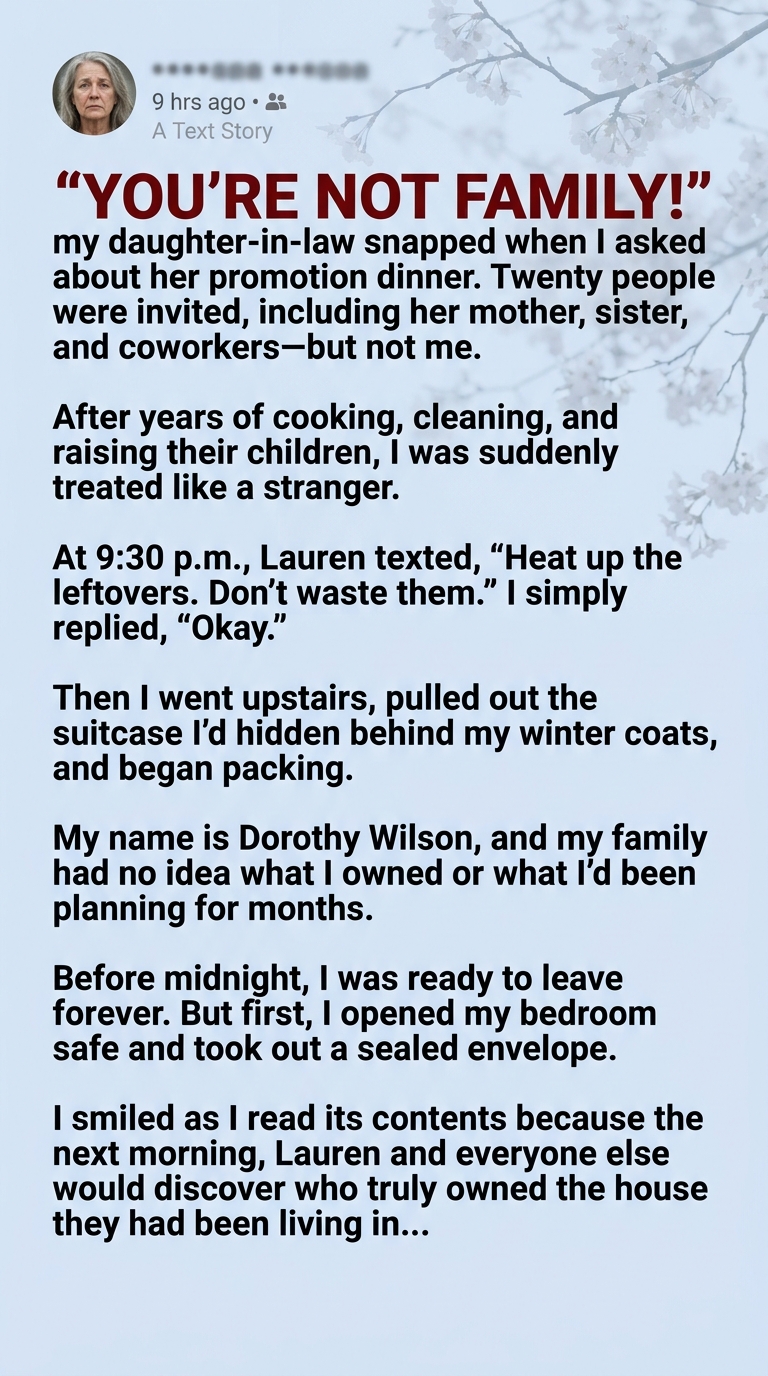
“YOU’RE NOT FAMILY!”
My daughter-in-law shouted those words when I asked why I hadn’t been invited to her promotion dinner.
I stood in the kitchen holding a dish towel, staring at the woman whose children I had raised, whose meals I had cooked, and whose laundry I had folded for nearly seven years.
Lauren didn’t even look embarrassed.
“It’s a work celebration, Dorothy. My mother is coming, my sister is coming, and a few colleagues. It’s not a family event.”
I glanced at the invitation sitting on the counter.
Twenty people were invited.
Her mother. Her sister. Her friends. Her coworkers. Even the neighbor who occasionally watched the children.
But not me.
I nodded slowly.
“All right.”
Lauren rolled her eyes.
“Please don’t make this another thing.”
I said nothing.
At 9:30 that night, while she was still celebrating at the restaurant, my phone buzzed.
It was a text from her.
Heat up the leftovers. Don’t waste them.
I looked at the message for a long moment.
Then I replied:
Okay.
I went upstairs, opened the closet, and pulled out the suitcase I had hidden behind my winter coats.
I began packing.
My name is Dorothy Wilson. I am sixty-nine years old, a widow, a retired school administrator, and the legal owner of the house my son and his wife had been living in for seven years.
They had no idea.
Or perhaps they had simply stopped caring.
Before midnight, I had packed my clothes, my important documents, a few photographs, and the small jewelry box my late husband had given me.
Then I opened the safe in my bedroom.
Inside was a sealed envelope.
I took it out, opened it, and read the document again.
A smile slowly spread across my face.
Because the next morning, Lauren and everyone else would discover something they had never bothered to ask.
They weren’t living in their house.
They were living in mine.
And I had finally decided it was time to go.
But before I tell you what happened the next morning, you need to understand how I became invisible in my own home.
My husband, Frank, and I had been married for forty-two years.
We raised one son, Michael, and spent most of our marriage saving for retirement.
Frank worked as an electrician. I worked in education.
We weren’t rich, but we were careful.
We paid off our mortgage, maintained our savings, and eventually bought a modest second property that we rented for extra income.
When Frank passed away, our son Michael was thirty-four.
He had recently married Lauren, and they had two young children, Sophie and Ethan.
Michael was struggling financially.
He had lost his job during a company restructuring, and Lauren was still working her way up in her corporate career.
They were living in a small apartment that had become too expensive.
One afternoon, Michael came to my house and asked if they could stay with me for a few months.
“Just until we get back on our feet, Mom.”
I agreed.
I loved my son.
I loved my grandchildren.
And I had more space than I needed.
I told them they could stay in the house while they saved money and figured out their next steps.
I didn’t charge them rent.
I paid the property taxes, insurance, and major maintenance costs.
They covered some groceries and their personal expenses when they could.
At the time, I thought we were helping one another.
But a few months became a year.
A year became three.
Then five.
Eventually, Lauren stopped saying they were staying temporarily.
She began referring to the house as “our home.”
At first, I didn’t correct her.
I wanted the children to feel secure.
I wanted Michael to recover financially.
I wanted Lauren to feel welcome.
So I made myself useful.
I cooked dinner.
I drove the children to school.
I cleaned the kitchen.
I helped with homework.
I attended school meetings when Michael was working late.
I folded laundry, prepared lunches, and kept the house running.
When Lauren was promoted to department manager, I watched the children while she attended evening meetings.
When she traveled for work, I handled everything at home.
I never asked for payment.
I thought being part of a family meant helping when you could.
But somewhere along the way, helping became expected.
And expected became demanded.
The first time Lauren insulted me, I ignored it.
She had come home late one evening and found that I had put her expensive cookware in the wrong cabinet.
“Dorothy, how many times do I have to tell you where things go?”
I apologized.
The second time, she complained that I had used the wrong brand of laundry detergent for the children.
The third time, she told me not to invite my sister over without asking her first.
I reminded her that it was my house.
She looked at me coldly.
“It’s our family home now.”
I didn’t argue.
Michael always had an excuse.
“She’s stressed, Mom.”
“She has a lot on her plate.”
“You know how demanding her job is.”
I understood stress.
I had raised a child, worked full-time, cared for my husband, and managed a household.
But I had never treated someone else’s kindness as an unlimited service.
The children were the reason I stayed.
Sophie, who was seven, liked sitting with me in the garden.
Ethan, who was five, still called me Grandma Dot and asked me to read him the same bedtime story over and over.
They made the house feel alive.
I couldn’t imagine leaving them.
Then Lauren received her promotion.
She came home waving the announcement letter.
“I got it!” she shouted.
Michael hugged her.
The children jumped up and down.
I made a special dinner and baked her favorite lemon cake.
Lauren thanked me.
For about ten minutes, I felt included.
Then she began discussing a celebration dinner.
She mentioned the restaurant, the guest list, and the outfit she planned to wear.
I assumed I would be invited.
I was wrong.
The evening before the dinner, I asked whether I should make arrangements to attend.
Lauren looked at me as if I had asked something ridiculous.
“Why?”
“Because it’s your promotion dinner.”
She sighed.
“It’s for my professional circle.”
“Your mother is going.”
“My mother has supported me throughout my career.”
I looked at her.
“So have I.”
Her expression hardened.
“Don’t make this about you.”
I took a breath.
“I was only asking.”
She stepped closer.
“Listen, Dorothy. You’re not family in the way you’re imagining. You’re Michael’s mother. That’s different. This is my celebration.”
The words hurt more than I expected.
I looked toward Michael.
He was standing by the refrigerator, pretending to read something on his phone.
“Michael?”
He looked up.
“Mom, just let it go.”
That was all he said.
Not a defense.
Not an apology.
Just an instruction to stop feeling hurt.
I nodded.
“Of course.”
The following evening, twenty people went to the restaurant.
Lauren’s mother posted photographs online.
There was a picture of Lauren holding a champagne glass beside her manager.
Another showed her sister hugging her.
A third showed the entire table.
I counted the faces.
Twenty.
Then I looked at the empty chair beside me.
At 9:30 p.m., Lauren sent her message.
Heat up the leftovers. Don’t waste them.
I replied:
Okay.
And then I went upstairs.
The suitcase had been hidden for three months.
I hadn’t bought it because I was planning a dramatic escape.
I had bought it because I had finally accepted that I couldn’t continue living the way I was.
Three months earlier, my sister Margaret had visited.
She noticed that I seemed tired.
When she asked what was wrong, I finally told her everything.
I told her about the chores, the insults, the way Lauren spoke to me, and how Michael never intervened.
Margaret listened quietly.
Then she asked one question.
“Dorothy, if this wasn’t your son, would you allow anyone to treat you this way?”
I didn’t answer.
She squeezed my hand.
“You’re allowed to have a life of your own.”
That night, I began researching independent living options.
I found a small apartment near the botanical garden, close enough to visit my grandchildren but far enough away to have my own space.
I also met with an attorney.
I wanted to understand exactly what I could do with my property.
The attorney reviewed the deed, the mortgage records, the estate documents, and the arrangements I had made with Michael when he moved in.
The house had never been transferred to my son.
It was still legally mine.
There was no written agreement giving Michael or Lauren ownership.
They had no lease, and I had never promised them the property.
However, my attorney explained that because they had lived there for years, I couldn’t simply change the locks or put their belongings outside.
If I wanted them to leave, I would need to follow the applicable legal process and give proper notice.
I agreed.
I wasn’t interested in throwing my family onto the street.
I wanted to end the arrangement properly.
My attorney helped me prepare a written notice explaining that I was ending their permission to occupy the house.
He also advised me to make sure the children had stable arrangements and that any discussions about moving out remained calm.
I signed the documents.
Then I placed them in a sealed envelope.
That envelope was the one I took out of my safe on the night of Lauren’s promotion dinner.
It contained the deed, my attorney’s letter, the written notice, and a copy of the timeline for the next steps.
It was not a magic document that could evict someone overnight.
It was the beginning of a decision I had delayed for far too long.
I finished packing around 11:45 p.m.
I walked through the house slowly.
The family photographs were still on the walls.
The children’s drawings were still attached to the refrigerator.
There were shoes by the back door, school bags in the hallway, and a half-finished puzzle on the coffee table.
I stopped outside the children’s bedrooms.
Sophie was asleep with her stuffed rabbit tucked under her arm.
Ethan had kicked off his blanket.
I went inside and covered him.
“I love you, sweetheart,” I whispered.
Then I left.
I had arranged for Margaret to pick me up.
She was waiting outside in her car.
“Are you ready?” she asked.
I looked back at the house.
“Yes.”
We drove to my new apartment.
It was small, bright, and quiet.
There was a balcony overlooking a row of trees.
For the first time in years, I didn’t have to wonder whether someone would complain about what I cooked, where I put something, or whether I had disturbed their evening.
I made myself a cup of tea.
Then I slept.
The next morning, Michael called.
I didn’t answer immediately.
He called again.
Then Lauren.
Then Michael again.
Finally, I picked up.
“Mom, where are you?”
“At my new apartment.”
There was silence.
“What do you mean, your new apartment?”
“I moved.”
“You moved where?”
I gave him the address.
He sounded confused.
“Why would you leave without telling us?”
I took a breath.
“Michael, I have been telling you for months that I was unhappy.”
He sighed.
“Mom, we can talk about that. But the children need you.”
I looked out at the trees.
“They need their parents. They need a grandmother who can love them without being treated like household staff.”
He went quiet.
Then Lauren’s voice came through in the background.
“Tell her to come home. The kids need breakfast.”
I closed my eyes.
There it was.
Not, “Is she okay?”
Not, “Did she arrive safely?”
Just breakfast.
Michael lowered his voice.
“Mom, please don’t do this.”
“I’ve already made my decision.”
Then he asked the question I had been waiting for.
“What about the house?”
I smiled slightly.
“That’s what the envelope is for.”
An hour later, they arrived at my apartment.
Michael looked angry.
Lauren looked furious.
She had dressed carefully, but her face was tight.
“Where is the envelope?” she demanded.
I pointed to the coffee table.
“Read it.”
Michael opened it.
He pulled out the deed first.
Then the attorney’s letter.
Then the written notice.
His expression changed as he read.
“Mom,” he whispered. “You own the house?”
“Yes.”
He looked at me.
“But we thought…”
“You thought what?”
Lauren snatched the deed.
She scanned the first page.
“This can’t be right.”
“It is.”
“Michael told me his father left the house to him.”
I looked at my daughter-in-law.
“Your father-in-law left me the house. We bought it together. It was never transferred to Michael.”
Lauren’s face went pale.
She turned toward my son.
“You told me that house would be ours.”
Michael looked down.
“I thought Mom would eventually give it to us.”
I shook my head.
“You thought. You never asked.”
For years, they had spoken about the house as though ownership were a matter of repetition.
They had referred to it as theirs so often that they had begun believing it.
But the deed had never changed.
I explained that I had decided to move out permanently.
The notice gave them the required time to make arrangements, and my attorney would handle any formal steps that became necessary.
Lauren slammed the papers onto the table.
“You can’t do this to us!”
I looked at her.
“I can decide where I live and what happens to my property, provided I follow the law. That’s exactly what I’m doing.”
“What about the children?”
“I love those children. I will always love them. But I will not stay in a house where I’m treated like an unpaid servant.”
Michael rubbed his face.
“Mom, we don’t have enough money to move right now.”
“I understand. That’s why the notice gives you time.”
Lauren crossed her arms.
“You’re punishing us because you weren’t invited to dinner.”
I stared at her.
“No, Lauren. The dinner was simply the moment I finally stopped making excuses for how you treated me.”
She opened her mouth.
Then closed it.
I continued.
“I spent seven years helping you. I raised your children while you worked. I cooked your meals, cleaned your kitchen, and kept this house running. I did it because I loved you. But you made it clear that you didn’t consider me family.”
Lauren looked away.
“Now you’re discovering that being family doesn’t mean you own my home.”
The next few weeks were difficult.
Michael called several times.
Sometimes he apologized.
Sometimes he complained about the expense of moving.
Lauren sent messages saying I was destroying the children’s stability.
I responded only when necessary.
My attorney handled the formal communication.
We agreed on a reasonable departure date and documented the condition of the property.
I also arranged to spend time with the children separately.
I didn’t want them caught in the middle.
Sophie was confused when she learned I wouldn’t be living with them anymore.
“Did we do something wrong, Grandma Dot?”
I knelt in front of her.
“No, sweetheart. You didn’t do anything wrong.”
“Are you coming back?”
“I’ll visit. And you can visit me too.”
She hugged me tightly.
Ethan gave me a drawing of our old house.
He had written my name above the roof.
I kept it.
The children were not responsible for the adults’ behavior.
I wanted them to know that.
During the moving process, I discovered something else.
Michael had been telling relatives that I had promised to give him the house after Frank died.
He said I had changed my mind because Lauren and I argued.
That wasn’t true.
I had never made such a promise.
I asked my attorney whether I should respond publicly.
He advised me not to turn a property matter into a family argument.
So I sent one message to the relatives who had contacted me.
The house has always been legally mine. I allowed Michael and his family to live there while they got established. I have decided to end that arrangement, and the proper notice has been provided. I will not discuss private legal matters further.
Some relatives apologized.
Others remained silent.
One aunt told me I should be more understanding because Michael was my only son.
I asked her whether she would let her own daughter-in-law tell her she wasn’t family after seven years of helping raise children.
She didn’t answer.
Michael and Lauren eventually moved into a rental property.
It was smaller than my house, and they had to adjust their budget.
They were responsible for their own household expenses, childcare arrangements, and daily routines.
I didn’t celebrate their difficulties.
I simply stopped solving them.
The first few months were lonely.
I missed hearing the children run through the hallway.
I missed Sunday breakfasts.
But I also discovered things about myself I had forgotten.
I joined a gardening group.
I started attending a weekly book club.
I visited Margaret more often.
I began volunteering at a community center that helped retired teachers tutor children.
And I traveled.
Not far at first.
A weekend by the lake.
A few days visiting an old friend.
Then a longer trip I had postponed for years.
I realized that I had spent so much time making life comfortable for everyone else that I had forgotten to make it comfortable for myself.
Six months after I moved out, Michael visited alone.
He looked tired.
We sat on my balcony.
He apologized for not defending me when Lauren said I wasn’t family.
He admitted that he had become comfortable with the arrangement and had stopped noticing how much I did.
“I thought you were happy,” he said.
I looked at him.
“You thought I was useful.”
He lowered his head.
“I didn’t mean that.”
“I know. But that’s how it felt.”
He told me Lauren was under pressure at work and that their finances were tighter than expected.
I listened.
Then he asked whether I would consider letting them return to the house.
I shook my head.
“No.”
He looked disappointed.
“Not even temporarily?”
“Michael, I love you. But I spent seven years living in a house where I didn’t feel respected. I won’t go back to that.”
He nodded slowly.
Then he asked whether he could bring the children over on Sunday.
I smiled.
“Of course.”
That Sunday, Sophie and Ethan came with him.
We baked cookies, planted flowers in pots, and played a board game.
For three hours, I was simply Grandma Dot.
Not the cook.
Not the cleaner.
Not the person expected to prepare dinner.
Just their grandmother.
It was wonderful.
A year later, Lauren received another promotion.
This time, I learned about it through Michael.
He asked whether I would like to attend a small family dinner.
I hesitated.
Then I agreed.
Lauren greeted me politely.
She didn’t apologize in front of everyone, and I didn’t demand that she do so.
But later, while we were alone in the kitchen, she said something I hadn’t expected.
“I didn’t realize how much you were doing until you stopped.”
I looked at her.
She continued.
“I thought because you were retired, you didn’t mind helping.”
“I didn’t mind helping,” I said. “I minded being treated as though I owed it to you.”
She nodded.
“I know.”
It wasn’t a perfect reconciliation.
But it was an honest conversation.
And that was more than we had managed in years.
Today, I still own the house.
I rent it to a family who treats it as a home rather than an entitlement.
Michael and Lauren live independently.
I see my grandchildren regularly, and I never again take responsibility for running another adult’s household.
I have my own apartment, my own routines, and my own plans.
Sometimes I think about that promotion dinner.
Twenty people gathered to celebrate Lauren.
I was excluded from the celebration, then instructed to heat up leftovers as though I were an employee who had been forgotten after her shift.
That night, I could have argued.
I could have begged them to understand how much they had hurt me.
Instead, I packed my suitcase.
The envelope didn’t make me powerful.
The deed didn’t make me valuable.
I had always owned the house, and I had always been valuable.
The difference was that I finally stopped waiting for my family to recognize it.
Lauren once told me I wasn’t family.
She was wrong about one thing.
I was family.
I was the mother who helped her husband when he needed somewhere to live. I was the grandmother who helped raise her children. I was the woman who opened her home and gave them seven years of security.
But I was never their servant.
And I was never required to give up the rest of my life to prove that I loved them.
The house had my name on the deed.
My life had my name on it too.
And this time, I chose to live it.