THE FUNERAL RECORDING
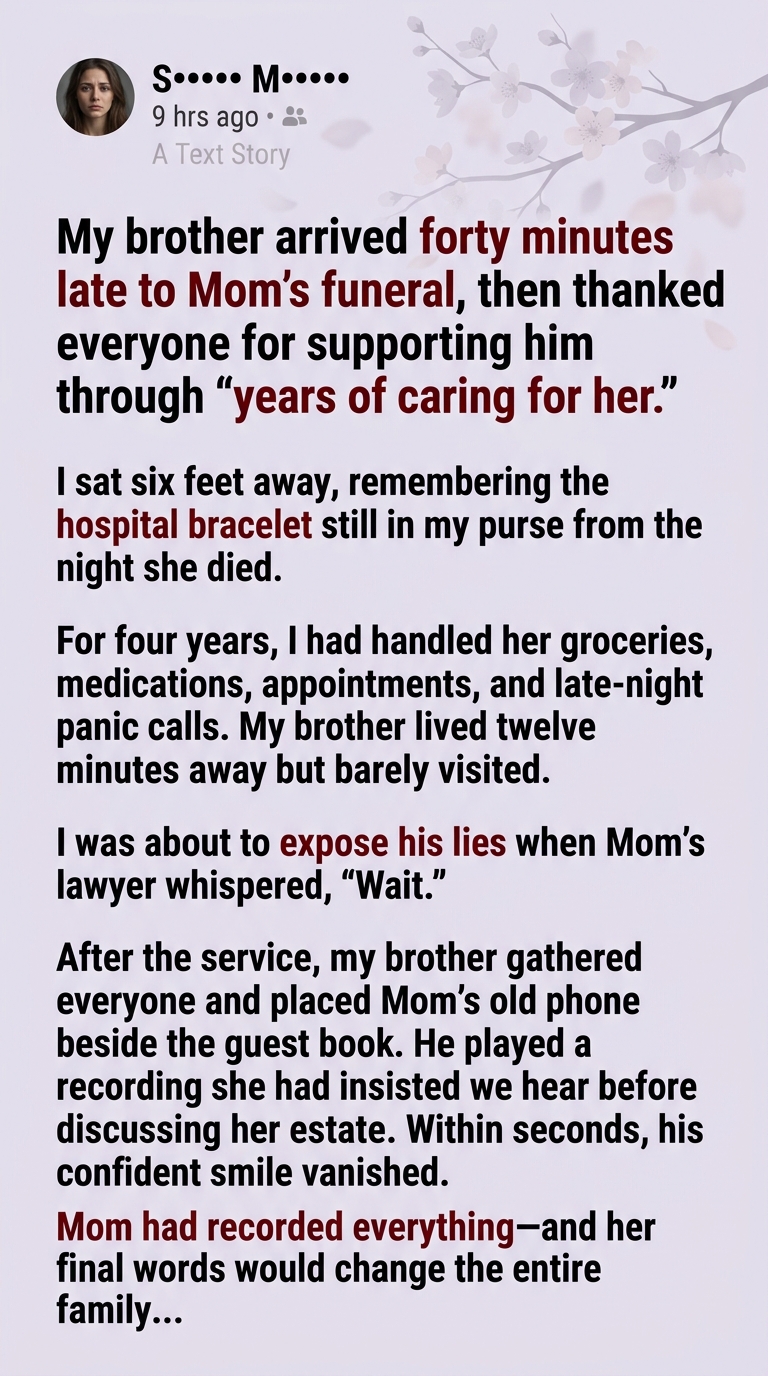
My brother arrived forty minutes late to our mother’s funeral.
He walked into the church wearing an expensive navy suit, holding a bouquet of white lilies, and immediately began shaking hands with relatives as if he were the guest of honor.
“Thank you for coming,” he told people. “It’s been a difficult four years. Caring for Mom really took everything out of me.”
I sat six feet away, staring at him.
Four years.
Four years of groceries, prescriptions, doctor’s appointments, emergency-room visits, sleepless nights, and answering phone calls at 2:00 a.m. when Mom couldn’t breathe properly and was terrified to be alone.
My brother Daniel lived twelve minutes from her house.
I lived forty minutes away.
Yet I was the one who came every Tuesday, Thursday, Saturday, and whenever she called.
Daniel visited occasionally, usually staying long enough to take a photograph, bring a pastry, or tell Mom he had a busy week.
And now, standing beside her casket, he was telling everyone he had been her primary caregiver.
My aunt leaned toward me.
“Your brother must have had such a difficult time. You know, caring for an elderly parent can be exhausting.”
I almost laughed.
Instead, I looked down at my hands.
I still had Mom’s hospital bracelet in my purse. I’d forgotten to take it out after the night she died. The plastic band had her name, birth date, and admission number printed across it.
I had been holding her hand when she took her final breath.
Daniel hadn’t even answered my first three calls that night.
When he finally called back, he asked whether the hospital had contacted the funeral home yet.
I wanted to stand up and tell everyone what he had actually done.
I wanted to explain that I had used my vacation days to take Mom to appointments. That I had paid for groceries when her pension ran short. That I had spent countless nights sleeping in a chair beside her bed because she was afraid of falling.
But before I could move, Mom’s attorney, Mr. Collins, gently touched my arm.
“Wait,” he whispered.
I looked at him.
“Not yet.”
I didn’t understand.
After the service, Daniel gathered the family in the reception room.
He stood beside the guest book, looking emotional.
“I know Mom would want us to stay together,” he began. “She was always worried about family. Before she passed, she told me she wanted me to make sure everything was handled properly.”
He reached into a leather bag and pulled out Mom’s old cellphone.
“This was the last phone she used. There’s something she wanted us to hear before we discuss the estate.”
My stomach tightened.
Mr. Collins stood quietly near the doorway.
Daniel connected the phone to a small speaker.
Then he pressed play.
Mom’s voice filled the room.
It was weak, but unmistakably hers.
“If everyone is listening to this, then I’m gone. And I know Daniel will probably be the one holding my phone because he always liked being the one to explain things.”
A few relatives smiled.
Daniel smiled, too.
Then Mom continued.
“There’s something I need to say while I still have the courage to say it clearly. I don’t want my children arguing over what happened during the last four years of my life. I know some things have been said that aren’t true, and I don’t want my daughter to keep quiet just because she doesn’t like conflict.”
My heart began pounding.
Daniel’s smile faded slightly.
Mom continued.
“My daughter, Claire, was the person who cared for me when I was frightened, sick, confused, or simply lonely. She came when I called. She took me to my appointments. She made sure I had food, my medications, clean clothes, and someone to talk to when the house felt too quiet.”
I covered my mouth.
“Daniel visited me, and I was happy to see him. But visiting isn’t the same as caring for someone every day. I don’t want him taking credit for things he didn’t do.”
The room became completely silent.
Daniel shifted his weight.
Mom’s voice grew more serious.
“Last year, Daniel asked me to tell people that he had been managing my care because he was worried what the family would think about him. He told me he was afraid people would say he was selfish. I refused. I won’t lie about my own life to protect someone else’s reputation.”
My brother reached toward the speaker.
“That’s enough,” he said.
But Mr. Collins stepped forward.
“Your mother specifically instructed me to ensure the entire recording was played.”
Daniel froze.
The recording continued.
“There’s also something about my finances that needs to be understood. Daniel helped me with some paperwork, but I never gave him permission to use my money for his own expenses. I noticed withdrawals that I didn’t recognize. I asked him about them, and he told me not to worry.”
I felt my blood run cold.
Mom had never told me about suspicious withdrawals.
“I asked Mr. Collins to review my accounts. I don’t know what the final answer will be, and I don’t want anyone accused without proof. But I want the records examined before anything is distributed. I want my daughter protected from being blamed for things she never did.”
Daniel’s face had gone pale.
Then Mom said the words that made the entire room turn toward him.
“Claire, I know you never asked me for anything. You never complained about the time you spent helping me. You never made me feel like I was a burden. I want you to know that I noticed. Every single time you came through my door, I noticed.”
Her voice trembled.
“I wish I could have told you more often how grateful I was.”
There was a pause.
Then the recording ended.
Nobody spoke.
Daniel tried to laugh.
“Mom was confused near the end. This doesn’t mean what you think it means. I was helping with her bills. Those withdrawals were probably reimbursements.”
Mr. Collins opened a folder.
“That’s why the accounts are being reviewed. Your mother requested a complete accounting. No one is making a final accusation today.”
Daniel turned toward me.
“You knew about this?”
I shook my head.
“No. I didn’t.”
For the first time in years, he didn’t have an answer ready.
THE TRUTH BEHIND THE WITHDRAWALS
Three weeks later, Mr. Collins called us to his office.
He had reviewed Mom’s bank statements, receipts, and the records Daniel had access to.
The withdrawals totaled $38,420 over approximately twenty months.
Some transactions were legitimate. Daniel had purchased a few household items for Mom, paid a utility bill, and covered a repair that he had been reimbursed for.
But the majority of the money had gone toward Daniel’s personal expenses.
Credit-card payments.
A weekend hotel stay.
A new television.
Several transfers to his own account.
Daniel had used Mom’s debit card and online banking access while telling her he was simply helping manage her finances.
When she questioned him, he had called the money temporary borrowing.
But he had never repaid it.
Mr. Collins explained that the estate could pursue repayment, and the family would need to decide whether to handle it through a formal claim.
Daniel immediately became defensive.
“She told me I could use it! I was having financial problems. I was going to put it back!”
Mr. Collins calmly replied, “Your mother documented that she did not authorize these personal expenses. We also have messages in which you acknowledged the money was borrowed and promised repayment.”
Daniel looked at me.
“You’re really going to do this? You’re going to take your own brother to court?”
I thought about the countless nights Mom had called me because she was scared.
I thought about the medication I had picked up in the rain.
I thought about the groceries I had paid for when she couldn’t afford everything that month.
And I thought about how Daniel had stood beside her casket, telling people he had sacrificed four years of his life.
“I didn’t do this,” I said quietly. “Mom did. She asked for the truth to be documented. I’m not going to pretend those withdrawals didn’t happen just to make you comfortable.”
The attorney recommended that Daniel repay the documented amount through a written settlement agreement rather than immediately litigating, provided the terms were enforceable and the estate’s interests were protected.
Daniel’s attorney reviewed the proposal.
After several weeks, Daniel agreed to repay the money through monthly installments, with the agreement properly documented.
The estate was distributed according to Mom’s will.
She had left her savings and home to be divided equally between us, with a modest additional amount set aside to reimburse expenses I had personally paid for her care, supported by receipts.
It wasn’t a fortune.
But it was fair.
THE LAST THING MOM LEFT ME
A month after everything was settled, I returned to Mom’s house to collect the last of her belongings.
Her kitchen still smelled faintly of the lavender soap she always used.
I found her old sweater hanging behind the bedroom door.
Her reading glasses were on the nightstand.
And beside the bed was a little notebook where she used to write down things she didn’t want to forget.
I opened it.
Most of the pages contained grocery lists, medication reminders, and phone numbers.
But on the last page, she had written something in shaky handwriting.
Claire came today. She fixed the curtain, made my soup, and sat with me even though she was tired. I wish I could give her those years back. I hope she knows that being loved by her has made my life less frightening.
I sat on the bed and cried.
Not because Daniel had been exposed.
Not because the money had been recovered.
But because my mother had seen me.
All those ordinary days I thought were disappearing into the routine of caregiving had mattered to her.
The errands.
The appointments.
The conversations.
The nights I stayed when I wanted to go home.
She had noticed.
I took the notebook home and placed it beside her hospital bracelet.
I never posted the recording online. I never shared it with people to humiliate my brother. Mom had made it for her family, and I wanted to respect that.
Daniel and I barely speak now.
He sent an apology months later. It wasn’t perfect, and it didn’t erase what happened. But I accepted it without pretending we could return to the relationship we had before.
I learned something at Mom’s funeral.
People can tell stories about themselves.
They can claim sacrifices they never made.
They can arrive late and speak loudly enough that others believe them.
But the truth doesn’t always need someone to shout.
Sometimes the truth is waiting on an old cellphone, recorded by a woman who knew her children well enough to understand what might happen after she was gone.
And sometimes, the person who quietly did everything is finally heard—not because they demanded recognition, but because the person they loved made sure the truth would have a voice.
Mom’s voice was gone from our house.
But she had left behind something stronger than silence.
She had left the truth.