My Granddaughter Asked Why Grandpa Talked to Grandma Like an Employee—Then I Discovered They Planned to Put Me in Senior Housing
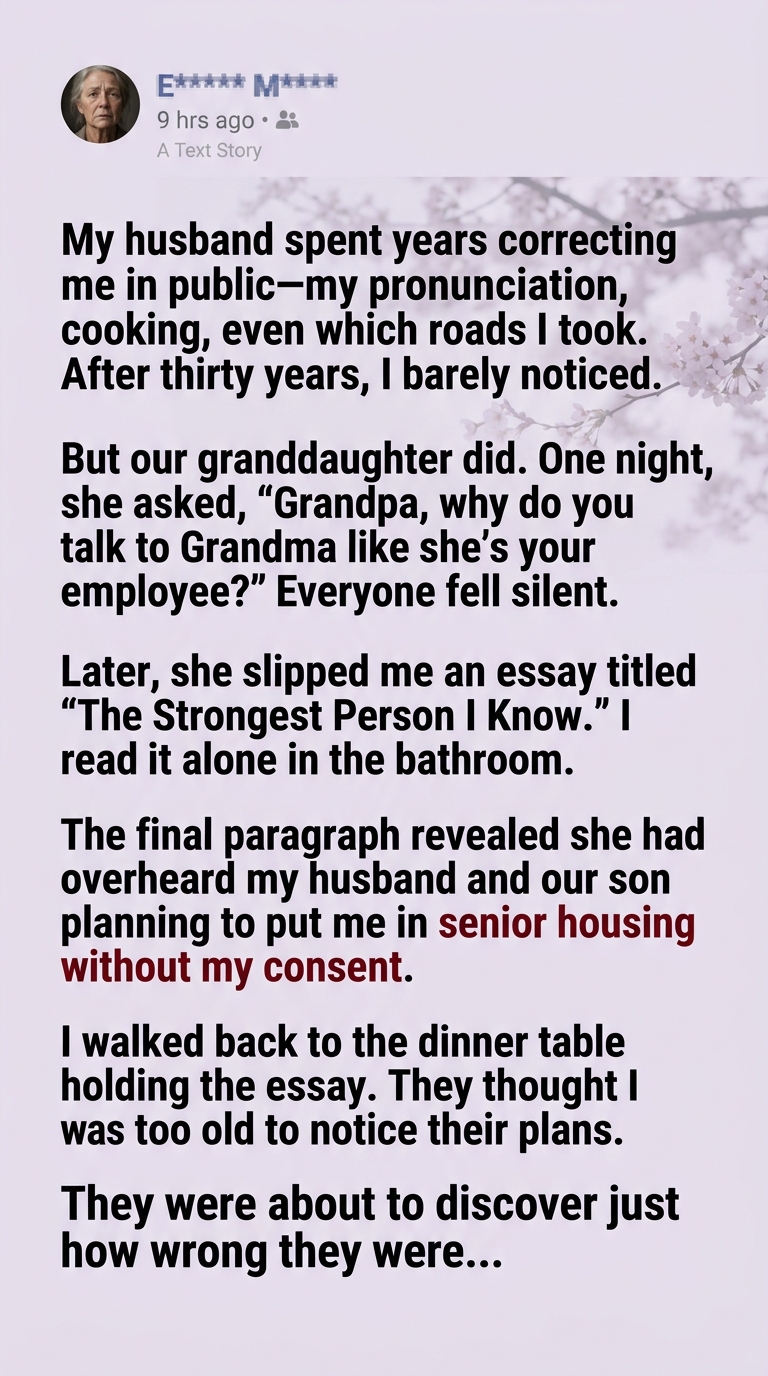
For thirty years, my husband corrected me in public.
If I mispronounced a word at dinner, he would repeat it slowly, exaggerating every syllable until everyone understood what I had supposedly done wrong.
If I cooked something he didn’t like, he would push his plate away and say, “Did you even follow the recipe?”
If I drove somewhere, he would criticize the route before we reached the first intersection.
“Wrong road.”
“You should have turned back there.”
“Why don’t you listen when I tell you something?”
At first, I argued.
Then I apologized.
Eventually, I stopped responding.
After thirty years of marriage, I had become so accustomed to his corrections that I barely noticed them anymore. I simply adjusted my words, changed my recipes, took different roads, and tried to avoid giving him another reason to criticize me.
My name is Eleanor. I was sixty-eight years old, and I had spent so much time trying to keep peace in my marriage that I hadn’t realized how much of myself I had quietly surrendered.
My husband, Frank, was seventy-one. He was a retired bank manager who still spoke as if everyone around him needed financial supervision.
Our son, David, was forty-two and lived twenty minutes away. He visited occasionally, usually bringing his wife and daughter, Lily, who was twelve.
Lily was the only person in our family who seemed to notice how Frank spoke to me.
One Sunday evening, we were all sitting around the dinner table. I had made roasted chicken, potatoes, and a salad. Frank was explaining something about the neighborhood association when I mentioned that a new grocery store had opened near the highway.
I pronounced the name incorrectly.
Frank interrupted immediately.
“No, Eleanor. That’s not how you say it.”
He repeated the name three times, slowly, while David smiled awkwardly.
Then Frank added, “You’d think after living here this long, she’d learn how to pronounce things properly.”
Everyone continued eating.
I lowered my eyes and reached for my water.
Lily suddenly put down her fork.
“Grandpa?”
Frank looked at her.
“What?”
She frowned.
“Why do you talk to Grandma like she’s your employee?”
The room went silent.
David stopped chewing.
My daughter-in-law looked at her plate.
Frank laughed nervously.
“What are you talking about?”
Lily didn’t laugh.
“You correct everything she says. Even when she’s just telling us something. You make her feel stupid.”
Frank leaned back.
“I’m helping her.”
Lily shook her head.
“No, you’re not. You’re embarrassing her.”
I felt my face burning.
“Lily, sweetheart, it’s okay.”
But she looked at me.
“Grandma, it isn’t okay.”
For the first time in years, someone said what I had been thinking without asking me to pretend otherwise.
Frank changed the subject.
David told Lily she shouldn’t speak to her grandfather that way.
Dinner continued, but something had shifted.
I couldn’t stop thinking about her question.
Why do you talk to Grandma like she’s your employee?
That night, Lily came to my bedroom.
She was holding a folded piece of paper.
“Grandma, I wrote something for school. It’s called ‘The Strongest Person I Know.’ I want you to read it.”
I smiled.
“Of course.”
She handed it to me and hugged me before leaving.
I unfolded the paper.
The first few paragraphs were about how I made her pancakes, helped her with homework, and stayed awake when she was sick.
Then she wrote:
My grandma is the strongest person I know because she never makes people feel small. She always says thank you, even when someone doesn’t deserve it. She always apologizes, even when she didn’t do anything wrong.
My throat tightened.
I continued reading.
Sometimes Grandpa makes fun of her. He tells her she says things wrong and that she doesn’t know how to do things. Grandma laughs, but I can tell she isn’t happy. I think she laughs because she doesn’t want everyone to fight.
I sat down on the edge of the bed.
Then I reached the final paragraph.
Last Thursday, I was getting water when I heard Grandpa talking to Dad in the study. They didn’t know I was there. Grandpa said Grandma was getting older and that she was becoming difficult to manage. Dad said he had found a senior apartment and that they could get her to agree if they told her it was temporary. Grandpa said they should do it before she started asking questions about the house and the money. Dad said he would handle the paperwork. I don’t know if Grandma knows. I think she deserves to know because she is the strongest person I know, and strong people should get to make their own decisions.
I read that paragraph twice.
Then a third time.
My hands began shaking.
I locked the bathroom door, sat on the closed toilet lid, and cried quietly.
They were planning to put me in senior housing.
Not because I needed care.
Not because a doctor had recommended it.
Not because I was unable to live independently.
Because they had decided I was becoming inconvenient.
And they planned to convince me it was my idea.
I had spent thirty years being corrected, dismissed, and told I wasn’t capable of making the right decisions.
Now they were planning to make one of the biggest decisions of my life without even asking me.
I wiped my face.
Then I read Lily’s essay one more time.
The last sentence stayed with me.
Strong people should get to make their own decisions.
I folded the essay carefully and walked downstairs.
Frank was sitting at the dining table with David.
They were talking about paperwork.
I stood in the doorway holding Lily’s essay.
“What’s this about senior housing?”
Both men looked up.
Frank frowned.
“Where did you hear that?”
I placed the essay on the table.
“From the strongest person in this family.”
David’s face went pale.
Frank picked up the paper and read the final paragraph.
Then he put it down.
“Eleanor, this is being taken out of context.”
I pulled out a chair and sat down.
“Then explain the context.”
David started speaking.
“Mom, Dad and I were just discussing possibilities. We thought it might be easier for you—”
“Easier for whom?”
He stopped.
Frank sighed.
“You’ve been struggling lately.”
I looked at him.
“Struggling with what?”
He began listing things.
I occasionally forgot where I put my glasses.
I had once taken the wrong road home.
I had asked him to repeat something during a conversation.
I had been tired after gardening.
I stared at him.
“You’ve been collecting my mistakes?”
Frank looked annoyed.
“Don’t be dramatic.”
I turned to David.
“Did you find a senior apartment?”
He hesitated.
That hesitation told me everything.
“Did you?”
“Yes,” he admitted. “I looked at a few places. I thought we could discuss it with you.”
“After you had already decided?”
“No, Mom. We hadn’t decided anything.”
I unfolded Lily’s essay.
“Your daughter heard you discussing how to get me to agree to something before I started asking questions about the house and the money.”
David looked down.
Frank’s face turned red.
“Children misunderstand conversations.”
“Then why did neither of you mention it to me?”
Silence.
I had spent years asking questions and receiving explanations.
This time, I wasn’t interested in excuses.
I stood up.
“Neither of you will make decisions about where I live, what I own, or how I spend my money without my consent.”
Frank laughed.
“Eleanor, you’re making this sound like some kind of conspiracy.”
I looked at him.
“Then you should have no problem explaining everything to me.”
I picked up Lily’s essay.
“I’m going to speak with an attorney tomorrow.”
David stood up.
“Mom, don’t make this bigger than it is.”
I turned toward him.
“You and your father already made it bigger than it was when you decided I was too old to have a say in my own life.”
For the first time, neither of them corrected me.
And I walked out of the room.