MY MOTHER-IN-LAW EXCLUDED ME FROM THE FAMILY REUNION—THEN I DISCOVERED THEY HAD BEEN USING A CREDIT CARD IN MY NAME
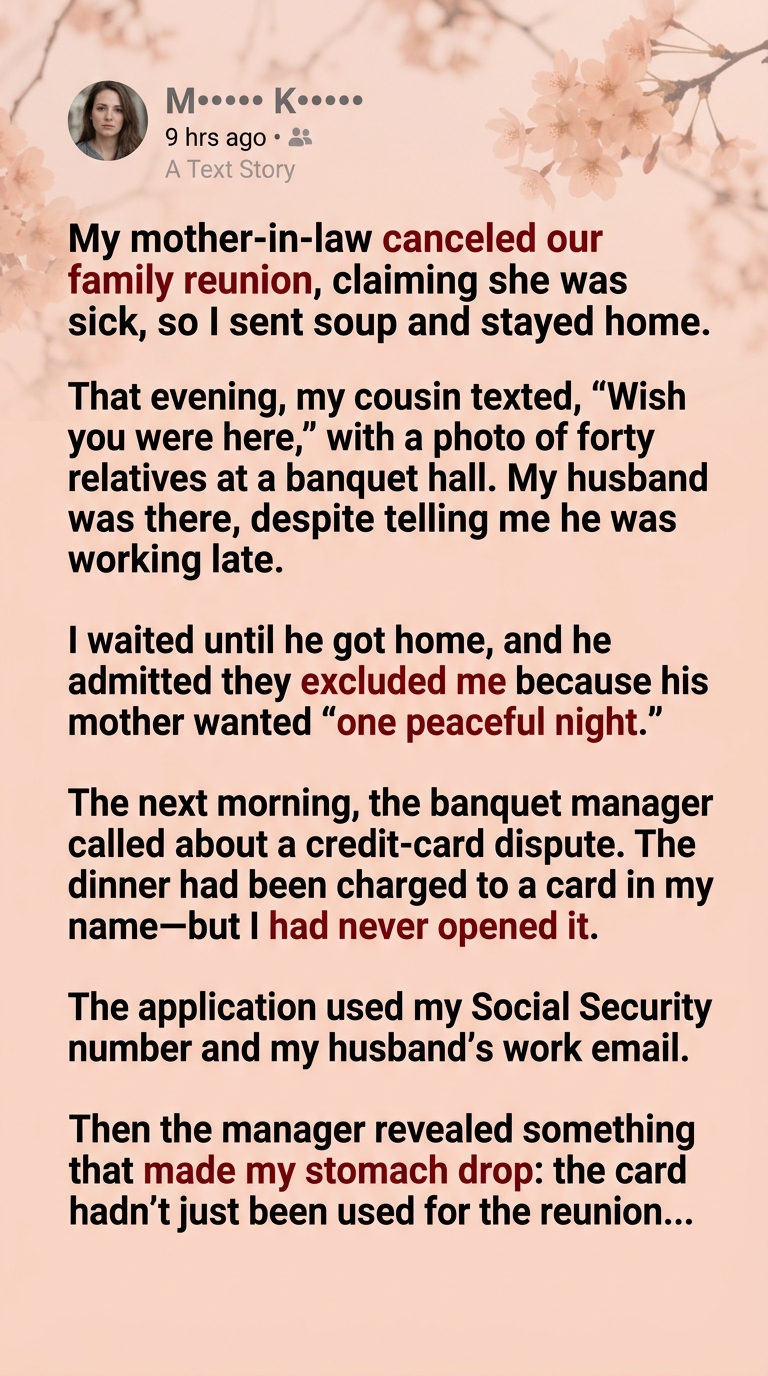
My mother-in-law canceled our family reunion, claiming she was sick.
She called me on Thursday, sounding weak and exhausted.
“Oh, sweetheart,” she said, “I don’t think I can manage the reunion this weekend. I’m terribly ill. We should just cancel everything.”
I felt bad for her.
I offered to bring groceries, medicine, and soup, but she insisted she needed rest.
“Just stay home and relax,” she told me. “We’ll reschedule when I’m feeling better.”
So I stayed home.
I made soup, watched television, and spent the evening folding laundry while my husband, Mark, told me he was working late.
At 8:43 p.m., my phone buzzed.
It was a message from my cousin.
“Wish you were here!”
Attached was a photograph of forty relatives gathered around a beautifully decorated banquet hall.
There was my mother-in-law, Evelyn, standing in the center with a champagne glass.
And there was Mark.
He was standing beside his brother, smiling, wearing the same shirt he’d told me he was wearing to work.
I stared at the photograph for nearly a minute.
Then I zoomed in.
Everyone was there.
My aunts, cousins, uncles, nieces, nephews.
Everyone except me.
I didn’t call anyone.
I didn’t send an angry message.
I simply waited.
Mark came home at 11:17 p.m.
He smelled like restaurant food and had a small gift bag in his hand.
“How was work?” I asked.
“Exhausting.”
I turned my phone toward him.
“Then why were you at the family reunion?”
His face changed immediately.
He looked at the photograph, then at me.
“Who sent you that?”
“That doesn’t matter. Why did you lie?”
He sat down.
After several minutes, he admitted the truth.
Evelyn had organized the reunion but specifically asked that I not be invited.
She told everyone she wanted “one peaceful night.”
Apparently, she believed I was too outspoken about family finances, too involved in decisions, and too willing to question things she thought should remain private.
Mark said he didn’t want an argument with his mother.
So he went without me.
He told me he was sorry.
But somehow, his apology felt worse than the lie.
“Did you know she told me she was sick?”
He looked down.
“Yes.”
I walked away without saying another word.
The next morning, at 9:12 a.m., my phone rang.
It was the banquet manager.
“Good morning, ma’am. I’m calling regarding the payment for last night’s family event. We have a dispute on the credit card used for the reservation, and we need to verify some information.”
I was confused.
“What credit card?”
He gave me the last four digits.
I didn’t recognize them.
Then he mentioned the name on the account.
Mine.
I felt my stomach tighten.
“I don’t have a credit card with those numbers.”
He paused.
“Ma’am, the account was opened in your name. We have a copy of the payment authorization.”
I asked him to send me the details.
Within minutes, an email arrived.
The credit-card application had my full name, my Social Security number, my date of birth, and my home address.
The email address listed as the account contact was Mark’s work email.
I had never applied for the card.
I had never signed an authorization.
And I had never given permission for anyone to use my identity to open an account.
I called the bank immediately.
The representative confirmed the account had been opened five months earlier.
The current balance was $18,640.
The banquet wasn’t the only charge.
There were hotel bills, restaurant purchases, catering deposits, furniture purchases, and several charges at a luxury department store.
The total amount of transactions was nearly $31,000.
I was shaking.
I asked for copies of the application and transaction history.
The bank opened a fraud investigation and instructed me to secure my credit reports, place fraud alerts, and document every unauthorized charge.
Then the banquet manager called me back.
“I found something else,” he said.
“What?”
“The card was used to pay the deposit for the reunion, but it was also used to pay for another event we hosted three months ago.”
I asked which event.
He read the name from his records.
Evelyn’s seventieth birthday celebration.
I remembered that party.
Mark had told me his mother paid for it herself.
I remembered bringing her a gift, congratulating her, and listening to her talk about how expensive the event had been.
Apparently, she had paid for it using a credit card opened in my name.
I sat down.
The reunion wasn’t simply a family event I had been excluded from.
It was another expense charged to an account I didn’t even know existed.
I called Mark.
He didn’t answer.
I sent him a message:
We need to talk about the credit card opened in my name.
He called me within thirty seconds.
“Please don’t panic,” he said.
That was the first thing he said.
Not, “What credit card?”
Not, “Someone stole your identity?”
Just, “Please don’t panic.”
I asked him whether he had opened it.
Silence.
Then he said, “I did.”
I felt something inside me go completely still.
He admitted he had used my information to apply for the card because his own credit utilization was too high. He said he intended to pay the balance every month but had fallen behind.
Evelyn knew about the card.
She knew it was in my name.
She knew I hadn’t approved it.
And she had been using it for family expenses because Mark told her it was “our family account.”
“Why would you do this?” I asked.
“Because I thought I could handle it.”
“You used my Social Security number.”
“I was going to tell you.”
“When?”
He didn’t answer.
I asked him about the reunion.
He admitted the banquet had been charged to the card because Evelyn had told him to use it.
He had gone to the reunion knowing I was excluded, knowing the card was in my name, and knowing I would be the one receiving the bill.
“Your mother told you I wasn’t invited,” I said.
“Yes.”
“And you still paid for her party with my card?”
He began crying.
“She said it was important to keep the family together.”
I laughed, but there was nothing funny about it.
“She kept forty people together by excluding me and using my identity to pay for their dinner.”
He had no answer.
I told him I had already contacted the bank.
The account was being investigated as identity theft, and I would not agree to take responsibility for charges I had never authorized.
I also told him not to use my information again.
That afternoon, Evelyn called.
She was furious.
“How could you dispute the reunion charge? Those people were family!”
“I didn’t authorize the card.”
“Mark told me it was a family account.”
“Mark didn’t have permission to open a credit card in my name.”
She began shouting.
“You’re making this into a criminal matter over a dinner!”
“No. You and Mark made it a financial matter when you used my identity.”
She told me I was selfish, vindictive, and ruining the family.
I ended the call.
Over the next several days, I gathered everything.
The credit-card application.
The transaction history.
The banquet invoices.
The text messages.
The emails.
I saved every document and followed the bank’s instructions.
I also contacted an attorney to understand my options and protect myself from further unauthorized financial activity.
Mark moved into the guest room.
He kept asking me to “work this out privately.”
I told him I wasn’t interested in protecting anyone’s reputation at the expense of my financial security.
The bank’s investigation eventually confirmed that I had not opened the account or authorized its use.
The disputed charges were handled through the bank’s fraud process, and the account was restricted while the investigation continued.
Mark was required to cooperate with the investigation and provide information about the application and purchases.
Evelyn stopped calling.
The family reunion photographs disappeared from her social media page.
But the consequences didn’t disappear with them.
Mark and I began meeting with a counselor, though I made it clear that counseling wasn’t a promise to stay married.
I needed to understand whether I could ever trust someone who had used my identity, lied to me for months, and then attended a dinner where I was deliberately excluded.
Eventually, I discovered that the credit card wasn’t the only thing he had hidden.
He had also been using money from our joint savings to cover payments on the account, without telling me why our balance kept dropping.
I separated our finances and consulted my attorney about the next steps.
The marriage didn’t end that week.
But it changed that week.
I stopped covering for Mark.
I stopped making excuses for Evelyn.
And I stopped pretending that being a good wife meant accepting whatever his family decided was convenient.
Months later, my cousin sent me another photograph from a family gathering.
This time, the caption read:
“Everyone’s here!”
I looked at the photo.
I wasn’t there.
And for the first time, I didn’t feel the need to ask why.
I had my own plans that weekend.
I was rebuilding my savings, protecting my identity, and deciding what kind of life I wanted to live.
The reunion had taught me something I never expected.
Being excluded from a family dinner hurt.
But discovering that the people who excluded you had also used your identity to pay for it was something else entirely.
The banquet manager’s phone call was the moment I realized I wasn’t just dealing with a cruel mother-in-law or a dishonest husband.
I was dealing with people who had mistaken my silence for permission.
And they would never make that mistake again.