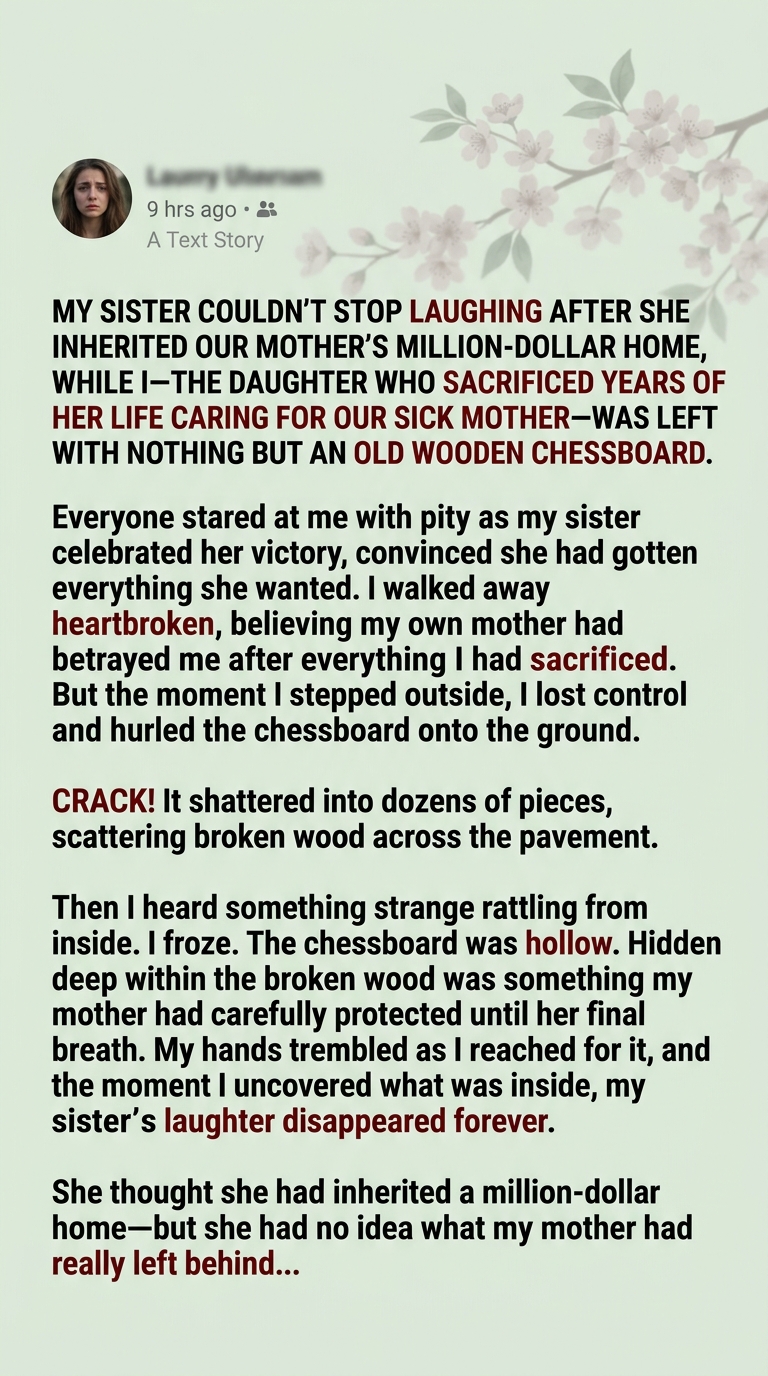
MY SISTER INHERITED OUR MOTHER’S MILLION-DOLLAR HOME—BUT THE CHESSBOARD I DESTROYED REVEALED THE SECRET THAT CHANGED EVERYTHING
Chapter 1: The Inheritance That Broke My Heart
The lawyer barely finished reading the will before my sister Vanessa burst into laughter.
“The house is mine?” she asked, leaning forward as though she needed to hear it twice. “The entire house?”
“Yes,” Mr. Collins replied calmly. “Your mother left the property, including the residence and surrounding land, to you.”
Vanessa covered her mouth, but her laughter kept escaping.
The estate was worth more than a million dollars. A beautiful home with six bedrooms, a landscaped garden, an old fountain, and enough land to make it one of the most valuable properties in our town.
And I received nothing.
Not a dollar.
Not a piece of jewelry.
Not even the family photographs my mother kept in her bedroom.
Instead, the lawyer slid a dusty wooden chessboard across the table toward me.
“Your mother specifically requested that this be given to Rebecca.”
I stared at it.
The board was old, scratched, and missing a small piece of wood along one corner. It was the same chessboard my father had made decades ago, back when our family still sat together on Sunday afternoons.
Vanessa burst into another fit of laughter.
“Oh my God, Rebecca. That’s perfect. You get the chessboard.”
She wiped a tear from her eye.
“Mom knew you liked taking care of things. So she gave you something you can take care of for the rest of your life.”
Nobody laughed loudly, but a few relatives smiled awkwardly.
I felt my face burn.
For six years, I had been the one caring for our mother.
When she became sick, I moved into her house. I quit a job I loved because she couldn’t be left alone. I learned how to manage her medication, prepare meals she could swallow, bathe her when she couldn’t stand, and sit beside her during nights when pain kept her awake.
I knew the sound of every machine in her room.
I knew which medication made her nauseous.
I knew how to calm her when she woke up frightened and confused.
Vanessa visited when she had time.
Sometimes she brought flowers. Sometimes she stayed for twenty minutes, took a few pictures, and left because she had dinner plans.
I never complained.
I believed that when our mother was gone, at least she would know who had stood beside her.
But sitting in that lawyer’s office, I realized how foolish I had been.
My mother had rewarded the daughter who barely showed up.
And punished the daughter who never left.
I picked up the chessboard.
“Thank you,” I whispered, though I didn’t know who I was thanking.
Vanessa smiled.
“Don’t worry, I’ll let you visit the house. Maybe you can play chess in the garden whenever you want.”
That was when I finally stood up.
I couldn’t breathe in that room anymore.
Chapter 2: The Board That Meant Nothing
I walked out of the lawyer’s office holding the chessboard against my chest.
The afternoon sun was bright, but everything around me felt gray.
I reached the parking lot and stopped beside my car.
Six years.
Six years of missed birthdays.
Six years of sleeping in a chair beside my mother’s bed.
Six years of watching friends move forward with their lives while mine became a calendar filled with doctor’s appointments and prescriptions.
I remembered my mother gripping my hand during her final weeks.
“Rebecca, don’t leave me.”
“I won’t, Mom.”
And I hadn’t.
Not once.
Now I was standing outside with an old chessboard while Vanessa was already talking on her phone about renovating the house.
“I’m going to turn the upstairs bedroom into a walk-in closet,” she said loudly. “And the garden? I want a pool.”
I heard her laughing behind me.
Something inside me snapped.
I looked down at the chessboard.
I remembered my father making it. I remembered him teaching me how to move the pieces. I remembered my mother sitting across from him, pretending she didn’t know how to play so he could win.
But now it was just another reminder of everything I had lost.
I raised the board.
And threw it against the pavement.
CRACK!
The sound was so loud that a man walking nearby turned around.
The wooden board broke into pieces. Small splinters scattered across the ground. One of the drawers came loose, and the chess pieces rolled into the parking lot.
“That’s it!” I shouted through my tears. “That’s all I was worth to her?”
I kicked one of the broken pieces.
Then I heard something.
A strange metallic rattle.
I froze.
It had come from inside the board.
I crouched down and moved the broken wood aside.
There was a hollow space beneath the playing surface.
A small brass cylinder had rolled out from the broken frame.
It was wrapped in an old piece of cloth and tied with a thin ribbon.
My mother’s handwriting was visible on the cloth.
“For Rebecca. When you finally see what I left you.”
My hands began trembling.
I carefully picked it up.
And for the first time that afternoon, I stopped crying.
Chapter 3: The Secret Inside the Chessboard
The cylinder was small enough to fit inside my palm.
It had a tiny brass cap that twisted open.
Inside was a folded letter and a little key.
My mother’s handwriting was unmistakable.
I sat inside my car, locked the doors, and unfolded the letter.
My dearest Rebecca,
If you are reading this, then I am no longer there to explain what I should have told you while I was alive.
I know you may be hurt. I know you may believe I forgot everything you did for me. You may even think I gave your sister everything and left you with nothing.
Please, before you decide that I betrayed you, open the envelope marked “The Final Move.”
I looked inside the cylinder again.
There was another envelope, sealed with wax.
On it, my mother had written:
THE FINAL MOVE.
My heart was beating so fast that I could barely open it.
Inside was a bank address, a safety deposit box number, and instructions to contact Mr. Collins immediately.
There was also one sentence that made me stop breathing.
The house your sister believes she inherited is not the entire inheritance.
I read it again.
And again.
Then I called the lawyer.
“Mr. Collins?”
“Rebecca? Are you all right?”
“I found something inside the chessboard.”
The silence on the other end lasted several seconds.
“What exactly did you find?”
“A letter. A key. And my mother says the house Vanessa inherited isn’t the entire inheritance.”
His voice changed immediately.
“Rebecca, don’t lose those documents. Do not let your sister sign, sell, transfer, or borrow against anything related to the estate until we speak.”
“Why?”
“Because your mother created a separate legal arrangement several years ago. I was waiting for the proper documents to be presented.”
I looked at the broken chessboard lying on the passenger seat.
“What’s inside the safety deposit box?”
“Your mother never told me the contents. She instructed me that the box could only be opened after you received the chessboard and contacted me.”
I swallowed hard.
“Why me?”
“Because your mother insisted you were the only person she trusted to follow her instructions without being influenced by anyone else.”
I looked at the envelope.
The final move.
Suddenly, the old chessboard didn’t feel like a cruel joke anymore.
Chapter 4: The Million-Dollar Mistake
Vanessa was already celebrating when I returned to the lawyer’s office the following morning.
She had a real estate agent on speakerphone.
“I want to list it as soon as possible,” she said. “The market is great. I could sell it, buy a condo, and invest the rest.”
Mr. Collins asked her to wait.
“Vanessa, before you take any action regarding the property, I need you to review some additional documents.”
She rolled her eyes.
“More paperwork? I already inherited the house.”
“Your mother’s estate involves a trust.”
Her smile disappeared slightly.
“What trust?”
I stepped into the room carrying the brass cylinder and the envelope.
Vanessa looked at me.
“Oh, here we go. What did you bring? More sentimental junk?”
I placed the letter on the desk.
“Something Mom wanted us to read.”
Mr. Collins opened a file and laid several documents before us.
“The main residence, portions of the land, and certain income-producing assets were placed in a family trust years ago. The will does not transfer ownership of those assets in the manner Vanessa assumed.”
Vanessa leaned forward.
“What are you talking about?”
“The trust governs the property. The will cannot override its terms.”
Her face went pale.
Mr. Collins explained that our mother had created the trust years earlier, after a financial disagreement within the family. The trust had been structured to protect the property, preserve its value, and prevent it from being sold or pledged without proper authorization.
I was named as the primary beneficiary under the trust’s terms.
Vanessa had received certain rights under the will—but those rights did not give her ownership of everything she thought she had inherited.
The property she had been celebrating was largely controlled by the trust.
The rental building.
The acreage.
The main house.
The income from several long-term leases.
All of it had legal restrictions.
Vanessa stared at the papers.
“No. That’s impossible. Mom told me the house was mine.”
Mr. Collins calmly replied, “She may have told you that you would inherit the house. But the legal documents are very clear.”
Vanessa turned toward me.
“You knew about this?”
“No,” I answered. “I found the letter yesterday.”
“Then why are you acting like you won something?”
I looked at her.
“Because I didn’t know there was anything to win.”
Chapter 5: The Hidden Video
The safety deposit box was opened that afternoon.
Inside were property documents, a flash drive, several photographs, and a stack of letters tied together with ribbon.
The documents confirmed the trust.
But the flash drive was what my mother wanted me to see.
Mr. Collins connected it to his laptop.
A video appeared.
My mother was sitting in her bedroom, wearing the blue sweater I had given her on her last birthday.
She looked tired, but her eyes were clear.
“Rebecca,” she began, “if you’re watching this, I hope you found the chessboard.”
I covered my mouth.
“I wanted to tell you everything while I was alive. But I was afraid that if I told Vanessa too soon, she would pressure me. And I was afraid that if I told you, you would try to fix everything for everyone, as you always do.”
She smiled sadly.
“Your sister believes the house was promised to her. I allowed her to believe that for too long. That was my mistake.”
Vanessa stood frozen beside the lawyer.
My mother continued.
“Vanessa has been making financial decisions based on the belief that she would receive the property. She has already discussed using the estate as collateral for a business loan. I told her she could not do that. The property is protected by the trust.”
Vanessa suddenly whispered, “Turn it off.”
But Mr. Collins didn’t.
My mother looked directly into the camera.
“Rebecca, I want you to understand something. This isn’t a reward for caring for me. Your love was never something I was supposed to repay with money. You cared for me because you loved me, and I know that.”
Tears streamed down my face.
“But I also know that I left you carrying too much. I allowed you to become the person everyone depended on, and I didn’t stop them from taking advantage of your kindness. I’m sorry.”
She paused.
“I’m leaving the trust in your hands because I believe you will protect what your father and I built. You understand that a house is more than a house. It’s security. It’s history. It’s something that should not be destroyed by greed or desperation.”
Then she looked down at her hands.
“Please don’t let your sister’s anger make you cruel. You have every right to be hurt. But you don’t have to become someone you aren’t just because someone treated you unfairly.”
The screen went black.
I cried so hard I couldn’t speak.
My mother hadn’t forgotten me.
But the truth was more complicated than I wanted it to be.
She had loved me.
She had also allowed me to sacrifice too much.
And now she was asking me to protect something she had placed in my hands.
Chapter 6: My Sister’s World Collapsed
Vanessa was no longer laughing.
She was staring at the trust documents as if they were written in another language.
“I already signed a loan agreement,” she said quietly.
Mr. Collins looked up.
“What loan agreement?”
“I told the bank the house would be mine. I used the inheritance as part of my financial plan.”
“Did you pledge the property itself?”
“I don’t know. I told them the property was coming to me. They approved the loan based on my future assets.”
The lawyer immediately advised her to contact the lender and correct the information. If she had made representations she couldn’t legally support, the lender could demand revised terms or reconsider the loan.
Vanessa started panicking.
“But I already bought things.”
She looked at me.
“Rebecca, you have to help me.”
For the first time in my life, I didn’t immediately say yes.
I thought about all those nights I sat beside our mother while Vanessa was at restaurants, on vacations, or shopping.
I thought about the way she laughed in that office.
I thought about the chessboard.
“I can’t undo the trust,” I said.
“You’re going to let me lose everything?”
“I’m not making you lose anything. I’m not responsible for the loan you took out.”
“You have the house! You have everything!”
“I didn’t even know I had any of it yesterday.”
She began crying.
“Please. You’re my sister.”
That sentence hurt more than her laughter.
Because for six years, I had wanted her to remember exactly that.
I had wanted her to be my sister when Mom was sick.
I had wanted her to show up without being asked.
I had wanted her to sit beside me in that hospital room and say, “Go home. I’ll take care of Mom tonight.”
But she hadn’t.
Now she was asking me to rescue her because the inheritance she thought she had won wasn’t what she imagined.
“I’ll help you understand the legal documents,” I said. “I’ll make sure you have the information you need. But I’m not going to put the trust at risk or lie to the bank for you.”
She looked at me with disbelief.
“You’ve changed.”
“No,” I whispered. “I think I’m finally learning.”
Chapter 7: The Last Letter
That evening, I returned to my mother’s house.
The house was quiet.
I walked through the rooms where I had spent so many years caring for her.
Her bedroom still smelled faintly of lavender.
Her slippers were beside the bed.
The blanket I had tucked around her every night was folded at the foot.
I sat in her chair and opened the final letter from the chessboard.
My Rebecca,
You always thought you were the daughter who had to hold everything together.
You believed that if you stopped, everything would fall apart.
I watched you carry more than your share. I watched you become exhausted, and I watched you hide your tears because you didn’t want to worry me.
I should have told you that you were allowed to live your own life.
You don’t owe anyone your entire future just because they need you.
The chessboard was your father’s favorite thing to make. He used to tell me that the most important move wasn’t the one that captured the most pieces. It was the one that protected what mattered.
I hope you understand now.
The trust is not your prize for being the better daughter. It is a responsibility, and you have the right to choose what kind of life you build with it.
Do not spend your life trying to prove that you deserved to be loved.
You already did.
Love, Mom.
I pressed the letter against my chest.
For years, I had thought my mother’s love was something I could measure by what she left behind.
But I finally understood that the inheritance was never the apology I had been waiting for.
The apology was in the letter.
The trust was a responsibility.
And my life was still mine.
Chapter 8: The Final Move
The months that followed weren’t easy.
Vanessa had to restructure her finances. She sold the expensive car she had purchased, canceled several commitments, and negotiated with the lender after the inheritance situation was clarified.
She blamed me at first.
Then she blamed the lawyer.
Then she blamed our mother.
Eventually, she stopped blaming everyone long enough to face what she had done.
I didn’t use the trust to punish her.
I didn’t throw her out of my life, but I stopped allowing her to treat me like the person who existed only to solve her problems.
The property was managed according to the trust.
The rental income helped maintain the estate.
I renovated a small room in the house and turned it into a quiet space where I could work, read, and finally sleep without listening for my mother’s breathing.
One afternoon, Vanessa came to visit.
She stood in the doorway holding a small paper bag.
“I brought coffee,” she said.
I let her in.
She looked around the room.
“Mom’s room still looks the same.”
“I haven’t changed it yet.”
She sat down.
For a long time, neither of us spoke.
Then she finally said, “I was horrible to you at the lawyer’s office.”
I looked at her.
“I know.”
“I thought I had won. I thought the house meant I was the daughter Mom loved more.”
She looked down.
“And when I saw you holding that stupid chessboard, I thought it was funny.”
Her eyes filled with tears.
“I didn’t think about what you had done for her. I didn’t think about the nights you stayed awake. I didn’t think about anything except what I was getting.”
I didn’t say it was okay.
Because it wasn’t.
But I listened.
“I can’t change what I did,” she whispered.
“No,” I said. “You can’t.”
She nodded.
“I know.”
For the first time, she didn’t ask me to fix anything.
She just sat there.
And somehow, that felt like the beginning of something different.
Chapter 9: The Chessboard
A few weeks later, I took the broken chessboard to a woodworker.
He repaired it carefully, preserving the original wood and restoring the hidden compartment.
He told me the board could never look completely new.
There would always be a thin seam where the pieces had been joined.
I told him I didn’t mind.
When I brought it home, I placed it on the table beside the window.
I opened the compartment.
It was empty now.
The letters were safely stored.
The documents were protected.
But I kept the brass cylinder inside the board.
Not because I needed another secret.
Because I wanted to remember the day I believed I had been left with nothing.
The day I discovered that sometimes the thing you think is worthless is the very thing that holds your future.
Vanessa came over one Sunday afternoon.
She looked at the board.
“Do you still know how to play?”
I smiled faintly.
“Of course.”
She sat across from me.
We began the game.
She made the first move.
I made the second.
For a while, we were just two sisters sitting across from a chessboard.
No lawyers.
No inheritance.
No arguments about who deserved what.
Just the quiet sound of wooden pieces moving across the board.
And for the first time since our mother died, I felt something close to peace.
I hadn’t received the inheritance I expected.
I hadn’t received the apology I wanted when I was standing outside that office.
But I had discovered the truth.
I had learned that sacrifice did not make me weak.
And I had finally stopped believing that being loved meant being the person who gave everything away.
My mother hadn’t left me a worthless chessboard.
She had left me the final move.
The chance to stop playing a game where my worth was measured by how much I could sacrifice—and finally start living a life that belonged to me.