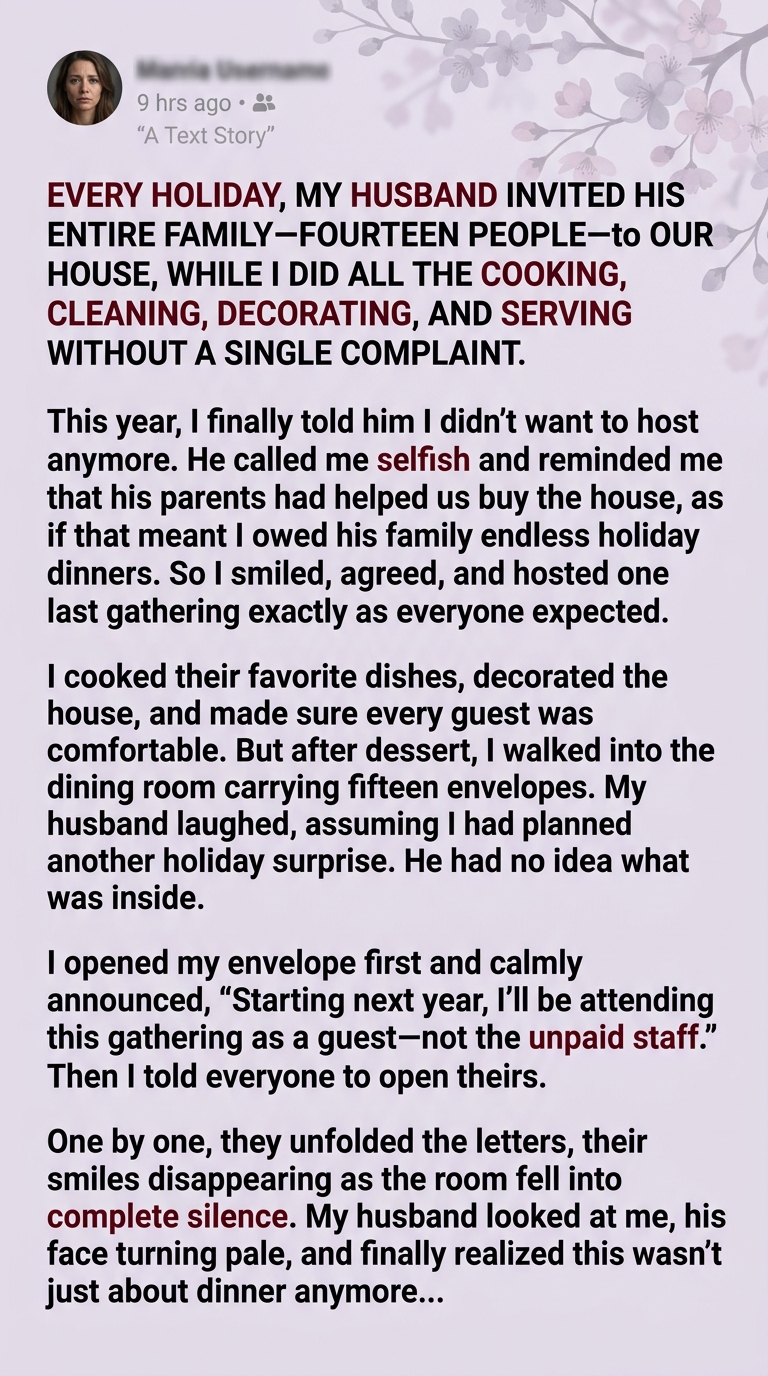
THE LAST HOLIDAY DINNER: FIFTEEN ENVELOPES THAT CHANGED EVERYTHING
My husband invited his entire family—fourteen people—to our house every holiday. And every year, I did everything.
I planned the menu weeks in advance. I bought the groceries, cooked for hours, decorated the house, cleaned every room, set the table, served everyone, refilled drinks, washed dishes, and somehow made sure nobody ever felt inconvenienced.
My husband, Daniel, called it “our family tradition.”
I called it exhaustion I was no longer allowed to admit.
For seven years, I hosted Thanksgiving, Christmas, Easter, birthdays, and every family gathering his relatives decided our house was perfect for. His mother would inspect the food. His sisters would bring their children and leave their dirty plates wherever they finished eating. His brothers would sit around discussing sports while Daniel proudly told everyone how beautiful our home looked.
Never once did anyone ask who had spent the previous three days making it look that way.
This year, I finally said no.
“Daniel, I don’t want to host the holidays anymore,” I told him one evening while folding laundry.
He barely looked up from his phone.
“What do you mean?”
“I mean I’m tired. I want us to celebrate without me spending the entire day in the kitchen.”
He laughed as if I had made a joke.
“It’s one day a year.”
“One day?” I asked. “We host almost every holiday. There are fourteen people coming. I cook for everyone, clean everything, and spend the entire gathering serving them. I don’t even sit down long enough to eat.”
His expression changed.
“My parents helped us buy this house, remember? They put money toward the down payment. It isn’t unreasonable to invite my family here.”
There it was.
The sentence that had silenced me for years.
His parents had helped us financially when we bought the house, and Daniel treated that generosity as if it had purchased permanent access to my time, labor, and silence.
“So you’re saying I owe them?” I asked.
“I’m saying you could be a little more grateful.”
I stared at him for a long moment.
Then I smiled.
“Okay. We’ll host one last holiday dinner.”
Daniel relaxed immediately.
“See? I knew you’d come around. You’re always better once you stop overthinking things.”
He kissed my forehead and went back to his phone.
He didn’t notice that I wasn’t smiling anymore.
I had already made a decision.
And this time, I wasn’t going to argue with anyone.
I was going to let them discover what my silence had been hiding.
THE DINNER EVERYONE THOUGHT I WAS PREPARING
For the next three weeks, I behaved exactly as I always had.
I bought the turkey. I ordered the ingredients for Daniel’s mother’s favorite casserole. I prepared his sister’s special salad, his brother’s favorite pie, and the homemade rolls everyone always praised.
I polished the silverware. I ironed the tablecloth. I hung the decorations. I cleaned the guest bathroom twice.
Daniel watched me work and grew increasingly pleased with himself.
“Mom said she’s excited,” he told me one night. “She hasn’t had everyone together like this in a while.”
“She has had everyone together here every holiday for seven years,” I replied.
He ignored me.
“Make sure you do that pecan dessert she loves. And my brother’s wife doesn’t eat mushrooms anymore, so don’t put them in the stuffing.”
I wrote it all down.
Not because I needed the reminder.
But because I wanted to remember something very clearly.
Even now, after I had told him I was exhausted, he was still giving me instructions.
The day before the gathering, I went into town and picked up fifteen envelopes.
I bought thick cream-colored stationery, printed the letters, and carefully sealed each envelope.
Fourteen envelopes for fourteen guests.
And one for me.
I placed them in a drawer beside the dining room table.
For the first time in seven years, I went to bed before midnight.
Daniel thought I was simply tired from all the preparations.
He had no idea I had spent the last month preparing something far more important than dinner.
THE PERFECT HOLIDAY
On the morning of the gathering, I woke up at five.
The turkey went into the oven. The casserole was prepared. The desserts were lined up on the counter. The house smelled of cinnamon, roasted vegetables, and fresh bread.
By noon, everything looked perfect.
At two o’clock, the first guests arrived.
Daniel’s mother, Patricia, entered wearing her expensive coat and immediately glanced around the house.
“Oh, you’ve really outdone yourself this year,” she said. “The dining room looks lovely.”
“Thank you,” I replied.
Daniel’s sister, Melissa, arrived with her husband and children.
“Where should we put the kids?” she asked, already walking toward the living room.
“Anywhere you like,” I said.
His brother arrived next. Then the cousins. Then the remaining relatives.
Fourteen people.
The house filled with laughter, conversations, children’s footsteps, and the familiar sounds of a family gathering.
Daniel stood near the fireplace with a glass of wine, telling everyone how he had helped prepare for the day.
“It’s a lot of work,” he said, smiling. “But you know how she is. She loves making everything special.”
I was carrying a tray of appetizers when I heard him say it.
I stopped for a second.
Then I continued walking.
Nobody noticed.
For the next several hours, I served food, collected empty plates, refilled drinks, and answered questions.
“Could you get me another fork?”
“Do you have more gravy?”
“Where are the extra napkins?”
“Can you warm this up?”
“Would you mind taking a picture of all of us?”
I did everything.
I even took the family photograph.
Fourteen people smiling in front of the fireplace.
Daniel stood in the middle, looking proud and happy.
I was nowhere in the picture.
Because I was holding the camera.
Again.
THE FIFTEEN ENVELOPES
After dinner, everyone moved into the dining room for dessert.
Daniel’s mother was praising the pie. His sister was talking about her upcoming vacation. The children were playing with their phones beneath the table.
Daniel leaned back in his chair.
“Honestly, this is the best holiday we’ve had in years.”
His mother nodded.
“You really know how to keep a family together, Daniel.”
He laughed.
Then he looked at me.
“Should we do the toast?”
I stood up.
“Actually, before everyone leaves, I have something I’d like to share.”
Daniel smiled.
“Oh, what is it? Another surprise?”
A few people chuckled.
I walked to the sideboard and picked up the fifteen envelopes.
I handed one to every person at the table.
Daniel laughed again.
“Did you make us all little holiday cards? That’s sweet.”
“Please open them,” I said.
His mother carefully pulled the paper from her envelope.
Melissa began reading hers.
His brother opened his.
Daniel was still smiling.
Then I opened my own envelope.
I unfolded the letter and read aloud.
“Dear family,
For the past seven years, I have hosted almost every major holiday in this home. I have cooked, cleaned, decorated, served, and sacrificed my time because I believed that family meant everyone contributing to one another’s happiness.
I was wrong about one thing.
I believed that if I kept giving without asking for anything in return, eventually someone would notice.
I believed that if I worked hard enough, someone would offer to help.
I believed that being a good wife meant never making anyone uncomfortable.
But I have learned that when people become accustomed to your sacrifices, they stop seeing them as sacrifices. They begin to see them as obligations.”
The room was quiet.
I continued.
“Earlier this year, I asked Daniel to stop hosting these gatherings because I was exhausted. Instead of listening, he reminded me that his parents helped us buy this house.
I was told that their financial help meant I should be grateful.
So I have spent time reviewing our finances, our household responsibilities, and the way we have been living.
And today, I want to make one thing clear.
I am grateful for generosity.
But gratitude is not a lifetime contract for unpaid labor.”
Daniel’s smile disappeared.
His mother lowered her letter.
I placed mine on the table.
“Starting next year, I will attend holiday gatherings as a guest—not the unpaid staff.”
I looked around at everyone.
“Please read the rest of your letters.”
WHAT WAS INSIDE THE ENVELOPES
The letters weren’t identical.
Every one of them contained the same message about the holidays, but each included a personal paragraph addressing the person who received it.
Daniel’s mother read hers first.
It said:
“Patricia, I appreciate the financial help you and Robert gave us when we purchased this house. It helped us get started, and I have never denied that.
But your contribution was a gift toward our home—not an agreement that I would cook for fourteen people every holiday indefinitely.
You have never once offered to host, organize, clean, or help pay for the groceries when you came here.
That changes next year.”
Melissa’s letter read:
“Melissa, I love your children, but when you bring them to our home, I should not be expected to clean up after them alone while you relax for hours. From now on, everyone is responsible for their own children, their own plates, and the mess they make.”
Daniel’s brother received this:
“Mark, you have repeatedly joked that I belong in the kitchen because I am the one who knows how to cook. I have laughed along because I didn’t want to ruin the atmosphere.
I am no longer laughing.
I am a family member, not a holiday catering service.”
Another letter addressed the relatives who always arrived empty-handed.
“Everyone is welcome in our home when we invite them. But hosting fourteen people requires real time, effort, and money. If future gatherings happen here, responsibilities will be shared. Nobody gets to arrive, eat, relax, and leave without contributing simply because they believe someone else will take care of everything.”
The letters continued.
Every person at the table received a reminder of something they had said or done.
Nothing was cruel.
Nothing was exaggerated.
But every sentence was specific.
And that made it impossible to dismiss.
The room became painfully quiet.
Then Daniel finally opened his letter.
His hands were shaking slightly as he unfolded the pages.
He read the first paragraph.
Then the second.
Then he looked up at me.
“What is this?”
“It’s my letter to you.”
His face turned pale.
The letter read:
“Daniel,
I told you I was exhausted.
I told you I didn’t want to host anymore.
Instead of listening to your wife, you reminded me that your parents helped us buy the house.
You made me feel like my place in this family depended on how much work I was willing to do for everyone.
You told me I was selfish for wanting a holiday where I could sit down, eat, and enjoy the people I love.
You have watched me cook for hours, clean up after everyone, and go to bed exhausted. You have called it tradition.
But tradition is not an excuse for one person to carry everything while everyone else enjoys the benefits.
Next year, you will be responsible for organizing your family gatherings.
If you want to host, you will plan the menu, shop for groceries, cook, clean, decorate, and serve.
I will not do it for you.
I am not asking for permission.
I am telling you what is changing.”
Daniel stopped reading.
His mother looked at him.
“Daniel, did you really tell her she owed us because we helped with the house?”
He didn’t answer.
I did.
“Yes. He did.”
THE FINANCIAL REALITY
Daniel looked furious.
“You could have talked to me privately instead of embarrassing everyone!”
I calmly replied, “I did talk to you privately. Three weeks ago. You called me selfish.”
“This is ridiculous! You made everyone feel terrible!”
“No,” I said. “I stopped pretending I didn’t feel terrible.”
He pushed his chair back.
“You’re acting like my family has done something horrible to you!”
I reached into the sideboard and pulled out one additional sheet of paper.
“I also included the grocery receipts from the last seven years.”
Everyone looked confused.
I placed the papers in the center of the table.
“Since we’re discussing gratitude and family contributions, I thought it might help to understand what hosting actually costs.”
I had carefully calculated the food, decorations, cleaning supplies, electricity, and other holiday expenses that I had paid for personally or from our household budget.
The total was not a bill.
I wasn’t asking anyone to repay me.
It was a record.
A record of the things that had been treated as invisible.
The number was over $18,000.
Melissa stared at the total.
“Wait. You spent that much?”
“Over seven years,” I said. “And that doesn’t include the hours of work.”
Daniel shook his head.
“You didn’t have to keep track of all that.”
“You’re right. I didn’t have to. But when I said I was exhausted, you told me your parents helped buy the house. I thought it was important to understand what I had contributed too.”
His mother looked uncomfortable.
“We never expected you to spend all that money.”
“Maybe not,” I replied. “But nobody ever asked what it cost me, either.”
For the first time that afternoon, Patricia looked at me instead of looking around the house.
“I didn’t realize,” she said quietly.
I nodded.
“That’s exactly the problem. Nobody realized because nobody had to.”
THE MOMENT MY HUSBAND FINALLY UNDERSTOOD
Daniel walked into the kitchen.
I followed him.
He turned toward me, his voice low.
“You’ve made me look like a terrible husband.”
I looked at him.
“I didn’t write anything you hadn’t said or done.”
“You could have just refused to host!”
“I did.”
He went silent.
“I told you I didn’t want to host. You said I was selfish. You reminded me that your parents helped with the house. You told me I was being ungrateful.”
His jaw tightened.
“So you planned all this just to punish me?”
“No. I planned this because I was tired of being ignored.”
I took a breath.
“I didn’t want a dramatic dinner. I wanted a partner who would hear me when I said I couldn’t do it anymore.”
For the first time, he didn’t have an answer.
Then he said something I had never expected.
“Are you saying you want a divorce?”
I looked at him carefully.
“No. I’m saying I want a marriage. And I don’t want to be the only person working to keep it alive.”
His eyes shifted toward the dining room.
His family was still sitting there.
Some had finished their letters. Some were staring at their plates. Nobody was laughing anymore.
Daniel whispered, “You could have warned me.”
“I did.”
And that was the truth he couldn’t escape.
THE FIRST PERSON WHO STOOD UP
Patricia came into the kitchen.
She held her letter in both hands.
“Can I say something?”
Daniel looked annoyed.
“Mom, not now.”
But she ignored him.
She looked at me.
“I should have offered to help. I should have noticed you weren’t sitting with us. I should have asked whether you wanted to host instead of assuming.”
Her voice trembled.
“I always thought you were happy doing it because you were so good at everything. That’s not an excuse. I should have asked.”
I wasn’t expecting an apology.
I didn’t know what to do with one.
“Thank you,” I said.
She looked toward Daniel.
“And you should have listened to her.”
His face flushed.
“Mom, you’re taking her side?”
“No. I’m telling you that your wife is a person. Not a service you get because we helped you buy a house.”
The words landed harder than anything I had said.
Daniel looked away.
Then Melissa spoke from the dining room.
“I didn’t know you were doing everything alone, either.”
She stepped into the kitchen.
“I should have helped with the kids and cleaned up. I just got used to coming here.”
I didn’t rush to comfort her.
I didn’t tell her it was okay.
Because it wasn’t okay.
But I appreciated that she finally said it.
THE GUESTS LEFT DIFFERENTLY
The evening ended in a way none of them had expected.
There was no shouting.
No dramatic scene.
No one threw a plate.
People quietly gathered their coats.
Melissa packed up her children’s things and took the leftover dishes she had brought. Daniel’s brother carried the trash to the garage. Patricia asked whether she could help wash the remaining dishes.
I told her she could leave.
“Tonight, I just want to be done.”
She nodded.
“That’s fair.”
One by one, the guests left.
Some hugged me.
Some avoided my eyes.
Some apologized awkwardly in the doorway.
Daniel stood near the front door watching them go.
The house that had been filled with noise all afternoon became quiet.
He looked at the dining room table.
Fifteen envelopes.
Fourteen people who had finally been forced to read something they had never bothered to notice.
And one woman who had finally stopped pretending.
When the last guest left, Daniel closed the door.
He stood there for several seconds.
Then he turned to me.
“I don’t know what to say.”
I answered honestly.
“That’s the first time tonight you’ve listened long enough to realize you don’t have an answer.”
He looked down.
I walked past him and sat on the couch.
For the first time in seven years, I did not clean the dining room after a holiday gathering.
I did not wash the dishes.
I did not wrap leftovers.
I did not check whether the guests had forgotten anything.
I sat down.
And I let the mess remain.
THE MORNING AFTER
The next morning, I woke up to the kitchen still messy.
There were dishes in the sink, leftover food on the counter, and decorations that needed to be put away.
Daniel was already awake.
He had made coffee.
He stood beside the sink, looking at the dishes.
“I’ll clean everything,” he said.
I looked at him.
“Everything?”
“Yes.”
“Without asking me how to do it?”
He hesitated.
Then he nodded.
I went upstairs and took a shower.
When I came back, the dishwasher was running, the counters were clean, and the leftovers were properly stored.
Daniel was sitting at the table.
“I know that doesn’t fix anything,” he said.
“No. It doesn’t.”
“I should have helped.”
“Yes.”
“I should have listened when you told me you were tired.”
“Yes.”
He rubbed his face.
“I thought you were just stressed about the holidays.”
“I was. But I was also tired of being treated like my time didn’t matter.”
He nodded.
“I understand that now.”
I sat across from him.
“Understanding it today isn’t enough. I need to see what changes when there isn’t an audience.”
He didn’t argue.
For once, he didn’t ask me to reassure him.
THE HOUSE WAS NOT A DEBT
Two weeks later, Daniel’s parents came over.
His father, Robert, was carrying a folder.
“I wanted to talk about the house,” he said.
I felt my stomach tighten.
But he opened the folder and took out the original paperwork.
“We helped with the down payment because we wanted you both to have a good start. We never meant it as something you had to repay through holidays.”
Patricia nodded.
“I think we let Daniel turn that gift into something it was never supposed to be.”
Daniel looked embarrassed.
His father continued.
“If you two don’t want to host, don’t host. We’ll rent a hall, take everyone to a restaurant, or celebrate at our house. We are perfectly capable of helping.”
I felt tears in my eyes, but I didn’t let them fall.
“Thank you for saying that.”
Robert looked at me.
“And for what it’s worth, I am sorry we didn’t offer before.”
That was the first time I felt the difference between being told I was part of a family and actually being treated like one.
THE NEXT HOLIDAY
A year later, the holidays arrived again.
Daniel’s family sent a group message asking where everyone would be celebrating.
Daniel replied before I could even look at my phone.
“Mom and Dad are hosting this year. We’ll bring dessert. Everyone else is bringing a dish. No one is expected to do everything.”
I read the message twice.
Then I put my phone down.
That year, I made one pie.
Not four desserts.
Not three casseroles.
One pie.
I bought it at a bakery, actually.
We arrived at his parents’ house at three in the afternoon. The table was already set. Robert was carving the turkey. Patricia was putting out plates. Melissa was helping the children.
Daniel carried our pie into the kitchen.
Then he came back, took my hand, and led me to a chair.
“Sit down,” he said. “You’re a guest today.”
I smiled.
And this time, I didn’t need an envelope to make my point.
I sat down.
I ate while the food was warm.
I laughed with the family.
I left before the cleanup was finished.
And for the first time, I understood what a holiday was supposed to feel like.
Not a performance.
Not a debt.
Not an obligation.
A day where everyone belongs—and nobody has to disappear into the kitchen to make everyone else happy.
My fifteen envelopes had not ruined a family holiday.
They had exposed a tradition that needed to change.
And the best part wasn’t that everyone finally apologized.
The best part was that I never again had to ask permission to stop doing everything.
Because I had finally stopped confusing being useful with being loved.