My Brother Told Me to Stay Away After His Fiancée Put Me in the ER—So I Took My Name Off Their Mortgage
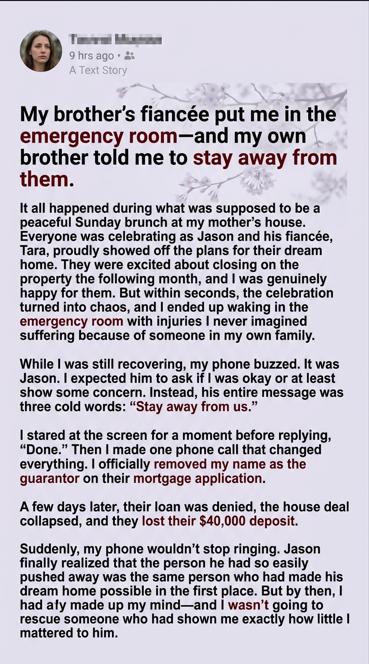
My brother’s fiancée put me in the emergency room, and my own brother’s first response was to tell me to stay away from them.
It happened during what was supposed to be a peaceful Sunday brunch at our mother’s house.
Jason and his fiancée, Tara, had arrived carrying a folder full of house plans. They were practically glowing as they spread the papers across the dining table.
“We’re finally doing it,” Jason announced. “Closing is next month.”
Everyone congratulated them. My mother hugged Tara, and I genuinely smiled. They had been talking about buying their dream home for months.
What most of my family didn’t know was how much I had done behind the scenes to make that purchase possible.
Jason’s credit history wasn’t strong enough to qualify for the mortgage he wanted. After several conversations, he asked whether I would consider guaranteeing the loan.
I was hesitant.
A mortgage guarantee was a serious financial responsibility, not a casual favor. I could potentially be held responsible if he failed to pay.
But Jason was my younger brother. He promised he had everything under control, showed me his budget, and insisted he would never put me in a difficult position.
After reviewing the documents and discussing the risks, I agreed to help.
My name was included as a guarantor on the application. The lender was still reviewing the final paperwork, but Jason was confident everything would be approved.
That Sunday, I thought we were celebrating the beginning of a happy new chapter.
Then Tara made a comment about the kitchen.
She pointed to the floor plan and said, “We’re thinking of making the kitchen completely open. It’ll be perfect for entertaining.”
I suggested they check the cost of moving a supporting wall before committing to the design.
Tara rolled her eyes.
“Not everything has to be a lecture.”
I laughed awkwardly, assuming she was joking.
But when Jason asked whether I could help cover some of the renovation expenses, I told him I couldn’t promise anything beyond the financial support I’d already agreed to.
Tara immediately became irritated.
“You act like you’re the only reason we’re getting this house,” she snapped.
I looked at her.
“I never said that. I just don’t want to take on more financial responsibility.”
Jason told her to calm down, but Tara was already getting louder.
She accused me of trying to control their decisions because my name was attached to the mortgage application.
I explained that being a guarantor didn’t give me ownership of their home. It simply meant I was accepting financial risk, and I had a right to understand what I was agreeing to.
Then everything happened so quickly.
Tara grabbed the folder from the table and shoved it toward me. When I reached out to keep the papers from scattering, she forcefully pushed me backward.
My heel caught against the leg of a chair.
I lost my balance and fell hard, striking the side of my head against the edge of a cabinet before hitting the floor.
The room erupted.
My mother screamed my name. Someone called an ambulance. Jason stood frozen for a moment while Tara insisted I had stumbled on my own.
I remember the pain, my mother’s frightened voice, and the ceiling lights passing above me as the paramedics carried me out.
When I woke up in the emergency room, my head was throbbing. I had a concussion, a deep cut that required stitches, and a badly bruised shoulder.
The doctor told me I would need rest and follow-up care.
I was still trying to understand what had happened when my phone buzzed.
It was Jason.
I expected him to ask whether I was okay.
Instead, his entire message contained three cold words:
“Stay away from us.”
I stared at the screen for a long time.
Then I typed:
“Done.”
I didn’t argue. I didn’t send a long message explaining how much he had hurt me.
I simply put my phone down.
A few minutes later, I called the mortgage broker handling the application.
I explained that I had been injured during a family dispute and no longer wished to serve as a guarantor. I asked what steps were available to withdraw my support before the loan was finalized.
The broker explained that my withdrawal would affect the application and that the lender would need to reassess Jason and Tara’s eligibility. I submitted the required written notice and requested confirmation that my name would not be used to support any further lending decision.
I didn’t cancel their mortgage.
I didn’t take their house away.
I withdrew my own financial commitment.
There was a difference, and it mattered.
Two days later, Jason called.
I didn’t answer.
Then came another call. And another.
Finally, he left a voicemail.
“What’s going on with the mortgage? The broker says the application can’t move forward without you. You need to fix this.”
I listened twice.
Not once did he ask how I was feeling.
Not once did he ask whether my injuries were serious.
His only concern was the house.
A few days later, I learned that the lender had declined the application in its current form. Jason and Tara couldn’t qualify for the amount they wanted without another acceptable guarantor or a different financial arrangement.
Their closing date passed.
The seller refused to keep the property under contract indefinitely, and the deal collapsed.
Then came the $40,000 deposit.
Jason and Tara had paid it under a purchase agreement with specific financing and cancellation conditions. They had assumed the money would be safe if the mortgage was delayed.
But the contract’s protections were not automatic, and they had failed to satisfy the requirements for recovering the full amount. After the dispute was reviewed, they lost the deposit.
Suddenly, my phone wouldn’t stop ringing.
Jason called repeatedly. Tara sent long messages accusing me of deliberately ruining their future.
My mother called too, crying and asking whether I could please speak to my brother.
I finally answered Jason.
He didn’t even say hello.
“Do you understand what you’ve done? We lost the house!”
I took a breath.
“You told me to stay away from you. I did exactly that.”
“You knew we needed you on the mortgage!”
“Yes. And you knew what being a guarantor meant when you asked me to sign.”
“You can’t just abandon your own brother over one argument!”
I looked down at the stitches near my hairline.
“One argument? Jason, I ended up in the emergency room. I was lying in a hospital bed when you told me to stay away. You didn’t ask whether I was alive. You told me to disappear.”
He went quiet.
Then he said, “Tara didn’t mean for you to fall.”
I closed my eyes.
“Maybe she didn’t plan for me to get hurt. But I was hurt, and you chose to defend her instead of even checking on me.”
He started talking about the deposit again.
I interrupted him.
“I’m not paying it back. I’m not finding another guarantor. And I’m not taking financial responsibility for a home you and Tara chose to buy.”
For once, he had nothing to say.
I later learned that Tara had been telling people I had intentionally sabotaged their purchase because I was jealous of their relationship.
I didn’t respond to the gossip.
I kept copies of the medical records, photographs of my injuries, and the messages from Jason. I also made sure the incident was documented through the appropriate channels.
My mother eventually visited me.
She sat at the kitchen table, holding a cup of tea.
“Your brother is under a lot of pressure,” she said quietly.
I looked at her.
“So was I, Mom. I was under a lot of pressure while I was lying in the emergency room.”
She lowered her eyes.
“I know. I just wish things hadn’t gone this far.”
“So do I.”
We sat in silence.
I didn’t ask her to choose sides. I only asked her not to pressure me into repairing a relationship with someone who hadn’t even acknowledged what happened.
Months passed.
My injuries healed, although I still had occasional headaches. Jason and Tara eventually found another property they could afford without my financial support. I heard about it through relatives, not from Jason himself.
He sent one message several months later.
“I’m sorry things got so bad. I hope we can talk someday.”
I read it, but I didn’t reply immediately.
An apology was a beginning, not a reset button.
I wasn’t interested in pretending that nothing had happened just because the house deal was over.
For the first time in my life, I understood that being someone’s family member didn’t mean I had to become their financial safety net, especially when they treated my well-being as less important than a mortgage application.
Jason had told me to stay away.
So I did.
And I learned that sometimes the most important thing you can take back from someone isn’t money, property, or an opportunity.
It’s your willingness to keep rescuing them when they refuse to care what happens to you.