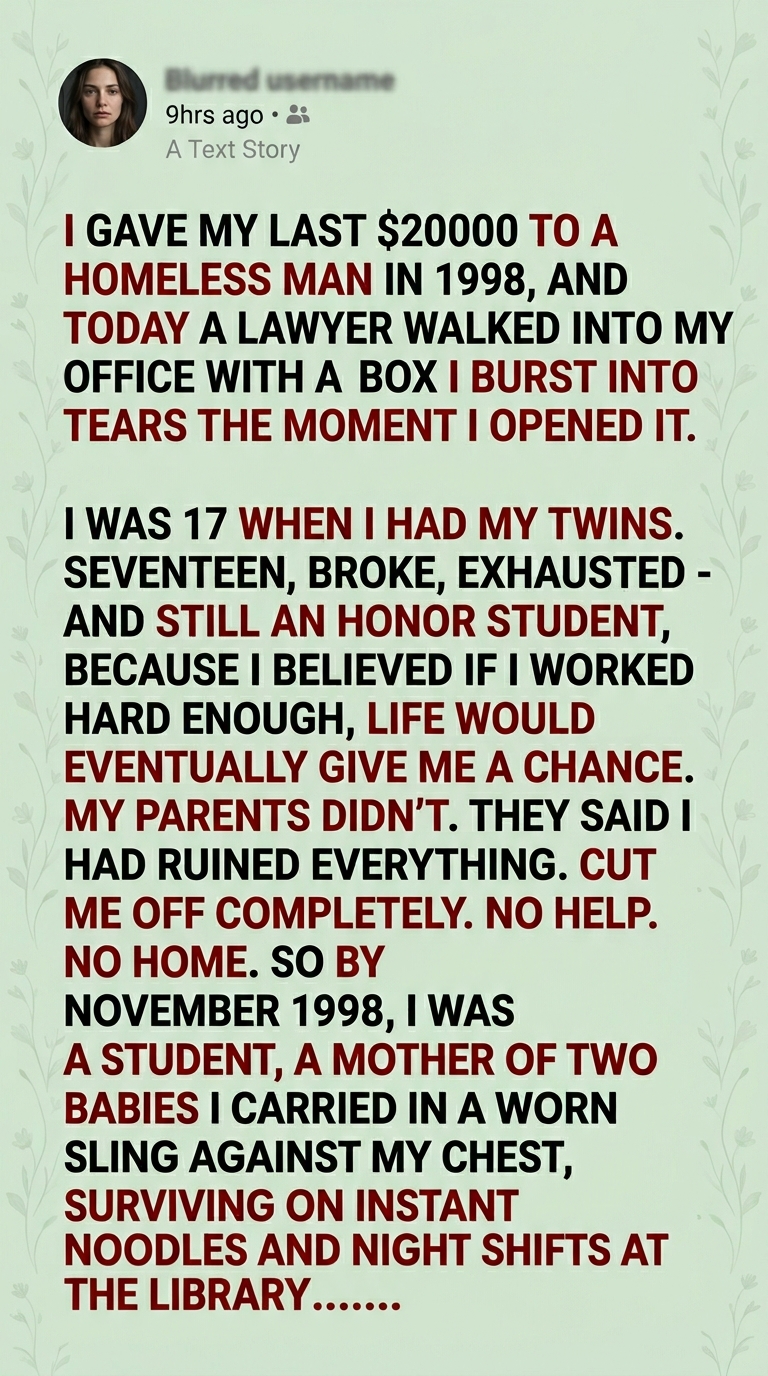
The library was cold that November. I used to tuck my twins inside my oversized thrift-store coat, praying their warmth would keep me from shivering and my shivering wouldn’t wake them.
The $20,000 wasn’t a gift from my parents. It was a settlement from a car accident I’d been in a year prior—money I had been clutching like a life raft. It was supposed to be our first month’s rent, a used car, and a tiny bit of peace.
But then I met Elias.
He sat outside the library every night, wrapped in a tarp that leaked. He didn’t ask for money; he offered me his seat under the heat vent because he saw me struggling with the babies. One night, as he coughed a sound that rattled his entire frame, he told me he was dying. He didn’t want a hospital; he just wanted to go home to Oregon to see his daughter one last time and ensure she’d have enough to finish nursing school.
I looked at my babies, then at my bank card, and then at his sunken eyes. I realized that while I was starting my life, he was finishing his. I went to the bank the next morning, withdrew every cent, and handed it to him in a brown paper bag.
“Go home, Elias,” I whispered. My friends called me a fool. My parents laughed when they heard. I spent the next five years working three jobs, barely sleeping, and eventually clawing my way through law school on grit and caffeine.
The Box on the Desk
Today, twenty-eight years later, a man in a sharp charcoal suit walked into my private practice. He didn’t have an appointment. He just placed a weathered wooden cigar box on my mahogany desk.
“My name is Marcus Thorne,” he said. “My grandfather was Elias. He passed away in 1999, but he spent his final year setting things right. He told me that if I ever became successful enough to find the woman who gave him his life back, I should return the favor.”
I opened the box.
My breath hitched. Inside was the same brown paper bag, now yellowed and brittle. But beneath it wasn’t cash. It was a stack of legal deeds and a series of worn-out journals.
Elias hadn’t just gone home to see his daughter; he had used the last of his strength—and the remainder of that money after his travel—to fight for a small plot of “worthless” land his family had lost in a tax lien decades prior. As it turned out, that land sat directly atop one of the largest shale gas deposits in the region.
The deeds were for a massive commercial property in the city center—the very building my office is currently located in. He had bought it in a trust under my name years ago, left to grow in value while his daughter’s education was settled by the royalties.
But it wasn’t the money that broke me.
At the very bottom of the box was a Polaroid. It was a photo of Elias, looking healthy and smiling, holding two toddlers I recognized instantly. He had tracked me down one afternoon at a park when my twins were three, watching us from a distance just to make sure we were okay.
On the back, in shaky handwriting, it read:
“You gave me a chance to die with dignity. Now, I’m giving you the chance to live without fear. You’re an honor student of life, Sarah. Class dismissed.”
I collapsed into my chair, the tears blurring the ink. I had spent nearly thirty years proving I could survive. For the first time, I realized I didn’t have to anymore.