The silence that followed was absolute. It was the kind of heavy, suffocating quiet that swallows all the air in a room, punctuated only by the clinking of champagne flutes from the oblivious elite mingling a few yards away.
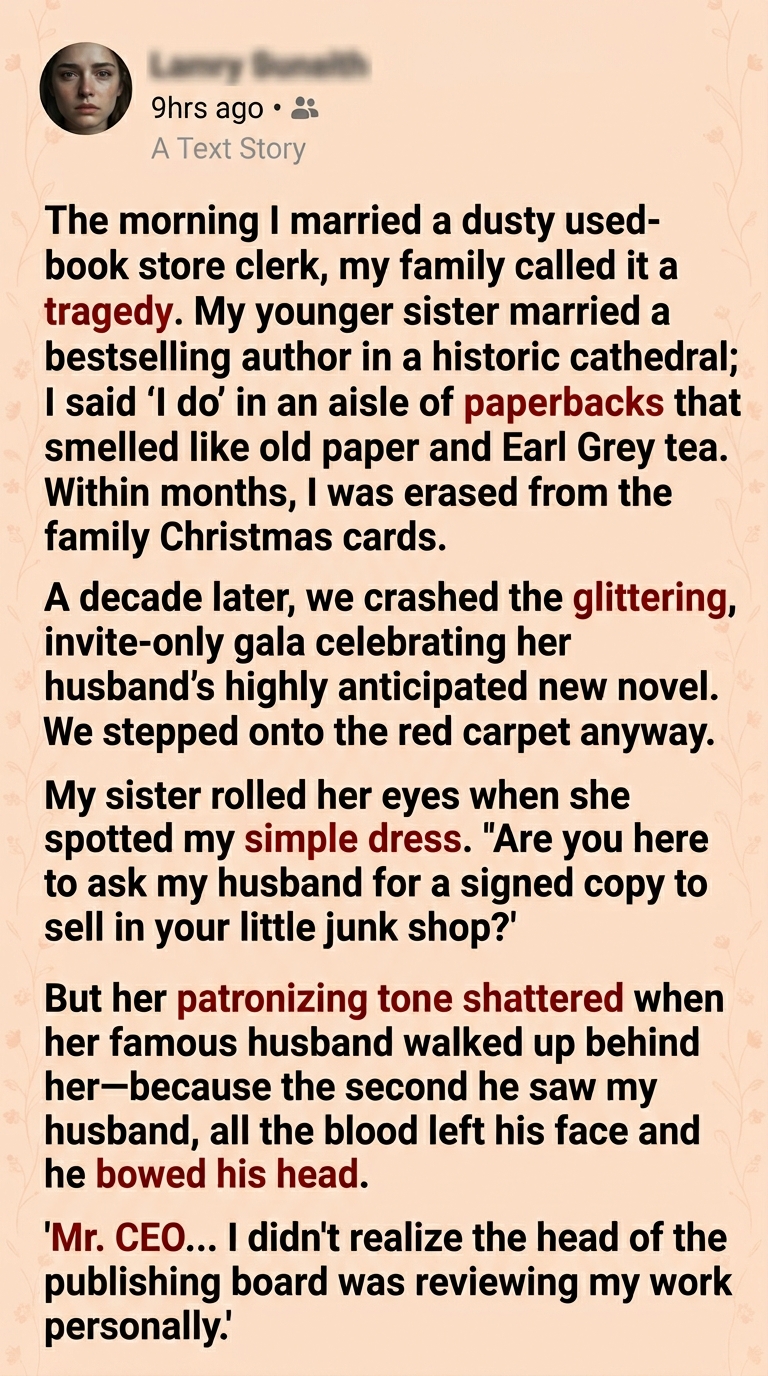
My sister, Chloe, blinked, her perfectly manicured hand freezing midway to her designer collar. She looked from her husband—whose normally smug, camera-ready face was now the color of wet ash—to the man standing beside me.
My Elias. The man who spent his Sundays meticulously repairing broken spines with archival glue. The man who made me Earl Grey tea every morning.
“Julian,” Chloe snapped, her voice trembling with forced nervous laughter. “What kind of joke is this? This is Elias. He runs that dusty little shop on 4th Street. He’s practically a hoarder.”
Julian didn’t look at her. He couldn’t. His eyes were locked on Elias, a bead of cold sweat tracing the line of his jaw. “Shut up, Chloe,” he hissed, the venom in his voice startling her into stunned silence. He swallowed hard, nervously adjusting his tuxedo jacket. “Mr. Sterling. I—I was told the board’s decision on the global rollout wouldn’t be finalized until next week.”
Elias offered a soft, unassuming smile—the exact same smile he gave customers when they found a rare first edition hidden in the stacks. He slipped his hands into the pockets of his tailored, but decidedly non-designer, charcoal suit.
“It wasn’t,” Elias said, his voice mild but carrying an unmistakable weight of absolute authority. “But I prefer to read the galleys myself when an advance is this… substantial. Especially for a work so highly touted as wholly original.”
I watched, utterly fascinated, as the puzzle pieces finally clicked together in my sister’s eyes. Ten years ago, Elias hadn’t just worked at the bookstore. He owned it. And he owned the building. And the block. The vintage shop was his quiet sanctuary, a passion project for a man who had inherited, and then ruthlessly expanded, the largest international publishing conglomerate in the world. He just preferred the smell of old paper to boardrooms. I had known for years, of course, but we had simply never felt the need to correct my family’s arrogant assumptions.
“Wholly original, sir. Yes,” Julian stammered, though his knees looked ready to give out.
Elias slowly pulled a small, worn paperback from his inner jacket pocket. Its cover was faded, the edges frayed. “It’s a beautiful narrative, Julian. Truly. The pacing, the dialogue, the tragic protagonist…” Elias paused, tracing the gold-leaf lettering on the ancient spine. “I was particularly struck by how flawlessly it mirrored The Midnight Vagabond, a rather obscure novella printed in a limited run in 1928 by a defunct Parisian press.”
Julian let out a pathetic, strangled noise. Chloe’s jaw finally dropped.
“Fortunately,” Elias continued pleasantly, “I happen to have a copy in my ‘little junk shop.’ I’ve had my legal team do a side-by-side comparison. It’s remarkable. Almost word-for-word in the third act.”
“Sir, I can explain—”
“You will,” Elias interrupted, his tone no longer mild. The bookstore clerk was gone; the CEO had arrived. “To the legal department. First thing tomorrow. Your advance is frozen, the publication is canceled, and I suggest you find a very good lawyer to handle the breach of contract.”
Elias turned to me, the icy executive demeanor instantly melting back into the warm, adoring gaze of the man I had married in the poetry aisle. “Ready to go, darling? The air in here is a bit too fabricated for my taste.”
“More than ready,” I smiled, wrapping my arm through his.
I didn’t look back as we walked down the red carpet, leaving Julian hyperventilating against a promotional poster of his own face, and my sister staring into the ruins of her glittering, carefully curated life. We stepped out into the crisp night air, heading back to our quiet apartment above the shop, where the true treasures were kept.