When I married Ethan, I thought the hardest part of marriage would be learning to compromise.
I was wrong.
The hardest part was realizing I was competing with someone who had decided, long before she truly knew me, that I would never be good enough.
His mother, Carol.
The first time I met her, she hugged me warmly.
Then she smiled and said,
“You’re prettier in photos.”
It sounded like a compliment.
It wasn’t.
Over the next five years, I learned her language.
Every insult arrived wrapped in politeness.
“Oh, I suppose Ethan doesn’t mind frozen vegetables.”
“My son always dated women who dressed a little more… elegantly.”
“I only want what’s best for him.”
Family dinners became performances.
If I cooked, she found fault.
If I stayed quiet, she called me cold.
If I defended myself, she accused me of disrespect.
I kept telling myself that if I loved Ethan well enough, eventually things would settle.
Instead, they got worse.
Small misunderstandings somehow became enormous arguments.
Carol would insist I had rolled my eyes.
Or ignored her.
Or spoken sharply.
Ethan always believed her.
“I don’t think Mom would make something like that up.”
After hearing those words enough times, you begin questioning your own memory.
Maybe I had sounded rude.
Maybe I really had forgotten something.
Maybe I was the problem.
I started apologizing for things I couldn’t even remember doing.
Friends noticed I seemed anxious.
My sister asked why I flinched every time my phone buzzed.
I laughed it off.
“It’ll get better.”
It didn’t.
Five years after our wedding, Ethan asked for a divorce.
“I can’t keep choosing between my wife and my mother.”
I looked at him quietly.
“You never had to.”
“You chose long ago.”
The divorce was surprisingly simple.
No children.
Few shared assets.
Just signatures ending years of slowly eroding trust.
I left town for a while.
Found a new job.
Started therapy.
Slowly, I rebuilt a life where I no longer apologized before speaking.
Eventually, I stopped checking Ethan’s social media.
Stopped wondering whether Carol was still talking about me.
Stopped caring.
Or so I thought.
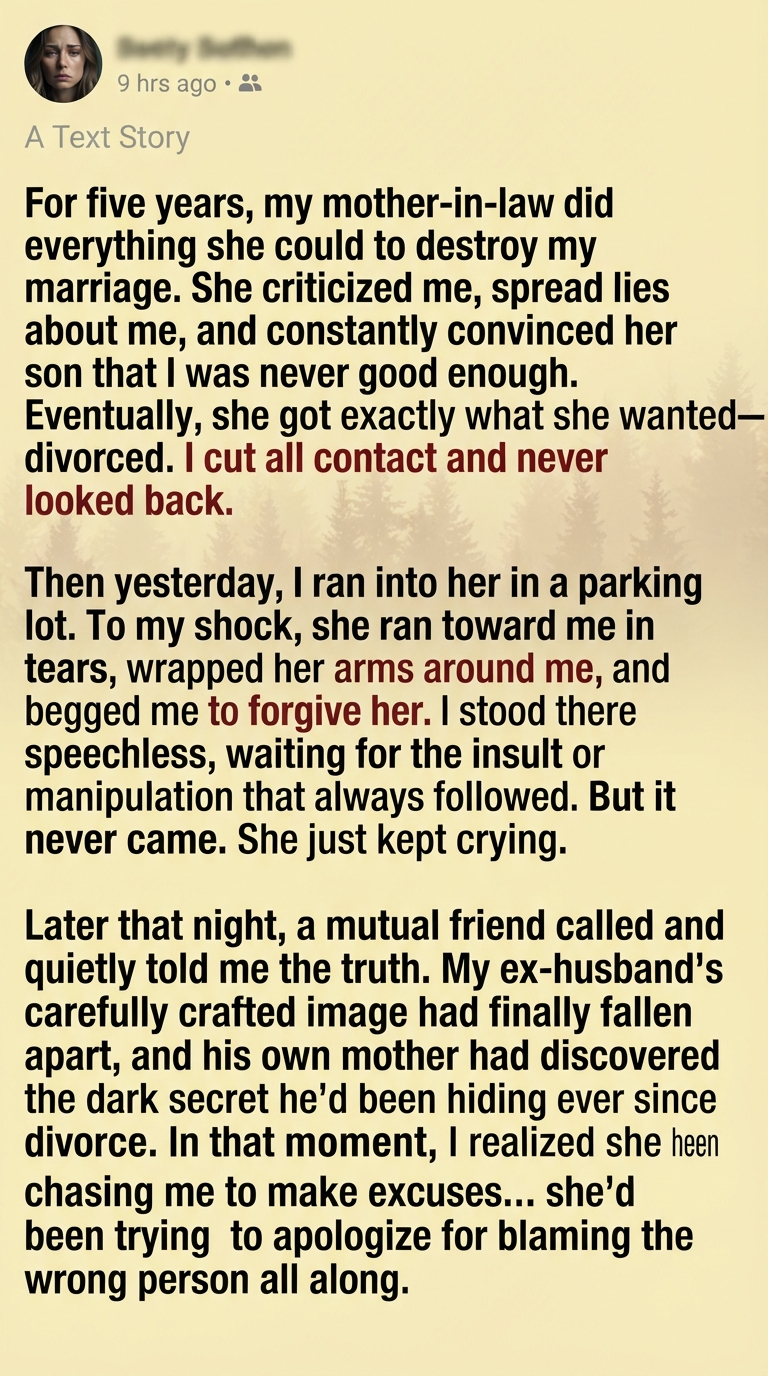
Six years later, I was loading groceries into my car when someone called my name.
I turned.
Carol.
For a split second, I considered getting into my car and driving away.
Instead, I froze.
She hurried toward me.
Then, completely unexpectedly, she wrapped her arms around me.
“I’m so sorry.”
She was crying.
Not politely dabbing at her eyes.
Actually crying.
I stood stiffly.
Waiting.
Surely this was the moment she’d explain why I had misunderstood everything.
Or remind me of my failures.
Instead she whispered,
“I was wrong.”
Again.
And again.
“I was so wrong.”
I gently stepped back.
“What happened?”
She shook her head.
“I can’t explain here.”
Before I could ask anything else, she walked away.
That evening my phone rang.
It was Denise, an old neighbor who had stayed friendly with everyone.
“I think you deserve to know.”
“What?”
She sighed.
“Carol found out the truth about Ethan.”
A knot formed in my stomach.
“What truth?”
“He wasn’t honest with either of you.”
The next day Denise met me for coffee.
She looked uncomfortable.
“Ethan’s second marriage ended.”
“I didn’t know he’d remarried.”
“Three years ago.”
“And?”
“His wife filed for divorce after discovering he’d secretly borrowed money in her name.”
I blinked.
“What?”
“There were forged signatures.”
“Hidden loans.”
“Credit cards she knew nothing about.”
I stared at her.
“That doesn’t sound like Ethan.”
Denise looked at me carefully.
“That’s what Carol said.”
Until the investigation began.
As lawyers sorted through financial records, something unexpected surfaced.
The hidden debts stretched back much further than anyone realized.
Including the years Ethan and I had been married.
My mind raced.
The arguments about money.
The mysteriously empty savings account.
The “unexpected expenses.”
I’d blamed myself for poor budgeting.
Carol had blamed me too.
Denise continued,
“When Carol confronted him…”
“…he admitted something.”
“What?”
“He’d been lying for years.”
Not just about money.
About me.
Every disagreement we’d ever had with Carol had been carefully rewritten before she heard it.
If I asked Ethan to set healthy boundaries, he told Carol I wanted to cut her out of his life.
If I asked for privacy, he claimed I’d called her controlling.
If I was hurt by something she’d said, he told her I’d insulted her behind her back.
He made each of us believe the other was constantly attacking.
I remembered dozens of conversations.
Carol saying,
“I can’t believe you’d say that about me.”
And me wondering,
I never did.
Denise nodded.
“He admitted he found it easier to let the two of you blame each other than admit he’d avoided difficult conversations.”
I felt sick.
“So we were both fighting a version of each other that didn’t exist.”
“Exactly.”
A week later Carol asked if we could meet.
Part of me wanted to refuse.
Another part needed answers.
We met at a small park.
She looked older.
Smaller somehow.
She carried a folder.
“I brought these because I don’t expect you to simply believe me.”
Inside were copies of Ethan’s written admissions from the financial case, along with messages showing how he had altered conversations and forwarded edited screenshots to create conflict between us.
“I kept wondering,” Carol whispered, “why the woman I met seemed so kind, but the woman my son described sounded so cruel.”
She looked down.
“I believed the wrong version.”
I was quiet for a long time.
Finally I asked,
“Why?”
She closed her eyes.
“Because he was my son.”
“I trusted him.”
“I never imagined he’d manipulate both of us.”
Tears rolled down her cheeks.
“I owe you more apologies than I can count.”
I looked across the pond before answering.
“You hurt me.”
“I know.”
“You made me feel like nothing I did would ever be enough.”
“I know.”
“And Ethan should have stood beside me.”
She nodded.
“He should have.”
We sat in silence.
Eventually she spoke again.
“I’ve spent years asking why every relationship he touched eventually fell apart.”
“Now I know.”
“He never let people solve problems.”
“He made sure they solved them against each other.”
That sentence stayed with me.
Because it explained so much.
Not only our marriage.
His friendships.
His relationship with coworkers.
Even his second marriage.
Conflict had always been easier for him to manage than honesty.
Months later Carol invited me to lunch.
Not because she expected a second chance.
Simply because she wanted to thank me for coming.
Over time we built something neither of us expected.
Not a replacement for the years we lost.
Just mutual respect.
One afternoon she quietly admitted,
“The hardest part wasn’t learning my son lied.”
“It was realizing an innocent woman paid the price for my refusal to question him.”
I smiled sadly.
“The hardest part for me was believing I deserved it.”
She reached across the table.
“You never did.”
Those four words healed something therapy alone never could.
Years later, when Carol passed away, I attended the memorial.
Not because anyone expected me to.
Because forgiveness had quietly grown where resentment once lived.
In her final letter to me, she wrote:
“If I had listened to your actions instead of my son’s stories, I would have gained a daughter instead of losing one.”
I keep that letter tucked inside my journal.
Not to remember the pain.
But to remember the lesson.
Truth doesn’t always arrive on time.
Sometimes it comes years after relationships have ended.
Years after trust has been broken.
Years after apologies could have changed everything.
But even late truth has power.
It frees innocent people from carrying blame that never belonged to them.
It reminds us that love without honesty cannot survive.
And it teaches us to judge people not by the stories someone else tells about them…
…but by the quiet consistency of their own character.
Because lies can separate families for years.
But when the truth finally finds its voice, it has a remarkable way of bringing peace to the people who deserved it all along.