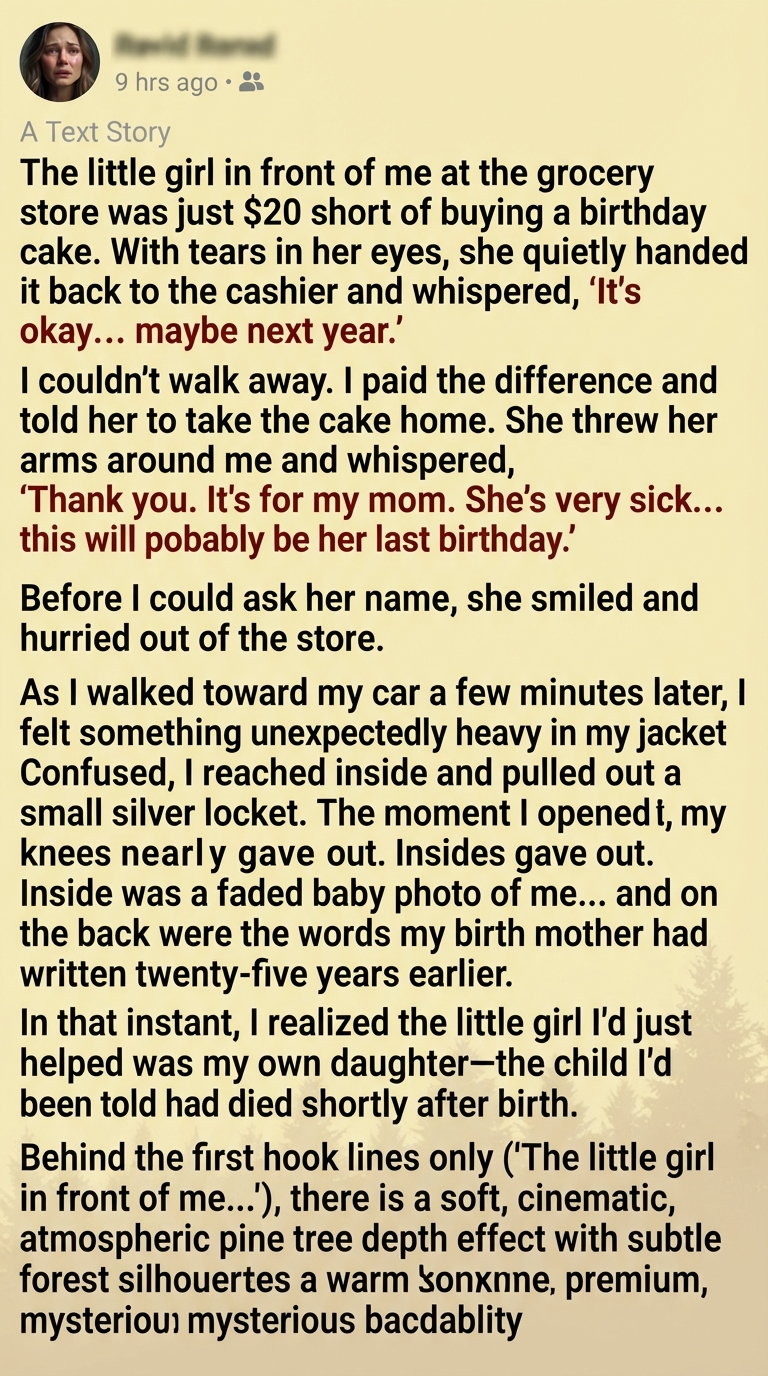
The little girl couldn’t have been more than ten.
She stood in front of me at the grocery store checkout, carefully counting crumpled one-dollar bills and loose change onto the conveyor belt.
The cashier scanned the birthday cake one more time.
“I’m sorry, sweetheart.”
“You’re still twenty dollars short.”
The girl’s shoulders slumped.
She looked at the cake—a simple white one with blue flowers piped around the edges—and gently pushed it back toward the cashier.
“It’s okay,” she whispered.
“Maybe next year.”
Something about those four words stopped me.
Children usually begged.
Argued.
Cried.
She didn’t.
She accepted disappointment with the quiet resignation of someone far too young to be familiar with it.
I stepped forward.
“I’ll cover it.”
She turned toward me, startled.
“You don’t have to.”
“I know.”
“But I’d like to.”
The cashier smiled and finished the transaction.
The little girl hugged the cake to her chest as though it were made of glass.
Then, before I could react, she wrapped both arms around me.
“Thank you.”
Her voice trembled.
“It’s for my mom.”
“She’s very sick.”
“The doctors say this will probably be her last birthday.”
I swallowed hard.
“I’m so sorry.”
She gave me a brave little smile.
“She says birthdays are for celebrating we’re still here.”
Before I could ask her name, she hurried toward the exit.
I watched her climb into an old blue sedan driven by an elderly woman.
Then they were gone.
I finished my shopping in silence.
As I crossed the parking lot toward my car, something in my jacket pocket felt strangely heavy.
I frowned.
I hadn’t put anything there.
Reaching inside, my fingers closed around cold metal.
I pulled out a small silver locket.
My first thought was that the little girl must have slipped it into my pocket while hugging me.
I opened it to find some way of identifying its owner.
The world tilted.
Inside was a tiny, faded photograph of a newborn.
Me.
I knew because I’d seen that photograph only once before.
My adoptive parents had shown it to me after I turned eighteen.
It was the only picture that existed from the first weeks of my life.
On the inside lid, engraved in delicate handwriting, were six words.
Always loved. Never willingly lost.
My knees buckled.
Those were the exact words my birth mother had written on the back of the photograph preserved in my adoption file.
I sat inside my car staring at the locket for nearly twenty minutes.
None of it made sense.
I had been adopted as an infant.
The records said my birth mother had died shortly after giving birth.
There had never been any mention of another child.
Certainly not a daughter.
The next morning, I called the adoption agency that had handled my case decades earlier.
Most records had been archived, but after hearing my story, a counselor agreed to investigate.
Three days later she called back.
“There are irregularities.”
“What kind?”
“There appear to be sealed court documents added years after your adoption.”
“Can you tell me what they say?”
“Not over the phone.”
When I arrived, she led me into a small meeting room.
She laid several copies of old documents on the table.
“The information in your original file wasn’t entirely accurate.”
I felt my stomach tighten.
“Your birth mother didn’t die.”
I stared at her.
“What?”
“She suffered severe complications after delivery and remained unconscious for weeks.”
“During that time, your grandfather petitioned for emergency guardianship.”
“He believed your mother wasn’t capable of raising a child.”
“When she recovered…”
The counselor paused.
“…she discovered you had already been adopted.”
I covered my mouth.
“No.”
The counselor nodded sadly.
“There was a lengthy legal battle.”
“But by then the adoption had been finalized.”
I could barely breathe.
“My whole life…”
“…I thought she abandoned me.”
“According to these records…”
“…she spent years trying to find you.”
My hands trembled.
“What about the little girl?”
The counselor looked puzzled.
“What little girl?”
I placed the locket on the table.
She examined it closely.
Then noticed a tiny jeweler’s stamp inside the hinge.
“We may be able to trace this.”
Two weeks later, I received another phone call.
The locket had been repaired several years earlier by a family-owned jewelry shop.
The repair ticket listed a customer name.
Elena Brooks.
The same first name that appeared in my sealed adoption records.
My birth mother.
The address on the repair form was less than eight miles from my home.
I drove there that afternoon.
It was a modest white house with flowers lining the front porch.
Before I could knock, the front door opened.
The little girl from the grocery store stood there.
Her eyes widened.
“It’s you!”
She smiled.
“The cake lady!”
An older woman called from inside.
“Lily, who’s at the door?”
Then she appeared.
She was thin.
Pale.
Wearing a scarf over her head.
Our eyes met.
The color drained from her face.
She looked from me…
…to the locket in my hand.
Her fingers began shaking.
“You found it.”
I nodded.
“It was in my pocket.”
She closed her eyes.
“Lily.”
The little girl looked confused.
“I put Grandma’s locket in your pocket.”
“You what?”
“I wanted to give the nice lady something beautiful because she bought Mommy’s birthday cake.”
She looked down.
“I didn’t know it was important.”
No one spoke.
Finally, the older woman stepped forward.
She looked at me for a very long time.
Then whispered,
“You have your mother’s eyes.”
I realized who she was.
My grandmother.
The woman who had once been told I was gone forever.
She began crying.
“My daughter never stopped looking for you.”
Elena invited me inside.
The birthday cake sat untouched on the dining room table.
There were only four candles on it.
Not because she was turning four.
Because, she explained with a smile,
“I stopped counting years.”
For hours we talked.
She showed me folders filled with newspaper notices, search requests, private investigator invoices, and letters she’d written every birthday, hoping that somehow they might reach me one day.
“I never wanted you to think I gave you away.”
“You didn’t?”
She shook her head through tears.
“I woke up believing you were still in the hospital nursery.”
“When they finally told me what had happened…”
Her voice broke.
“…it was already too late.”
The little girl—Lily—sat quietly coloring while we spoke.
Eventually she looked up.
“So…”
She tilted her head.
“Are you my sister?”
Everyone laughed softly through tears.
I smiled.
“I think I am.”
She ran over and hugged me again.
This time I hugged her back with everything I had.
In the months that followed, I learned the rest of the story.
Lily wasn’t my daughter.
She was my much younger half-sister.
The confusion had come from the assumptions I’d made when I first opened the locket.
The woman I had helped in the grocery store hadn’t been Lily’s mother.
She had been buying the cake for Elena—our mother—who had recently entered hospice care after a long illness.
Elena had remarried years after losing me and eventually welcomed Lily late in life.
The silver locket had always contained my baby picture because it was the only photograph Elena had left of her first child.
The child she had searched for for twenty-five years.
We were given only eight more months together before Elena passed away peacefully.
Eight months will never make up for twenty-five lost years.
But they were enough.
Enough to hear her laugh.
Enough to learn her favorite songs.
Enough to cook together.
Enough to forgive a history neither of us had chosen.
On her final birthday, we ate the same grocery-store cake Lily had almost left behind.
Elena smiled at both of us and whispered,
“Funny, isn’t it?”
“What is?”
“The smallest act of kindness brought my children back together.”
I still think about that afternoon in the checkout line.
I believed I was buying a birthday cake for a stranger.
Instead, I unknowingly walked back into the family I’d been searching for all my life.
Sometimes we imagine life-changing moments arrive with fanfare.
But often they begin with something much simpler.
A child quietly saying,
“Maybe next year.”
And one person deciding that today mattered too much to walk away.