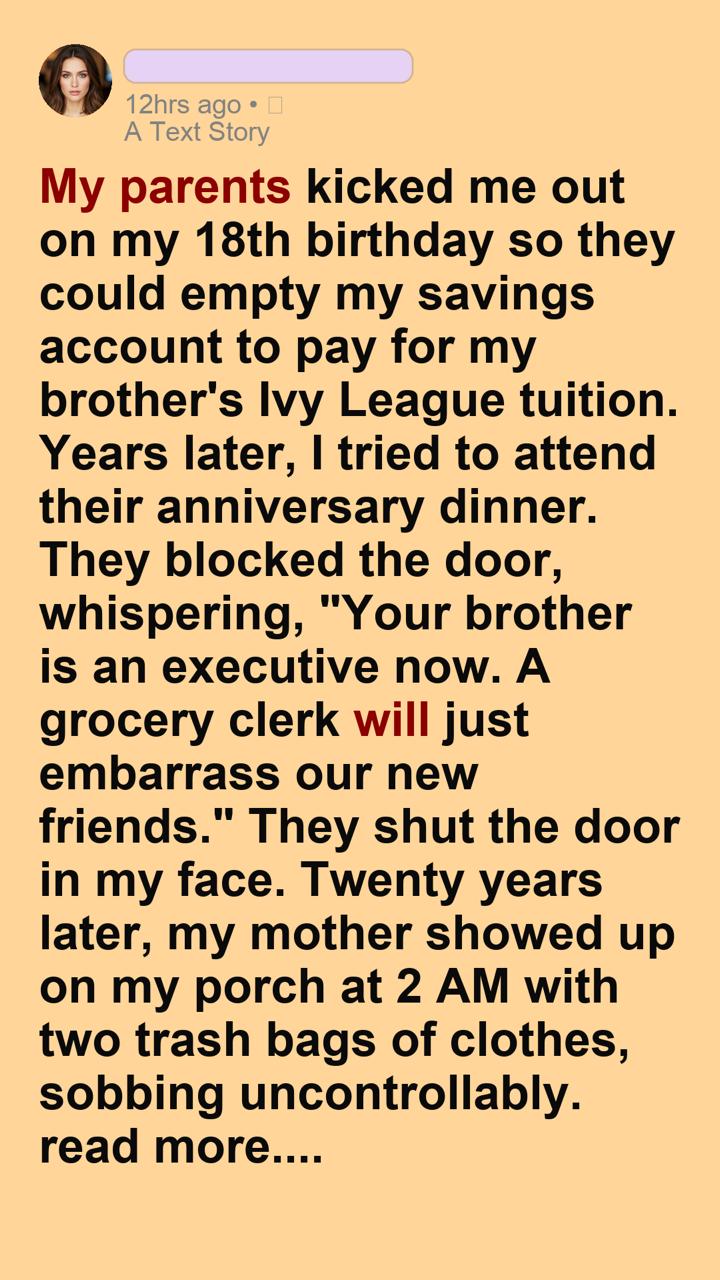
The Golden Child’s Fall
The porch light flickered, casting harsh shadows across my mother’s face. She was shivering, clutching two heavy-duty black trash bags that seemed to contain the entirety of her life. The woman who had once stood in a designer dress, blocking the door of a high-end restaurant to protect her social standing, now looked small, fragile, and utterly terrified.
“Please,” she choked out, her voice cracking. “It’s freezing. Just let me in.”
I didn’t unlatch the screen door. Through the mesh, I could feel the cold night air, but the chill radiating from my own chest was colder. “Where is Dad? Where is Richard?”
At the mention of my brother’s name, a sob violently shook her shoulders. “He lost it all. The executive job… it was built on debt. He leveraged our house, our retirement, everything to keep his lifestyle afloat when the company went under. The bank foreclosed on us yesterday. Your father is at a state-funded care facility; his heart couldn’t take the stress. Richard… Richard changed his number.”
I stood there, letting the silence stretch between us. Twenty years ago, I had begged on my knees when they drained my childhood savings—the money I had earned bagging groceries and stocking shelves—just so Richard could have a debt-free ride through the Ivy League. I remembered the smirk on my brother’s face, and the cold indifference in my mother’s eyes when she told me, “Family requires sacrifice. You’re resilient; you’ll figure it out.”
Now, she was peering past my shoulder, into the warm, softly lit foyer of my home. She saw the oak floors, the framed photos of my own family on the walls, and the quiet stability I had built from absolute scratch. The “grocery clerk” she had been so ashamed of had spent two decades working up to regional management, eventually buying out a chain of local independent markets. I had figured it out, just like she said I would.
“I have nowhere else to go,” she whispered, her hands pressing against the screen. “You’re my child.”
“I stopped being your child the day I turned eighteen,” I said, my voice steady, entirely devoid of the anger I thought I’d feel if this moment ever came. Instead, there was just a profound emptiness. “You chose your family. You invested everything you had—financially and emotionally—into Richard. I was just the collateral damage.”
“People make mistakes! We were foolish, I know that now. But you can’t leave your mother out in the cold!”
“You watched me pack a single duffel bag when I was a teenager, and you locked the door behind me,” I reminded her quietly. “You stood in front of a restaurant and told me my very existence was an embarrassment. I didn’t come here to punish you, Mom. But I won’t let you infect the peace I’ve built with the toxicity you chose.”
I reached into my pocket, pulled out my wallet, and extracted a few crisp hundred-dollar bills. I opened the screen door just enough to hand them to her.
“There’s an extended-stay motel two miles down the road,” I said, looking her dead in the eye. “This will cover a week and your cab fare. After that, I suggest you track down the executive you paid so dearly to create.”
Before she could form another plea, I stepped back and closed the heavy wooden door. I locked the deadbolt, the sharp click echoing in the quiet hallway. I stood there for a long moment, listening to her muffled cries eventually fade as she walked down the driveway. Then, I turned off the porch light and went back upstairs to the life I had built on my own.