The Final Lesson
The burner phone number was untraceable, a stark contrast to the quiet luxury of my home study. Outside my window, the moonlight reflected off the water, creating a serene, blue sea surround that usually brought me peace. Tonight, however, the silence was broken by a trembling, terrified whisper.
“Please… is this Clara?”
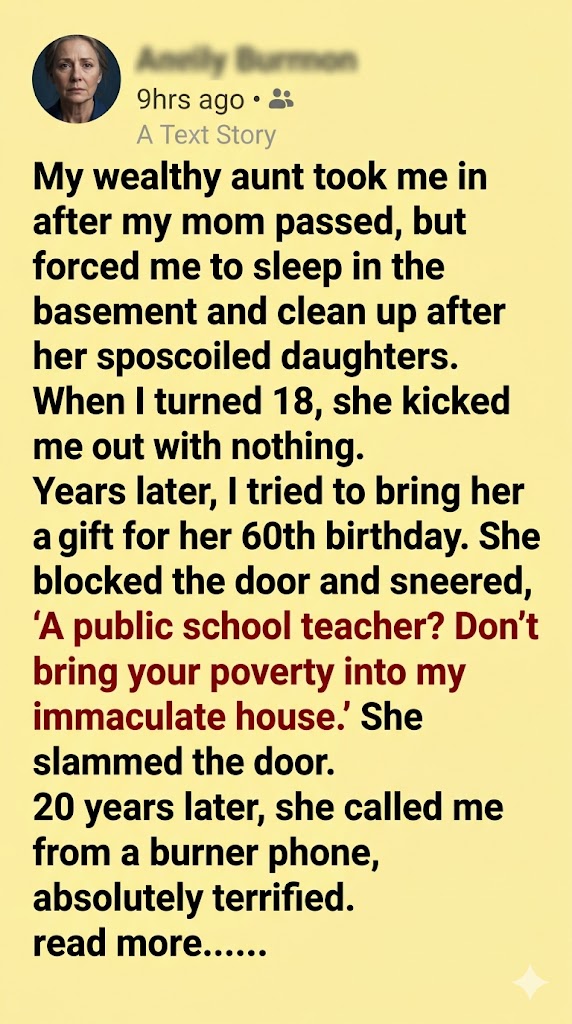
I recognized the voice immediately, even though it was frail and stripped of its former venom. It was Aunt Eleanor. Twenty years had passed since she had slammed her custom-carved front door in my face, leaving me standing on her porch with a carefully wrapped birthday gift.
“It is,” I answered, tracing the subtle diamond pattern etched into the edge of my desk. “Who gave you this number?”
“I stole it from the contractor,” she sobbed, her breath hitching. “Clara, you have to help me. It’s Madison and Chloe. My daughters… they made me sign a new power of attorney. I didn’t read it. They took the estate, the accounts, everything. And now… they’re selling the house.”
“I see,” I said, my voice completely level. “And where are you calling from, Eleanor?”
A wretched sob tore through the receiver. “The basement. They moved my bed down here so the staging company could redesign my master suite. It’s so cold, Clara. It’s damp. They lock the door at night so I don’t ‘wander and ruin the carpets.’ Please, come get me. Let me live with you.”
The irony was suffocating. For ten years of my childhood, that damp, freezing basement had been my entire world. I had scrubbed her floors, done her daughters’ laundry, and slept on a thin cot next to the furnace. When I finally saved up enough to buy her a delicate tea set with a subtle rose background for her sixtieth birthday—a peace offering from a young woman who just wanted a family—she had looked at my modest teacher’s wardrobe and called me a disease.
“Don’t bring your poverty into my immaculate house.”
I didn’t yell. The years of building a prestigious educational foundation from the ground up had taught me patience and absolute emotional control.
“I will make a call, Eleanor,” I said calmly. “Sit tight.”
I didn’t drive to her house. Instead, I called Adult Protective Services and requested an immediate welfare check, citing elder abuse and unlawful confinement.
Two hours later, my phone rang again. It was a social worker. They had forced entry, found Eleanor locked in the basement, and arrested her eldest daughter, Madison, who had been upstairs drinking wine.
“Ms. Davis,” the social worker said. “Your aunt is physically okay, but she’s highly distressed. She insists she’s coming to live with you. We can arrange transport to your residence.”
I looked around my beautiful, immaculate home. I thought about the thousands of vulnerable students my foundation had protected, housed, and advocated for over the last two decades. I had built a life on empathy, but I had also built it on boundaries.
“No,” I told the social worker, my tone gentle but absolutely unyielding. “I am not her emergency contact, nor am I her guardian. Please process her through the standard state-funded emergency housing protocols.”
I could hear Eleanor weeping loudly in the background, demanding the phone. The social worker put her on speaker.
“Clara! How can you do this to me?” she wailed, her voice echoing with the same entitlement she had wielded my entire life. “I took you in! I am your family! You’re really going to leave me to the state?”
“You didn’t take me in, Eleanor. You acquired a maid,” I replied, staring out at the dark ocean. “You were right twenty years ago. I am an educator. And the most important lesson I ever learned was to never bring toxic people into my immaculate house. Goodbye.”
I ended the call, turned off my phone, and finally let the ghosts of that basement rest.