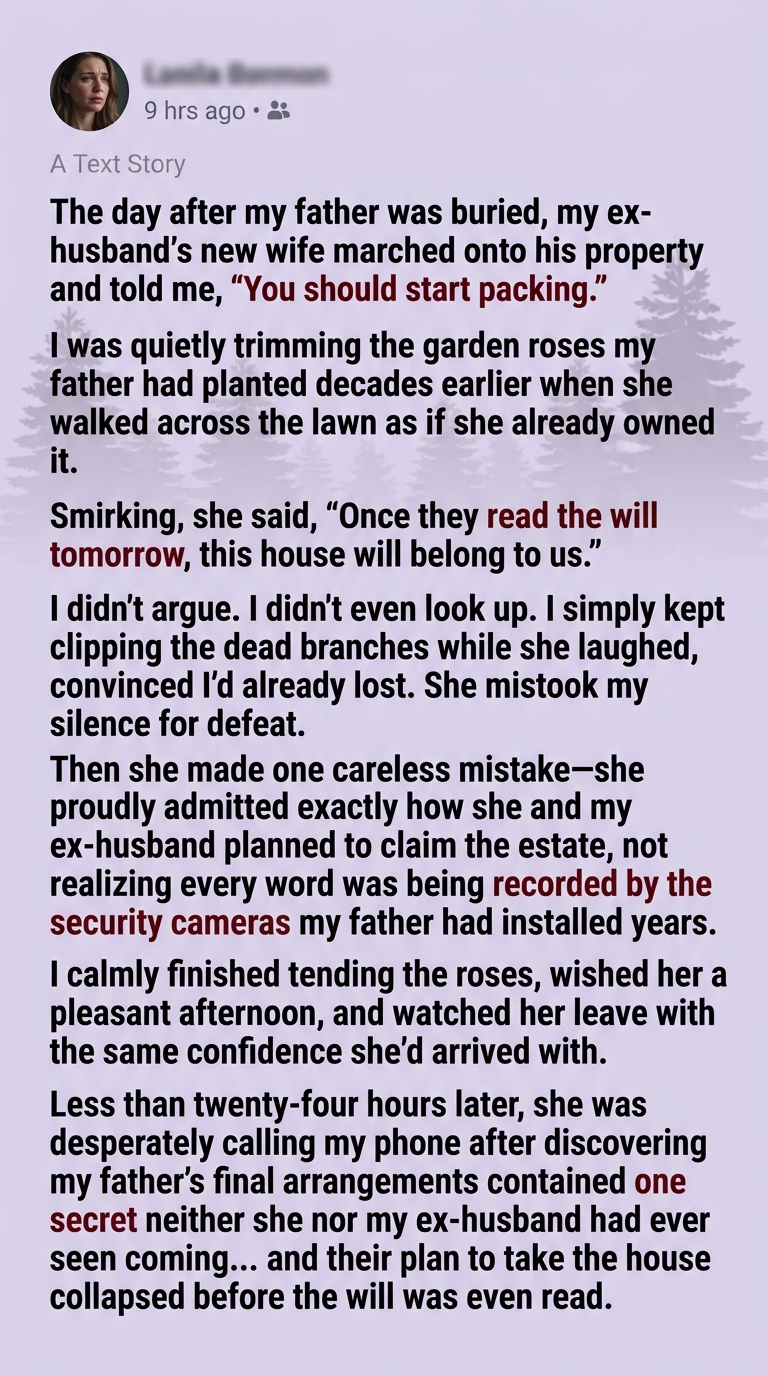
The morning after my father was buried, the house felt impossibly quiet.
For thirty-eight years it had been filled with the sounds of coffee brewing before sunrise, old country music drifting from the workshop, and my father’s steady footsteps on the back porch.
Now all I could hear were birds and the gentle scrape of my pruning shears.
He had loved his roses.
Every spring he insisted they needed “a conversation more than fertilizer.”
I still wasn’t entirely sure what that meant.
But there I was, trimming away the dead branches exactly the way he’d taught me.
That’s when I heard heels clicking across the stone walkway.
I didn’t need to turn around.
I already knew who it was.
Vanessa.
My ex-husband’s new wife.
She had been married to Daniel for less than two years, but she carried herself as though she’d been part of every chapter of his life.
She stopped beside the flower bed.
“You should probably start packing.”
I kept trimming.
“I beg your pardon?”
She smiled.
“Tomorrow’s the reading of the will.”
“I know.”
She folded her arms.
“Once they read it…”
“…this house will belong to us.”
I clipped another branch.
The silence seemed to irritate her.
“Didn’t Daniel tell you?”
“No.”
“He didn’t have to.”
She laughed.
“Your father knew he needed someone responsible to manage the property.”
I looked up for the first time.
“My father?”
“That’s right.”
“He and Daniel had an understanding.”
That surprised me.
Not because I believed her.
But because my father and Daniel hadn’t willingly spoken to one another in almost twelve years.
Their last conversation had ended when Daniel demanded money for one of his business ventures and my father refused.
After my divorce, Dad had made it clear.
“My relationship with him ended when yours did.”
Vanessa obviously didn’t know that.
She continued smiling.
“We’re already talking to contractors.”
“The place needs updating.”
She glanced toward the workshop.
“That old building will probably come down first.”
I looked back at my roses.
“I’d wait before making plans.”
“Oh, I don’t think so.”
She leaned closer.
“Daniel says once probate starts, everything will move quickly.”
Then she made the mistake that changed everything.
She laughed and said,
“It was honestly easier than we expected.”
I remained quiet.
She mistook my silence for encouragement.
“He spent months convincing everyone your father wanted him involved.”
She smiled proudly.
“By the time anyone questions it…”
“…we’ll already be living here.”
I said nothing.
She kept talking.
“People believe whatever sounds confident.”
I clipped another rose.
“I’m glad you’re feeling optimistic.”
She shook her head.
“You really don’t understand what’s happening.”
“I suppose we’ll find out tomorrow.”
She rolled her eyes.
“Suit yourself.”
As she walked away, she turned back one last time.
“I’d start boxing things tonight.”
I smiled politely.
“I hope you have a pleasant afternoon.”
She drove away looking completely satisfied.
Only after her car disappeared did I glance toward the corner of the porch.
A small security camera blinked quietly.
Dad had installed six cameras around the property years earlier after a series of break-ins in the area.
They recorded both video and audio whenever someone approached the house.
He’d once joked,
“They remember conversations better than I do.”
That evening I called Mr. Whitmore, the attorney handling Dad’s estate.
“I think you should preserve today’s camera footage.”
He asked why.
I simply answered,
“Someone made statements about the estate that you may want to hear before tomorrow.”
He agreed to review it.
The following morning, family members gathered in the attorney’s conference room.
Daniel arrived wearing a confident smile.
Vanessa sat beside him carrying a leather portfolio.
She looked around the room as though deciding where to place furniture in a house she already owned.
Mr. Whitmore greeted everyone politely.
Before opening the estate file, he addressed the room.
“Before we begin, I need to clarify several matters concerning the administration of Mr. Harrison’s estate.”
Daniel smiled.
“Of course.”
The attorney opened a different folder.
“Yesterday, I received security footage from the residence.”
Vanessa’s expression changed almost imperceptibly.
Mr. Whitmore continued.
“The recording contains statements about anticipated ownership of the property and representations concerning conversations allegedly held with the deceased.”
Daniel frowned.
“What does that have to do with anything?”
The attorney looked directly at him.
“Quite a bit.”
He pressed a button on his laptop.
The room filled with Vanessa’s unmistakable voice.
“He spent months convincing everyone your father wanted him involved.”
Then:
“By the time anyone questions it…”
“…we’ll already be living here.”
Silence.
Mr. Whitmore closed the laptop.
“I have independently reviewed Mr. Harrison’s correspondence.”
He lifted a sealed envelope.
“This letter was written six months before his death.”
He began reading.
If anyone ever claims I intended Daniel to inherit this property or manage my affairs, know that such a statement is false. Our relationship ended years ago, and I have deliberately made different arrangements.
Daniel’s face went pale.
Vanessa stared at the table.
The attorney continued.
“Mr. Harrison anticipated there might be misunderstandings after his passing.”
“He therefore transferred the house several years ago into a revocable living trust.”
I blinked.
Even I hadn’t known that.
“The trust became irrevocable upon his death.”
He smiled gently toward me.
“The successor trustee is his daughter.”
Me.
“The property is not part of the probate estate.”
Daniel leaned forward.
“That’s impossible.”
Mr. Whitmore calmly slid certified copies of the trust documents across the table.
“They were properly executed and recorded years ago.”
Vanessa whispered,
“You never told me about a trust.”
Daniel didn’t answer.
Mr. Whitmore continued.
“The trust also contains a clause directing the trustee to preserve the rose garden exactly where it stands for as long as reasonably practical.”
I laughed softly through unexpected tears.
That sounded exactly like Dad.
After the meeting ended, Daniel tried to stop me in the parking lot.
“I didn’t know about the trust.”
“I believe you.”
“Vanessa misunderstood.”
“I think both of you made assumptions.”
He lowered his voice.
“Can we talk?”
“I don’t think there’s anything left to discuss.”
Behind him, Vanessa hurried across the lot.
Her phone was already in her hand.
She called once.
Twice.
Three times.
I didn’t answer.
Instead, I drove home.
The roses were waiting.
Over the next several weeks, Mr. Whitmore completed the administration of the estate.
Because the house was already owned by the trust, there was no dramatic courtroom battle over who inherited it.
The recordings never became public.
They were simply one more piece of information that helped the attorney address misleading claims before they could create unnecessary conflict.
Months later, I converted my father’s workshop into a community gardening center.
Children learned how to grow vegetables.
Retirees shared decades of experience.
Every spring, neighbors gathered to prune the rose bushes my father had planted.
Near the entrance hung a small wooden sign bearing one of his favorite sayings:
“Strong roots don’t panic when the wind starts talking.”
People often ask why I never confronted Vanessa that afternoon.
The answer is simple.
Arguments rarely change people who have already decided what they want to believe.
Evidence speaks more quietly.
And far more clearly.
Sometimes the greatest victory isn’t watching someone else’s plans fall apart.
It’s protecting what matters without sacrificing your own peace in the process.