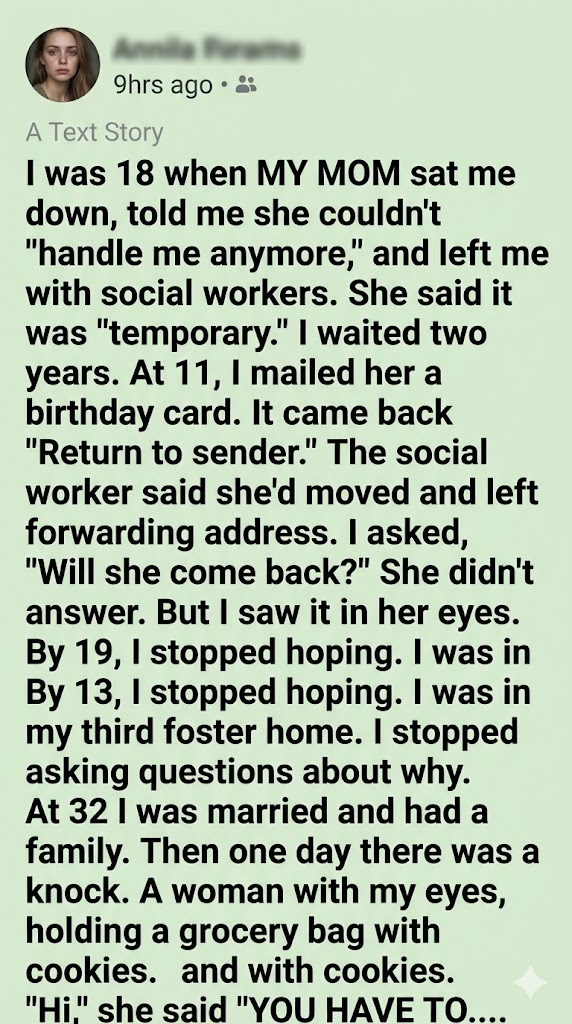
…YOU HAVE TO let me explain.”
She held out the grocery bag, her hands trembling slightly, the cheap plastic crinkling in the silence between us. I stared down at the bag. Through the semi-transparent plastic, I could see they were peanut butter cookies. The exact kind she used to buy at the corner store when she felt guilty for missing my school plays.
Time seemed to freeze. For a split second, the terrified, heartbroken child inside of me screamed—the one who had waited by the window, the one who had cried over returned birthday cards. But the woman standing in the doorway wasn’t that child anymore. I was thirty-two. I had a mortgage, a husband, and a life I had built entirely from scratch.
“You’re decades late,” I said, my voice eerily calm. I had spent hundreds of hours in therapy preparing for a moment I eventually decided would never come. Yet here she was, standing on my welcome mat like a ghost demanding to be let in.
She took a half-step forward, her eyes pleading. “I know. I know I messed up. But I was broken back then. I’m better now. I’ve been getting my life together. I wanted to find you when I was finally ready to be a mother.”
“Ready?” The word tasted like ash in my mouth. “I wasn’t a piece of furniture you could put in storage until you felt ‘ready’ to deal with me. I was a child. Your child. I survived without you, and eventually, I learned how to live without you.”
Just then, my five-year-old daughter, Maya, came skipping into the hallway. “Mommy, who’s at the door?” she asked, wrapping her small arms around my leg.
My mother’s eyes darted to Maya, welling with heavy, spilling tears. She reached a hand out, her voice cracking. “Is that… is she my granddaughter?”
I instinctively stepped back, shielding Maya with my body, protecting her from the woman who had taught me everything there was to know about abandonment.
“No,” I said firmly, the boundaries of my new life hardening into steel. “This is my daughter. And she will never know what it feels like to wait for someone who isn’t coming back.”
I looked my mother in the eyes—the exact same eyes I saw in the mirror every morning—and felt the last remaining, frayed thread of hope I didn’t even know I was holding onto finally snap. Not out of spite, but out of peace.
“I’m glad you’re doing better,” I told her, and to my own surprise, I genuinely meant it. “But you don’t get to walk into the home I built from the pieces you left behind. Goodbye.”
I didn’t wait for her to argue. I gently but firmly closed the door, the deadbolt engaging with a heavy, final click. I took a deep breath, picked Maya up in my arms, and carried her back to the kitchen where my family was waiting. For the first time in my life, I knew exactly where I belonged.