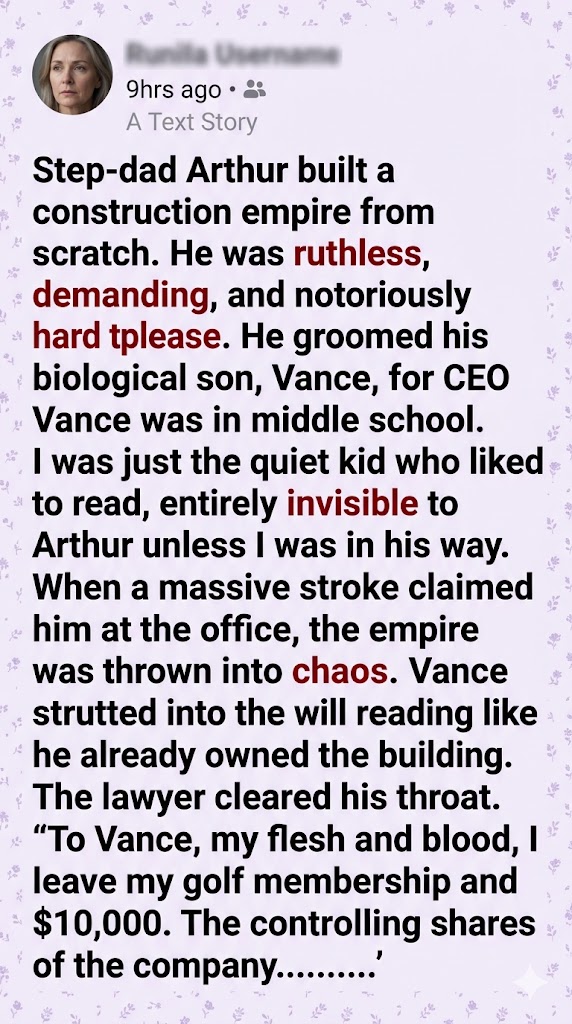
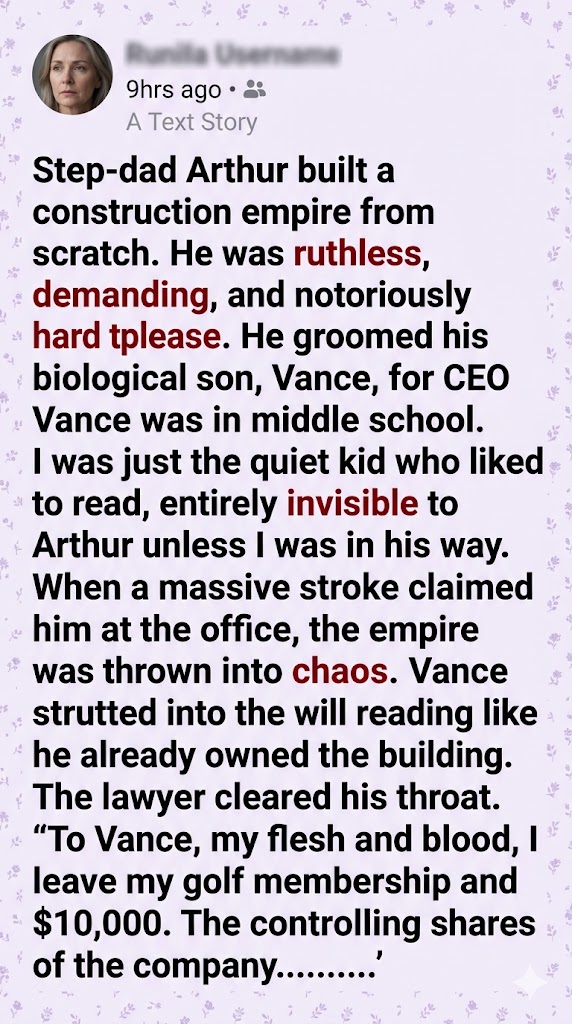
“…are left in their entirety to my step-child.”
The words hung in the stale, air-conditioned air of the conference room. For a long, agonizing moment, the only sound was the distant hum of traffic outside the high-rise window.
Vance’s smug, practiced smile didn’t immediately fall; it froze, warping into a grotesque mask of confusion. He let out a short, incredulous laugh. “Read that again, Mr. Sterling. You skipped a page. Or maybe you’re misreading the name.”
“I am reading the document exactly as your father dictated it three months ago, Vance,” the lawyer replied, his voice a flat, emotionless drone. He adjusted his glasses and looked up. “The controlling shares—sixty-eight percent of Arthur’s Holdings—are bequeathed to your step-sibling.”
“That’s impossible!” Vance slammed his hands onto the glass table, rattling the water pitchers. The veins in his neck bulged, his face flushing a furious, mottled red. “I am his son! I spent ten years on construction sites, shadowing him, learning the business! They,” he pointed a trembling, accusatory finger at me, “sit in the corner reading paperback novels! They don’t know the first thing about pouring concrete or negotiating a municipal bid!”
“Your father addressed that as well,” Mr. Sterling said smoothly. He turned a page in the heavy leather binder and began to read from a personal addendum.
To Vance: You have my temper, my pride, and my name. But you do not possess my patience. A construction empire is not maintained by swinging a sledgehammer at every problem. Over the last five years, I watched you alienate foremen, bully suppliers, and prioritize your ego over the bottom line. You are a demolition crew, Vance. Not a builder. If I give you the company, you will reduce it to rubble within a decade. The golf membership will keep you occupied while the adults work.
To my quiet step-child: You thought I didn’t see you. I saw everything. I saw you analyzing the structural blueprints I left on the kitchen island. I saw the margins of your books filled with notes, recognizing patterns and structures. You don’t speak unless you have something worth saying, and you observe the flaws in the foundation before anyone else even realizes the ground is unstable. The company doesn’t need another ruthless tyrant. It needs an architect. Build it better than I did.
I sat paralyzed, my fingers gripping the armrests of my leather chair. Arthur had never been warm. He had never offered a word of encouragement or a paternal pat on the back. But beneath his terrifying, stony exterior, he had been calculating. He hadn’t been ignoring me; he had been evaluating me.
Vance was breathing heavily, pacing the length of the room like a caged animal. “I’ll contest it,” he spat, turning on his heel. “He wasn’t in his right mind. I’ll drag you through court until you’re bankrupt!”
“Arthur anticipated that,” Mr. Sterling noted, tapping a finger on the desk. “The will contains a strict no-contest clause. If you challenge this document and lose, you forfeit the ten thousand dollars and the golf membership. You will walk away with absolutely nothing.”
Vance stopped dead in his tracks. The realization hit him like a physical blow, draining the furious color from his face. He looked at the lawyer, then at me. The bravado evaporated, leaving behind a hollow, defeated shell of a man who had built his entire identity on an inheritance he never actually earned. Without another word, he turned and walked out of the room, the heavy oak door clicking softly shut behind him.
Mr. Sterling closed the binder and offered me a small, rare smile. He slid a thick stack of urgent company documents and a heavy, gold-plated pen across the table.
“Well,” the lawyer said softly. “The board is expecting their new CEO at two o’clock. Shall we begin?”
I looked at the pen, then at the empty chair where Vance had been sitting. I picked up the pen. It felt heavy, cold, and immensely powerful. I didn’t know how to pour concrete, but Arthur was right. I knew how to read the blueprints.
“Let’s begin,” I said.