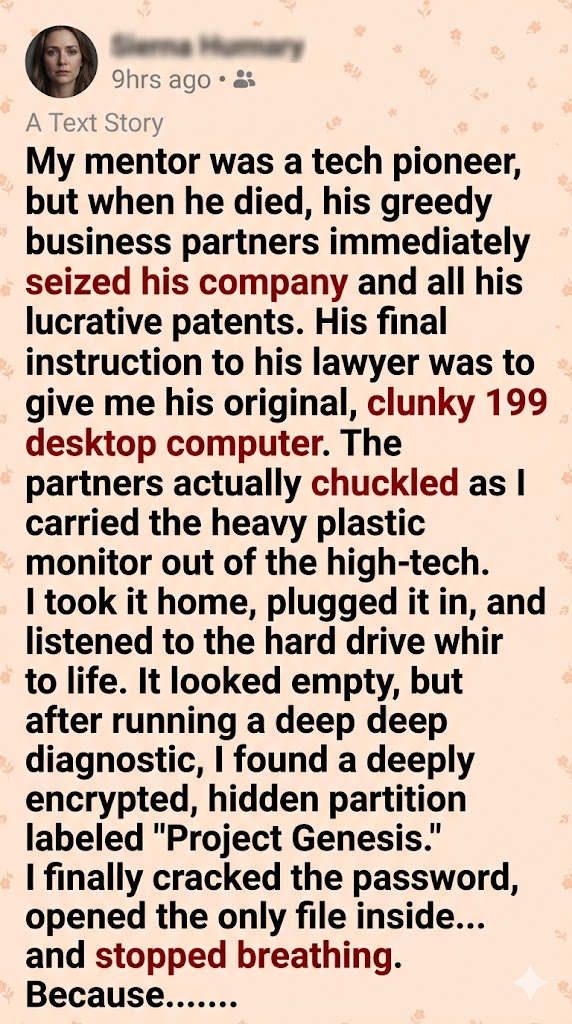
Because the screen didn’t display lines of code or legal documents—it displayed a live, pulsing network map of every single server, database, and proprietary algorithm owned by the company.
And right at the center, blinking in primitive green text, was a single command prompt: [ROOT ACCESS GRANTED. AWAITING COMMAND.]
I stared at the heavy CRT monitor, the realization washing over me like ice water. My mentor, Arthur, hadn’t just been a brilliant engineer; he was a paranoid visionary. He knew exactly what his partners, Sterling and Vance, would do the moment his heart stopped beating. They had spent years maneuvering him out of operational control, waiting for the day they could snatch the crown jewel: the Nexus AI framework, a multi-billion-dollar infrastructure that powered half the modern financial sector.
They thought they had won. They had the building, the lawyers, the flashy patents, and the bank accounts.
What they didn’t know—what nobody knew—was that Arthur never built the Nexus AI on their shiny silicon servers. He built its foundational architecture in 1998, on this exact machine. And he had hardcoded the ultimate backdoor into the framework itself. Every line of code written over the last twenty-five years, every update, every patent they just stole, was layered on top of a core protocol that only recognized this single, obsolete desktop as its absolute master.
My hands trembled as I clicked a secondary file labeled ReadMe.txt.
A video window popped up. The resolution was terrible, but there was Arthur, looking tired but possessing that familiar, mischievous spark in his eyes.
“If you’re watching this, kid,” his recorded voice crackled through the ancient plastic speakers, “it means I’m gone, and the vultures have descended. Sterling and Vance think they own the future. But they forgot that you can’t own the branches if you don’t own the roots.”
He coughed, taking a sip of water before leaning into the camera.
“The patents they seized are worthless shells. The core engine, Project Genesis, was legally registered to a blind trust twenty years ago—a trust that automatically transfers to whoever holds the digital key on this hard drive. They built a billion-dollar mansion on land they don’t own. I’m giving the deed to you. Do what you know is right.”
The video ended. Below the media player, a final script lay waiting. The file name was simply: EVICTION.exe.
I didn’t sleep that night. I sat in the glow of the 1998 monitor, watching the network traffic hum across the screen. At 9:00 AM the next morning, I knew Sterling and Vance were stepping onto the stage at the global tech summit in Geneva to announce their “new era” of leadership, completely unburdening the company of Arthur’s “outdated” morals.
I waited until 9:15 AM, right when the livestream showed Sterling walking up to the microphone, flashing his signature predatory smile to the investors.
I reached out to the heavy, yellowed plastic keyboard.
I typed RUN EVICTION.exe.
I pressed Enter.
The old hard drive ground loudly, a rhythmic clicking that sounded like a ticking clock. On my screen, a progress bar filled instantly.
On the livestream, the massive digital displays behind Sterling suddenly flickered. The corporate logos vanished. Across the globe, the company’s servers didn’t crash; they simply locked down. The proprietary AI halted. The trading algorithms paused.
Sterling tapped his microphone, looking confused as murmurs rippled through the Geneva crowd. A technician rushed onto the stage, pale and sweating, whispering frantically into Vance’s ear. I could read the technician’s lips on the high-definition feed: “We’re locked out. Of everything.”
Then, the giant screens behind them went entirely black. A single line of primitive, bright green text appeared, projected fifty feet high for the world’s most powerful investors to see.
SYSTEM REBOOT INITIATED. OWNERSHIP TRANSFERRED. GOODBYE, STERLING.
My phone began to ring almost immediately. The caller ID flashed Sterling’s name. I let it ring.
They had laughed when I carried this heavy, useless piece of junk out of their sleek, glass-walled office. Now, sitting in my cramped apartment with a computer older than most of their employees, I was the sole administrator of their entire empire.
I reached back, patted the warm plastic casing of the monitor, and picked up the phone.
“Hello, Sterling,” I said, leaning back in my chair. “We need to talk about my new lease terms.”