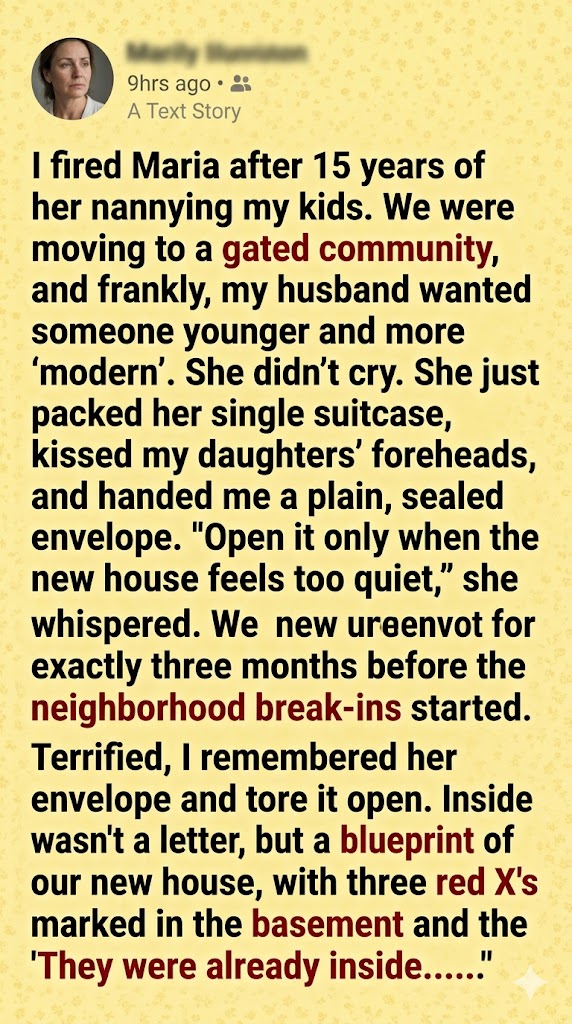
My blood turned to ice, the heavy silence of the house suddenly pressing against my eardrums. Open it only when the new house feels too quiet. It was a Tuesday afternoon. My husband, Greg, was at the firm. Our new, ‘modern’ nanny, a twenty-two-year-old named Chloe, had supposedly taken my daughters to the community clubhouse for a swim. But standing in the center of my immaculate, sun-drenched kitchen, I realized the hum of the refrigerator was the only sound I could hear.
No splashing from the backyard. No echoes of laughter from the street.
My hands trembled as I flattened the blueprint against the marble island. The three red X’s were clustered around the perimeter of our sprawling finished basement: one behind the custom wine rack, one in the utility room, and one at the back of the walk-in storage closet.
I grabbed the heaviest thing within reach—a solid cast-iron meat tenderizer from the drawer—and crept toward the basement door. Every step on the plush carpet felt deafening.
The basement was cool and dark, smelling faintly of fresh paint and cedar. I turned on the flashlight on my phone, moving first toward the utility room. The furnace hummed a low, steady rhythm. I held the blueprint up. The first X was marked directly behind the massive water heater.
I squeezed past the cylindrical tank, my breath catching in my throat. There, flush against the concrete foundation, the drywall had been cleanly cut and refitted on a set of subtle, recessed hinges. It wasn’t a wall. It was a door.
Before I could reach out to touch it, a sound froze me in place.
Scrape. Thud. Scrape.
It wasn’t coming from outside. It was coming from behind the drywall.
My mind raced back to the neighborhood break-ins. The police had been baffled. No shattered glass, no forced doors, no tripped alarms. The thieves were bypassing millions of dollars in state-of-the-art neighborhood security because they never had to cross the perimeter. The developer of this exclusive, gated community had built a network of maintenance tunnels connecting the homes—tunnels that someone had clearly repurposed.
And Maria, observant, quiet, fiercely protective Maria, had noticed the discrepancies in the floor plans during our walk-throughs. She had seen what Greg’s arrogance and my complacency had blinded us to.
Suddenly, I heard the heavy thud of the front door closing upstairs, followed by muffled voices.
“The husband’s at work until six,” a voice said. It was Chloe, the new nanny. Her tone wasn’t the bubbly, high-pitched chirp she used with my girls. It was cold, flat, and professional. “Are the basement guys in position? We need to clear out the safe before she gets back from her yoga class.”
My daughters. “Where are the kids?” a rough, male voice replied.
“Locked in the clubhouse media room with a movie,” Chloe answered dismissively. “They’re fine. Just give the signal to the walls.”
Panic and pure maternal adrenaline flooded my veins. I didn’t wait to see the utility room panel open. I scrambled out from behind the water heater, bolted silently up the back staircase, and slipped out the patio door just as the basement hinges began to squeal.
I ran. I didn’t stop to grab my purse or my car keys. I sprinted barefoot across the manicured lawns of our ‘perfect’ neighborhood, the irony of the towering iron gates mocking me. We had paid a premium to lock out the dangers of the world, never realizing we had invited them directly into our foundation—and handed them our children.
I reached the clubhouse, shattered the media room window with a landscaping rock when I found the door padlocked from the outside, and pulled my terrified daughters into my arms. We didn’t stop running until we reached the main road and flagged down a passing patrol car.
By the time the police raided the house, Chloe and the men in the walls were gone, leaving behind an empty wall safe and a network of tunnels that snaked beneath every multi-million-dollar mansion in the development.
We moved into a modest apartment across town the next week. Greg complained about the lack of square footage and the dated appliances. I didn’t care. The walls were solid. And the next morning, when a knock came at the door, I opened it to find Maria standing there, a single suitcase by her side.
She didn’t smile, and she didn’t say I told you so. She just walked past me, took my daughters into a fierce hug, and began making them breakfast.