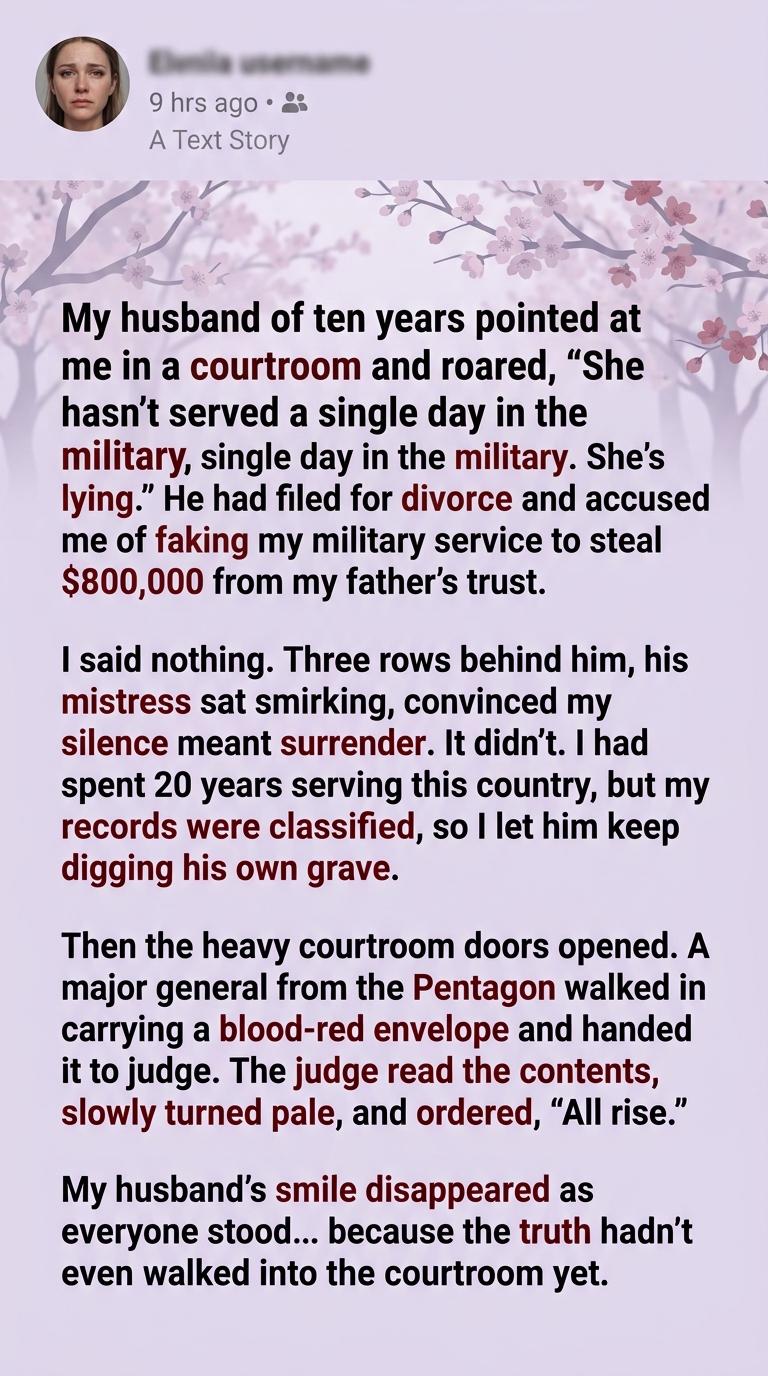
My husband of ten years pointed at me across the courtroom and roared,
“She hasn’t served a single day in the military. She’s lying!”
Every head turned toward me.
I didn’t move.
I didn’t defend myself.
I didn’t even look at him.
Because he had no idea what he was accusing me of.
And he had no idea who he was accusing.
My husband had filed for divorce three months earlier.
But divorce wasn’t enough for him.
He wanted my father’s trust.
Nearly $800,000 had been placed in my name years ago, with one condition: I had to remain legally married to my husband for the trust to remain untouched.
My husband knew about the money.
He also knew that my military history was private.
So he built his entire case around one accusation:
I had lied about serving in the military.
His attorney claimed I had invented my service history to make myself appear more successful and trustworthy.
Then my husband stood up and pointed directly at me.
“She told me she served for twenty years!”
His voice echoed through the courtroom.
“She has no military records proving it. She’s a fraud!”
Three rows behind him sat the woman he’d been having an affair with.
His mistress.
She was smiling.
She actually looked pleased.
I recognized that smile.
It was the expression of someone who believed the outcome had already been decided.
My husband glanced at her.
She nodded.
Then he turned back toward the judge.
“She lied to me for ten years,” he said. “And now she expects this court to believe her?”
The judge looked at me.
“Do you have anything to say?”
I slowly stood.
“No, Your Honor.”
My husband smiled.
His attorney smiled too.
But they misunderstood my silence.
I wasn’t silent because I had nothing to say.
I was silent because I knew exactly what would happen next.
My military service had involved assignments that weren’t publicly searchable.
Some of my records were classified.
I had never discussed the details with my husband.
Not because I was ashamed.
Because I had been ordered not to.
For ten years, my husband had assumed that meant there was nothing to find.
He was wrong.
He had spent weeks collecting screenshots from old social media posts.
He had contacted former coworkers.
He had searched public databases.
He had even hired someone to investigate me.
Every search came back with the same result:
Almost nothing.
And my husband thought “almost nothing” meant “fake.”
So I let him keep digging.
The judge asked his attorney to present the evidence.
One document after another appeared.
No public service record.
No photographs in uniform.
No online military profile.
No searchable deployment history.
The attorney looked at the judge triumphantly.
“Your Honor, there is simply no evidence that this woman served.”
I looked down at my hands.
My husband leaned back in his chair.
His mistress smiled again.
Then—
BANG.
The courtroom doors opened.
Everyone turned.
A man in a dark military uniform entered.
A major general.
The room immediately went silent.
He walked directly toward the judge.
In his hand was a thick envelope.
It wasn’t ordinary white paper.
It was dark red.
He stopped beside the judge and said,
“Your Honor, I was instructed to deliver this personally.”
The judge accepted the envelope.
He opened it.
He read the first page.
Then the second.
Then the third.
His expression changed.
The color drained from his face.
He looked at me.
Then at the major general.
Then back at the documents.
Finally, he stood.
“All rise.”
Everyone in the courtroom immediately got to their feet.
My husband’s smile disappeared.
The major general turned toward the judge.
“Your Honor, the records contained in that envelope confirm the woman’s identity, service history, rank, and assignments. Certain details remain classified.”
My husband’s attorney looked stunned.
The judge continued reading.
Then he stopped.
He looked directly at my husband.
“Mr. Carter, you accused your wife of fabricating twenty years of military service?”
My husband swallowed.
“Yes, Your Honor.”
The judge held up one page.
“She didn’t fabricate anything.”
Silence.
Then the judge read the next line.
“According to these records, your wife served under a classified designation for nearly two decades.”
My husband’s face went white.
But that wasn’t the worst part.
The judge continued.
“Her final assignment involved intelligence operations that required her identity and operational history to remain restricted.”
My husband slowly turned toward me.
For the first time in ten years, he looked at me as if he had never actually known me.
The judge then opened another document.
“And regarding the $800,000 trust…”
My husband’s attorney immediately stood.
“Your Honor—”
“Sit down,” the judge said.
The attorney sat.
The judge continued.
“The trust contains a clause concerning marital misconduct.”
My husband froze.
The judge looked at him.
“Specifically, the beneficiary loses access to the marital portion of the trust if the spouse engages in financial fraud or adultery.”
My husband’s mistress stopped smiling.
The judge looked at the evidence submitted by my attorney.
Bank transfers.
Hotel receipts.
Messages.
Photographs.
Private investigator reports.
Everything my husband thought he had hidden.
Everything he thought I hadn’t discovered.
Everything he thought would never reach the courtroom.
My attorney stood.
“Your Honor, we have evidence that Mr. Carter transferred funds from the couple’s joint account to a private account controlled by the woman seated behind him.”
The mistress’s face turned pale.
My husband turned toward her.
“What?”
She shook her head.
“No…”
My attorney continued.
“We also have evidence that Mr. Carter attempted to pressure his wife into signing documents transferring control of the trust.”
The judge looked at my husband.
“Is this true?”
He said nothing.
For the first time, he couldn’t.
The judge looked at me.
“Mrs. Carter, is there anything else you’d like this court to know?”
I stood.
I looked at my husband.
The man I’d spent ten years loving.
The man who had just stood in court and called me a liar.
Then I said quietly,
“Yes, Your Honor.”
My husband looked at me.
I held his gaze.
“I didn’t hide my military service because I was ashamed of it.”
I paused.
“I hid it because people were safer when they didn’t know.”
The courtroom went completely silent.
Then I turned toward my husband.
“But apparently, I spent ten years protecting the wrong person.”
His face crumbled.
The judge ruled against him on the trust claim.
The divorce proceeded.
The evidence of his affair and financial misconduct was entered into the record.
His attempt to seize the trust failed.
And the mistress who had spent the entire morning smiling left the courtroom alone.
As for me?
I walked out with the same silence I’d entered with.
But this time, everyone understood what that silence meant.
My husband thought silence meant weakness.
He thought classified records meant I had something to hide.
He thought he could expose me.
Instead, he exposed himself.
And as I reached the courthouse steps, the major general caught up with me.
He handed me the empty red envelope.
“You kept your promise,” he said.
I looked at him.
“What promise?”
He smiled.
“That you would never reveal what you didn’t have permission to reveal.”
I looked back at the courthouse.
Then I smiled.
Because my husband had spent months trying to prove I was a fraud.
And in the end…
the only thing he successfully proved was that he never knew the woman he married.