I Refused to Attend My Daughter’s Wedding—Then I Discovered the Woman She Had Become
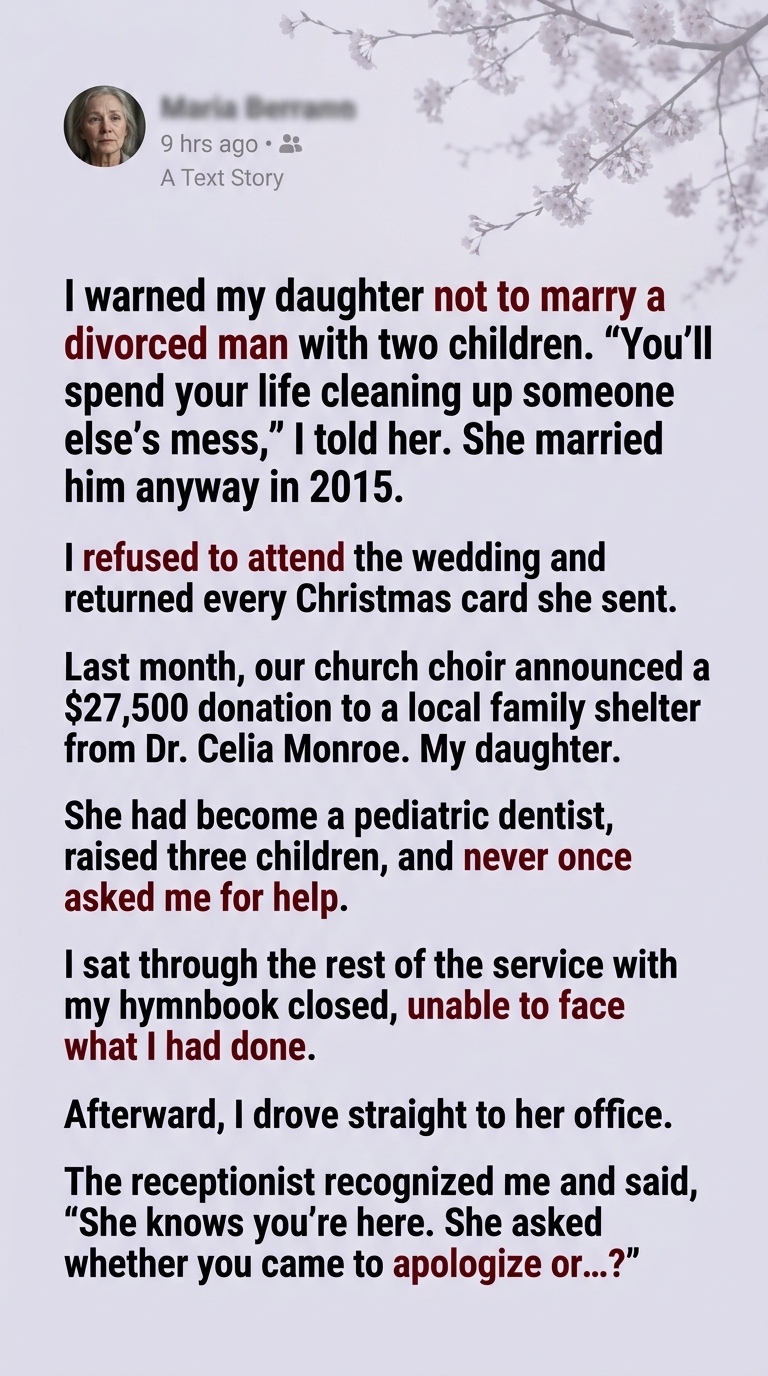
“I warned my daughter not to marry a divorced man with two children. You’ll spend your life cleaning up someone else’s mess.”
I said those words to Celia in my living room in the spring of 2015.
She was twenty-eight, intelligent, independent, and deeply in love with a man named Thomas Monroe.
Thomas had been married before. He had two children, a six-year-old boy named Oliver and a four-year-old girl named Sophie.
His divorce had been difficult, his finances were stretched, and he came with responsibilities that I believed my daughter was too young to understand.
I told her she deserved someone without baggage.
She told me she loved him.
I told her love wasn’t enough.
She said she wasn’t asking for my permission.
That was the beginning of the end.
When she announced their wedding date, I refused to attend.
I returned the invitation without opening it.
She called me several times.
I didn’t answer.
She sent a Christmas card that December, with a photograph of herself, Thomas, and the two children.
I wrote Return to sender across the envelope.
The following year, another card arrived.
I returned that one too.
By the third year, the cards stopped.
I told myself I had protected my daughter from a difficult life.
I told my friends she had made her choice and would eventually understand.
But she never came back asking me to rescue her.
And that, more than anything, made me angry.
I was sixty-three years old, and I believed I knew exactly how her marriage would end.
I imagined her exhausted, financially dependent, and constantly competing with her husband’s former wife.
I pictured her sacrificing her career to raise children who weren’t hers.
I had already written the ending in my head.
I never considered that she might write a different one.
Last month, I attended Sunday service at St. Andrew’s Church.
I had been a member for nearly thirty years. I knew the choir director, the pastor, and most of the families who sat in the front rows.
After the service, the choir director stepped toward the microphone.
“We have some wonderful news to share today,” she announced.
“A generous donation of twenty-seven thousand five hundred dollars has been made to our local family shelter. This contribution will help provide temporary housing, meals, and essential support for families experiencing difficult circumstances.”
People applauded.
Then she read the donor’s name.
“Dr. Celia Monroe.”
My daughter.
For a moment, I thought I had misheard.
But the choir director continued.
“Dr. Monroe is a pediatric dentist who has also spent years supporting families in our community. She asked that the donation be made quietly, but the shelter requested permission to recognize her generosity.”
The congregation applauded again.
I sat frozen.
My daughter had become a pediatric dentist.
She had married the man I had warned her against.
She had raised three children.
And she had donated $27,500 to help families she had never met.
I had spent nine years refusing to acknowledge her life.
She had spent those same nine years building one.
I closed my hymnbook.
I couldn’t sing.
I couldn’t even look toward the people sitting beside me.
After the service, an older woman approached.
“Isn’t that your Celia?” she asked warmly.
I nodded.
“You must be so proud.”
I forced a smile.
“Yes,” I whispered.
But the word caught in my throat.
Because the truth was that I was proud.
And ashamed.
I had missed her wedding, her achievements, her birthdays, and the ordinary moments that make a mother a mother.
I had returned her Christmas cards without even reading what she wrote.
I didn’t know whether she still liked the same flowers or whether she had changed her favorite dessert.
I didn’t know what her children called her.
I didn’t know what kind of dentist she had become.
I knew nothing.
And it was my own doing.
I drove straight to her dental office.
It was a bright building near the town center, with colorful illustrations of animals on the windows and a small waiting area filled with children’s books.
A little boy was sitting on his mother’s lap, holding a stuffed dinosaur.
The receptionist looked up.
“Good afternoon. How can I help you?”
I gave her my name.
Her expression changed slightly.
“Mrs. Monroe?”
I nodded.
She glanced toward the hallway.
“Dr. Monroe knows you’re here.”
My heart began beating faster.
The receptionist hesitated, then said:
“She asked whether you came to apologize or…?”
She didn’t finish.
I looked down at my handbag.
“I came to see my daughter.”
The receptionist gave me a gentle nod.
“Please have a seat. I’ll let her know you’re ready.”
I sat down.
There were photographs on the wall.
Celia in her white dental coat.
Celia standing beside Thomas at what looked like a school event.
Celia with three children, all smiling.
I recognized the oldest two from the Christmas cards I had returned.
Oliver was now a teenager.
Sophie had grown into a beautiful young woman.
The third child was a little boy I had never met.
My grandson.
A child whose birth I had missed.
A child who might not even know I existed.
I pressed my hands together.
Then a door opened.
“Mom?”
I stood.
Celia was wearing a white coat, with her hair pulled back and a small name badge pinned to her chest.
She looked older, of course.
There were faint lines near her eyes, and her face had the calm confidence of someone who had spent years making difficult decisions.
But her eyes were still the same.
I wanted to hug her.
Instead, I stood there like a stranger.
“Hello, Celia.”
She glanced toward the receptionist.
“Can we use my office?”
I followed her down the hallway.
Her office was small and tidy.
There were children’s drawings pinned to a board, a photograph of Thomas holding a newborn baby, and a framed certificate from her dental school.
Celia closed the door.
Then she turned toward me.
“You have twenty minutes before my next patient,” she said.
I nodded.
“I won’t take long.”
She sat behind her desk.
I remained standing.
“I heard about the donation at church,” I began.
“That’s nice.”
“Twenty-seven thousand five hundred dollars. That’s a lot of money.”
“Yes. The shelter needed help.”
I looked at her.
“You’ve done very well for yourself.”
She didn’t smile.
“I’ve worked hard.”
“I know.”
“No, Mom. You don’t.”
Her words were quiet, but they hurt.
I sat down.
She continued.
“You don’t know how hard dental school was while raising two children. You don’t know how many evenings Thomas cooked dinner because I was studying. You don’t know how Oliver used to sit outside my room and wait for me to finish assignments so I could read him a bedtime story.”
I lowered my eyes.
“You don’t know how scared Sophie was when she started school, or how Thomas held my hand when I gave birth to Noah.”
She paused.
“You don’t know any of those things because you weren’t there.”
I began crying.
“I know.”
Celia leaned back.
“Why are you here?”
I took a breath.
“Because I was wrong.”
She didn’t respond.
“I was wrong about Thomas. I was wrong about the children. I was wrong to think your marriage would ruin your life.”
Celia stared at me.
I continued.
“I thought I was protecting you. I thought I knew what was best. But I was so determined to prove myself right that I stopped seeing you as my daughter.”
My voice broke.
“I returned your Christmas cards. I refused to attend your wedding. I missed years of your life because I couldn’t accept that you had made a choice I disagreed with.”
Celia looked down at her desk.
For a moment, I thought she might cry too.
Instead, she asked a question I wasn’t prepared for.
“Do you remember the Christmas card I sent in 2018?”
I nodded slowly.
“I remember returning it.”
She opened a drawer and removed a small envelope.
It was the same card.
She had kept it.
I recognized my handwriting across the front.
Return to sender.
Celia placed it on the desk.
“I kept this because I wanted to remember what it felt like to finally stop waiting.”
I covered my mouth.
“I didn’t know.”
“You didn’t ask.”
She was right.
I wanted to explain myself.
I wanted to tell her about the fear I had carried after watching friends struggle through second marriages. I wanted to explain that I had worried she would become a caretaker instead of a wife.
But I realized that explanations could easily become excuses.
So I said the only thing that mattered.
“I’m sorry.”
Celia looked at me for a long time.
Then she asked:
“Are you apologizing because you finally believe I made the right choice, or because the church announced how much money I donated?”
I felt the question like a slap.
“Because I hurt you.”
She waited.
“I’m proud of what you’ve accomplished,” I continued. “But I shouldn’t need to hear about your achievements before recognizing that I treated you terribly.”
Celia’s expression softened slightly.
“I didn’t donate that money to impress anyone.”
“I know.”
“I donated it because I know what it feels like when a family is struggling. Those children deserve support. Their parents deserve a chance to rebuild.”
I nodded.
Then I said something I had been afraid to say.
“Would you ever let me meet them?”
She looked toward the family photograph on her desk.
“Oliver and Sophie know about you. Noah knows you exist, but he doesn’t really understand why you haven’t been around.”
I swallowed.
“I would love to meet them.”
“Mom, you can’t walk into their lives and expect them to act like nothing happened.”
“I understand.”
“They have feelings too. Especially Oliver and Sophie. They remember when you stopped responding.”
I nodded.
“I won’t pressure them.”
Celia looked at me carefully.
“I can’t promise everything will go back to how it was.”
“I don’t expect that.”
“Then what do you expect?”
I thought for a moment.
“A chance to show you that I can do better. Even if it takes years.”
She looked away.
Her next patient was due in ten minutes.
Finally, she stood.
“I have to get back to work.”
I stood too.
Before I reached the door, she said something quietly.
“Mom?”
I turned.
“I did miss you.”
My eyes filled.
“I missed you too.”
“But I learned how to live without waiting for you.”
I nodded.
“I understand.”
She didn’t hug me.
And I didn’t ask her to.
Two weeks later, Celia sent me a message.
Would you like to come for Sunday lunch? Just you and us. No big expectations.
I read it several times.
Then I replied.
I would love that. Thank you for inviting me.
On Sunday, I arrived with a homemade apple pie.
Thomas opened the door.
He looked at me for a moment before stepping aside.
“Hello, Margaret.”
“Hello, Thomas.”
I wanted to apologize immediately, but I didn’t know where to begin.
He simply said, “Celia is in the kitchen.”
Inside, Oliver was sitting on the sofa looking at his phone. Sophie was setting the table, and little Noah was building a tower with wooden blocks.
Celia introduced me.
“This is Grandma Margaret.”
Noah looked up.
“Are you really my grandma?”
I smiled through my tears.
“Yes, sweetheart.”
He considered that for a moment.
“Do you like dinosaurs?”
I laughed softly.
“I think I could learn to.”
He immediately brought me a plastic dinosaur.
Oliver gave me a polite nod.
Sophie smiled, but there was still distance in her eyes.
I understood.
I hadn’t earned their affection simply by arriving.
Lunch was awkward at first.
Thomas asked about the church. Celia talked about work. I listened more than I spoke.
After lunch, I helped clear the table.
Celia joined me in the kitchen.
For a moment, we stood side by side.
Then she said, “Thank you for not making today about the past.”
I looked at her.
“I’ve had enough years of making everything about my opinion.”
She smiled faintly.
It wasn’t forgiveness.
But it was a beginning.
Over the next several months, I made an effort to become part of their lives without demanding a place I hadn’t earned.
I attended Noah’s school concert when Celia invited me.
I sent Oliver a birthday card and didn’t expect a reply.
I bought Sophie a book she had mentioned liking, but I let her decide whether she wanted it.
I stopped criticizing Thomas.
More importantly, I stopped offering advice unless someone asked.
One afternoon, Celia called me.
“Mom, can you watch Noah for an hour next Thursday? I have an appointment.”
I nearly cried.
“Of course.”
When I arrived, Noah ran toward me holding a toy dinosaur.
“Grandma! I saved you the biggest one!”
I knelt and hugged him.
That evening, after I returned home, I sat at my kitchen table and thought about the woman I had been in 2015.
I had believed that refusing to attend the wedding would teach Celia a lesson.
Instead, I had taught her that my love came with conditions.
She had built a beautiful family without my approval.
She had become a respected pediatric dentist.
She had helped children she had never met.
And she had done all of it while carrying the pain of being rejected by her own mother.
I couldn’t change the years I had missed.
But I could stop wasting the years I had left.
At Christmas, Celia invited me to their home.
When I arrived, there were lights around the windows and children’s stockings hanging above the fireplace.
Thomas greeted me warmly.
Oliver helped carry my gifts inside.
Sophie asked whether I wanted tea.
And Noah ran toward me shouting, “Grandma’s here!”
I stood in the doorway, taking it all in.
Celia came over and handed me a small envelope.
Inside was a photograph of the family at the beach.
On the back, she had written:
We can’t change the past, but we can decide what we do next.
I held the photograph against my chest.
“I don’t deserve this,” I whispered.
Celia looked at me.
“Maybe not. But I want to give us a chance.”
I hugged her.
This time, she hugged me back.
Not because everything was forgiven.
Not because the past had disappeared.
But because she had decided to leave a little room for something new.
Later that evening, we sat around the table while Noah told everyone a very complicated story about a dinosaur who had lost his Christmas hat.
Everyone laughed.
I looked at my daughter.
She was happy.
Not in the way I had once imagined happiness should look.
In her own way.
With a husband I had judged unfairly, children I had refused to welcome, and a life she had built through hard work and love.
I had spent nine years believing I was protecting her.
The truth was that she had never needed me to approve of her choices.
She had only needed me to love her.
And I had nearly lost the chance to do that.
That night, when I returned home, I placed the old returned Christmas cards in a drawer.
I didn’t throw them away.
They were a reminder of the years I could never recover.
But beside them, I placed the new family photograph.
And for the first time in a very long time, I had something to look forward to.
I was no longer waiting for my daughter to admit I had been right.
I was finally learning how to be her mother again.