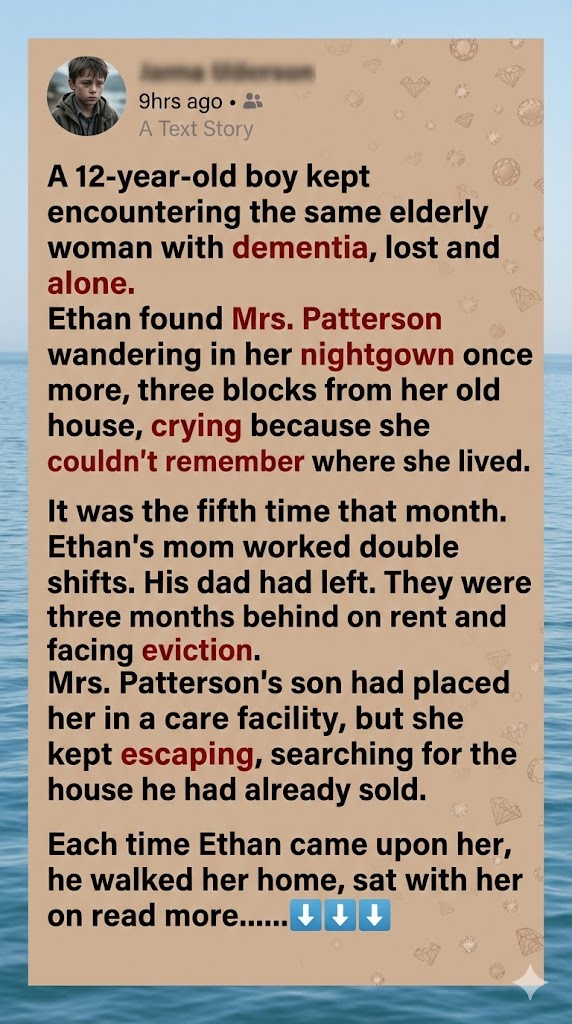
Each time Ethan came upon her, he walked her home, sat with her on the porch steps of the care facility, and waited until a nurse came rushing out, breathless and apologetic.
“It’s okay,” Ethan would always say. “I found her.”
Mrs. Patterson never quite remembered him. Some days she called him “Tommy.” Other days she thought he was her late husband. But she always held his hand tightly, as if it were the only solid thing in her shifting world.
That afternoon, when Ethan found her again, she was shivering despite the warm breeze.
“They sold it,” she kept whispering. “I just need to get back before they change the locks.”
Ethan swallowed. He knew that house. Blue shutters. A big oak tree in the yard. A wind chime that still hung on the porch even though a new family lived there now.
“Come on, Mrs. Patterson,” he said gently. “Let’s get you somewhere warm.”
Instead of heading straight to the facility, he walked her slowly past her old street. He didn’t take her to the door — he knew that would only confuse her more. But he stopped across the road.
“Look,” he said softly. “Your flowers are still blooming.”
She stared at the garden the new owners had kept alive. Her face softened.
“They are?” she asked.
“Yep. Means someone’s taking good care of it.”
For a moment, she seemed peaceful.
The next day, Ethan did something bold.
He knocked on the door of the blue-shuttered house.
A young couple answered, hesitant at first. Ethan explained about Mrs. Patterson — how she wandered, how she cried for this house, how she just needed something familiar to hold onto.
To his surprise, their expressions changed from caution to compassion.
Two days later, they called him over.
They had placed a small bench beneath the oak tree and hung a new wind chime beside the old hook. On the fence, they’d mounted a simple sign:
“Patterson’s Garden — Always Welcome.”
The following week, Ethan spoke with the care facility director. With permission from Mrs. Patterson’s son and supervision from staff, they arranged short, scheduled visits to the garden when she became restless.
The first time they brought her back properly, escorted and safe, she stepped into the yard and smiled in a way Ethan had never seen before.
“Oh,” she breathed. “There it is.”
She didn’t ask to go inside. She didn’t cry.
She just sat on the bench, listening to the wind chime, her hand resting in Ethan’s.
Meanwhile, things at Ethan’s apartment weren’t getting easier. The eviction notice still sat folded in a kitchen drawer. His mom came home exhausted every night, trying to hide her fear.
One evening, the young couple from the blue house stopped by Ethan’s building. They had spoken with neighbors, heard about his family’s situation, and quietly organized something of their own.
Between neighbors, church members, and even staff from the care facility, they pooled enough money to cover two months of Ethan’s rent — just enough time for his mom to catch up.
When Ethan’s mom found the envelope taped to their door, she cried harder than Mrs. Patterson ever had.
“You did this?” she asked Ethan.
He shook his head. “No. I just helped someone find her way home.”
Mrs. Patterson never fully regained her memory. Some days she still wandered. But she wandered less. And when she grew anxious, the staff would say, “Do you want to visit your garden?”
And that was enough.
As for Ethan, he learned something at twelve years old that many adults never do:
Sometimes, when you help someone find their home, the world finds a way to protect yours too.