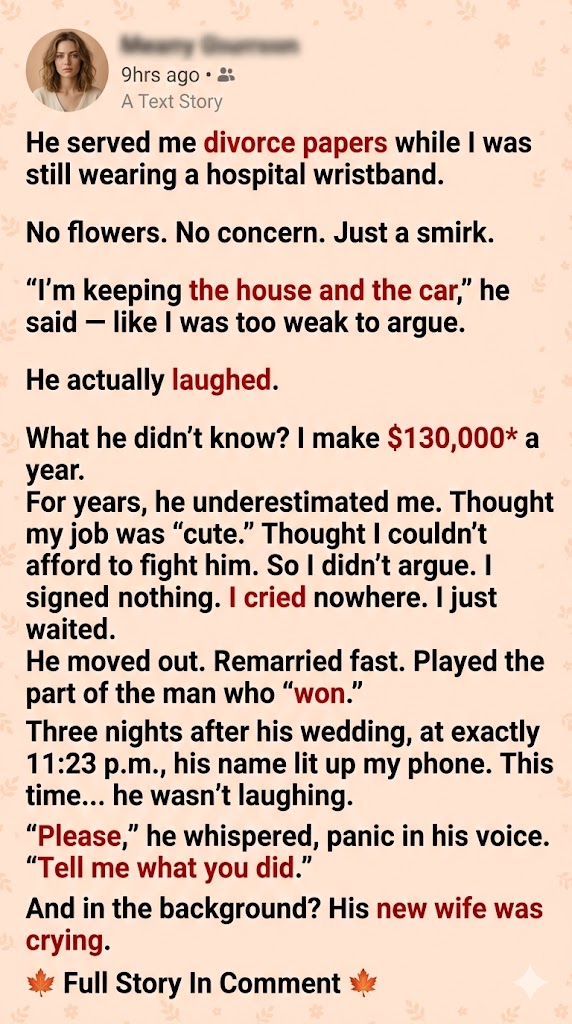
He served me divorce papers while I was still wearing a hospital wristband.
I remember the antiseptic smell. The way the fluorescent lights made everything look pale and unreal. I’d just been discharged after a minor surgery—nothing life-threatening, but enough to leave me exhausted and stitched up. I thought he was coming to take me home.
Instead, he handed me an envelope.
No flowers. No concern. Just a smirk.
“I’m keeping the house and the car,” he said casually, like he was calling dibs on leftovers. “It’ll be easier for you this way.”
Easier.
He actually laughed when I stared at him.
What he didn’t know? I make $130,000 a year. And I’d been quietly saving for three.
For years, he underestimated me. Called my job “cute.” Told his friends I “helped out with bills.” He never asked questions because he never thought he needed to. He assumed I couldn’t afford to fight him.
So I didn’t argue.
I signed nothing.
I cried nowhere he could see.
And I waited.
While he strutted around like he’d won, I met with a lawyer. A very good one. I brought bank statements, proof of my contributions to the mortgage, the renovations I paid for, the joint investments he’d forgotten I managed.
The house wasn’t just “his.” Neither was the car. And the small consulting business he’d started during our marriage? Legally, I owned half of that too.
He moved out before the court date. Remarried fast. Posted photos in a tailored suit, arm wrapped around someone younger, shinier. The caption read: “Finally with someone who truly supports me.”
I almost laughed.
The settlement came two weeks later.
He had two choices: sell the house and split the equity… or buy me out at market value. The market had climbed. A lot.
He couldn’t afford to buy me out without liquidating his business shares.
So we sold the house.
I took my half of the equity. My half of the investments. And a negotiated portion of his business to keep him from dragging it out in court.
He thought the nightmare was over when he remarried.
It wasn’t.
Three nights after his wedding, at exactly 11:23 p.m., his name lit up my phone.
I let it ring twice before answering.
He wasn’t laughing now.
“Please,” he whispered, panic shredding his voice. “Tell me what you did.”
“I followed the law,” I said calmly.
In the background, I heard a woman crying.
His new wife.
“You told her the house was paid off?” I asked softly.
Silence.
“You told her the business was fully yours?”
Another silence.
“You didn’t mention the loan you had to take to buy me out… or the fact that half your profits are tied up in repayment for the next five years?”
His breathing grew ragged.
“She thinks I lied,” he said. “She thinks I trapped her.”
“No,” I corrected gently. “You trapped yourself.”
Apparently, during their honeymoon, paperwork from the bank had arrived at their new apartment. Reality doesn’t care about wedding vows.
“She says she wants an annulment,” he choked.
I closed my eyes, not from sadness—but from release.
For years, I had shrunk myself so he could feel tall. I let him believe I was fragile. Dependent. Powerless.
But strength doesn’t always look loud. Sometimes it looks like patience. Like preparation. Like silence.
“I didn’t do anything to you,” I told him. “I just stopped protecting you from the consequences of your own arrogance.”
His new wife’s sobbing got louder.
“Please,” he whispered again.
But this time, I didn’t feel anger.
I felt free.
“I hope you figure it out,” I said.
And I hung up.
The next morning, I signed the papers on my new place—a sunlit condo with floor-to-ceiling windows and not a single memory of him inside it.
He thought I was too weak to argue.
He never realized I was strong enough to wait.