I Found My Mother-in-Law Locked in the Attic—Then She Whispered Something That Changed Everything
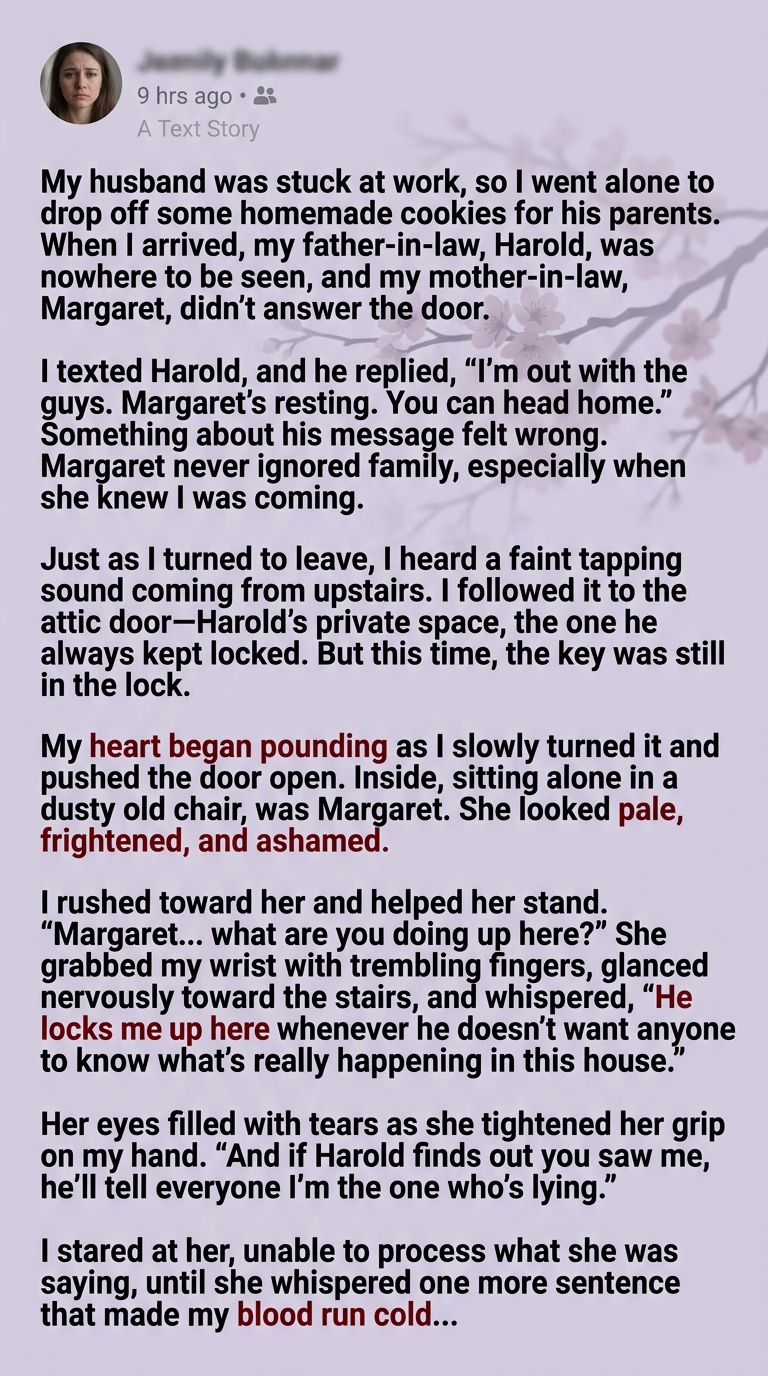
I was only supposed to drop off a batch of homemade cookies.
My husband, Ethan, had been stuck at work, so I decided to visit his parents alone. Margaret had always loved my baking, and I thought a surprise visit might brighten her afternoon.
But when I arrived, something felt wrong.
The front curtains were closed. No television was playing. Margaret’s car was parked outside, but nobody answered when I knocked.
I called her.
Nothing.
I tried Harold, my father-in-law.
He texted back almost immediately.
I’m out with the guys. Margaret’s resting. You can head home.
I stared at the message.
Margaret never ignored me. Even when she was sick, she always answered with a quick message or asked me to leave something on the kitchen counter.
I was about to walk back to my car when I heard it.
Tap.
Tap.
Tap.
The sound came from somewhere above me.
I stopped.
Then it happened again.
I followed the sound through the hallway to the staircase leading to the attic. Harold always kept that door locked. He called it his private office and storage room, and nobody was allowed inside.
But that afternoon, the key was still hanging in the lock.
My stomach tightened.
I turned it slowly.
The door creaked open, revealing a narrow staircase covered in dust.
“Margaret?”
A faint voice answered.
“Please…”
I rushed upstairs.
She was sitting in an old chair near the window, her hands trembling. Her hair was messy, her face pale, and there was a glass of water beside her that looked untouched.
“Margaret!”
I ran toward her.
“What happened? Why are you up here?”
She grabbed my wrist so tightly that I felt her fingernails digging into my skin.
“Don’t let him know you found me.”
“Who? Harold?”
She nodded frantically.
“He locks me up here whenever I try to tell someone.”
I couldn’t believe what I was hearing.
“Why would he do that?”
She began crying.
“He says nobody will believe me. He says I’m confused. He says I’m getting old and imagining things.”
I helped her stand, but she suddenly pulled me back.
Then she whispered the sentence that made my blood run cold.
“Harold has been trying to make everyone believe I’m losing my mind because he’s been stealing our money—and he’s preparing to have me declared incapable of making my own decisions.”
I stared at her.
“What?”
She reached beneath the chair cushion and pulled out a folded piece of paper.
“I found this in his desk. It’s a copy of a document with my signature. But I never signed it.”
My hands began shaking as I unfolded it.
It was a financial authorization granting Harold control over several of Margaret’s accounts.
The signature looked almost identical to hers.
Almost.
But Margaret had never agreed to anything like that.
“He told me it was paperwork for the insurance,” she whispered. “Then I saw the bank statements. He was moving money every month.”
“How much?”
She looked at me.
“Almost everything.”
I felt sick.
“How long has this been happening?”
“Three years.”
Three years.
The man who sat at family dinners, told jokes, and acted like the perfect husband had been quietly draining his wife’s savings.
Margaret tried to explain that she had confronted him weeks earlier. Harold had denied everything, then told their relatives she was becoming forgetful.
When she threatened to go to the bank, he began locking her upstairs whenever he left the house.
“He told me today that he was going out with friends,” she whispered. “But he wasn’t. He was meeting the lawyer who is helping him sell the house.”
I looked toward the attic door.
“Then we’re leaving. Right now.”
Margaret shook her head.
“He has cameras downstairs.”
I felt a cold wave of fear.
“Cameras?”
“Not everywhere. But he watches the front door. He knows when I try to leave.”
I took out my phone.
“I’m calling the police.”
Margaret grabbed my hand again.
“Please. He’ll say I’m lying.”
I looked directly into her eyes.
“Then we’ll make sure someone listens.”
I called emergency services and quietly explained that I had found an elderly woman locked inside an attic, that she was afraid of her husband, and that she needed immediate assistance.
Then I called Ethan.
He answered on the second ring.
“Hey, babe. What’s going on?”
“Your mother is locked in the attic.”
Silence.
“What?”
“Your father locked her upstairs. She says he’s been stealing her money and trying to make everyone believe she’s mentally incapable of handling her finances.”
Ethan didn’t say anything for several seconds.
Then he said,
“I’m leaving work. Don’t let Mom out of your sight.”
I stayed beside Margaret until the officers arrived.
When they entered the house, I heard a car pull into the driveway.
Harold was back.
He walked through the front door carrying a grocery bag and stopped when he saw two police officers.
“What is this?”
One officer stepped forward.
“Sir, we need to speak with you.”
Harold looked up toward the staircase.
Then he saw me.
His expression changed instantly.
“What did you do?”
I didn’t answer.
Margaret was sitting beside me, holding my hand.
Harold pointed at her.
“She gets confused. She shouldn’t be up there wandering around. I was keeping her safe.”
One officer asked,
“Why was the attic door locked?”
Harold hesitated.
“It’s my office. I keep private documents there.”
“Then why was your wife inside?”
“She went up there herself.”
Margaret finally spoke.
“No, Harold.”
Her voice was weak, but clear.
“You locked me in.”
His face hardened.
“You don’t know what you’re talking about.”
She began trembling.
I moved closer to her.
“Don’t talk to her like that.”
The officer immediately intervened.
Harold started explaining that Margaret had been suffering from memory problems, that she had been making accusations, that the family knew she wasn’t well.
But Ethan arrived before he could finish.
He walked into the room, looked at his mother, and then looked at his father.
“Dad. What did you do?”
Harold shook his head.
“This is a misunderstanding.”
Margaret slowly pulled the forged financial authorization from her pocket.
“I found this.”
Ethan looked at the paper.
Then at his father.
“Did you forge Mom’s signature?”
Harold’s voice rose.
“You don’t understand how complicated the finances are!”
“Then explain it.”
Harold couldn’t.
The police separated everyone and began documenting the situation. Margaret was taken for a medical examination, and officers photographed the attic, the lock, and the conditions in which she had been kept.
That night, she refused to return to the house.
We brought her to ours.
She slept in the guest bedroom, but Ethan sat beside her for hours. Every time she woke up, she asked whether Harold knew where she was.
“Mom, you’re safe,” Ethan kept telling her.
But she didn’t believe it yet.
The following morning, Ethan and I accompanied Margaret to a lawyer.
She brought everything she had managed to collect over the past several months.
Bank statements.
Copies of documents.
Emails.
Notes she had written whenever Harold made her sign something.
The attorney reviewed the papers and discovered that several withdrawals had been made from Margaret’s personal accounts. Harold had also attempted to transfer ownership of a property that belonged solely to her.
The authorization document she had found was not legitimate.
A forensic review later confirmed that the signature had been copied from an older document.
Harold had been using Margaret’s money to pay debts connected to a failed investment and had been hiding the losses from the family.
When he realized she had discovered the transactions, he began trying to convince relatives that she was becoming mentally unstable.
He thought if nobody believed her, nobody would question him.
But he had made one mistake.
He had locked her in the attic.
And I had found her.
Within days, the bank placed restrictions on the disputed accounts while the matter was investigated. Margaret’s attorney filed for protective orders and began the process of securing her property and finances.
Harold was questioned about the confinement and the financial documents.
His carefully constructed story began falling apart.
Ethan was devastated.
“I ate dinner with him last week,” he told me. “He joked with me. He asked about my job. How could he do this to Mom?”
I didn’t have an answer.
Sometimes the people who hurt others are the same people who know exactly how to act normal afterward.
A few weeks later, Margaret was sitting in our kitchen when she suddenly began crying.
I put down my coffee.
“What’s wrong?”
She shook her head.
“I keep thinking about the cookies.”
I smiled gently.
“What cookies?”
“The ones you brought that day. If you hadn’t come…”
Her voice broke.
I reached across the table and held her hand.
“You don’t have to think about that.”
She wiped her tears.
“I thought everyone would believe him. I thought I would spend the rest of my life locked in that house while he told people I was crazy.”
“You’re not crazy, Margaret.”
She looked at me for a long time.
Then she whispered,
“I know that now.”
The investigation continued for months. Harold faced legal consequences for the financial misconduct and unlawful confinement, and the family finally learned the truth about the money he had taken and the lies he had told.
Margaret eventually recovered control of her accounts and moved into a smaller, peaceful home of her own choosing.
She planted flowers outside her front door.
She started attending a weekly book club.
She began answering the phone without fear.
And every Sunday, she baked cookies with me.
Sometimes chocolate chip.
Sometimes oatmeal.
Sometimes the terrible lemon cookies she insisted were delicious, even though Ethan and I secretly hated them.
One afternoon, while we were cleaning flour off the kitchen counter, she looked at me and said,
“You know, I used to think being a good wife meant protecting my husband’s reputation.”
I stopped wiping the counter.
“And now?”
She smiled.
“Now I know protecting myself isn’t betrayal.”
I hugged her.
And I thought about that locked attic, the dusty chair, the key left in the door, and the woman who had been terrified nobody would believe her.
Harold had spent years convincing Margaret that she was powerless.
But he was wrong.
All it took was one person refusing to walk away when something felt wrong.
And that afternoon, I had been that person.