They Humiliated Me at My Sister’s Wedding—Then One Phone Call Changed Everything
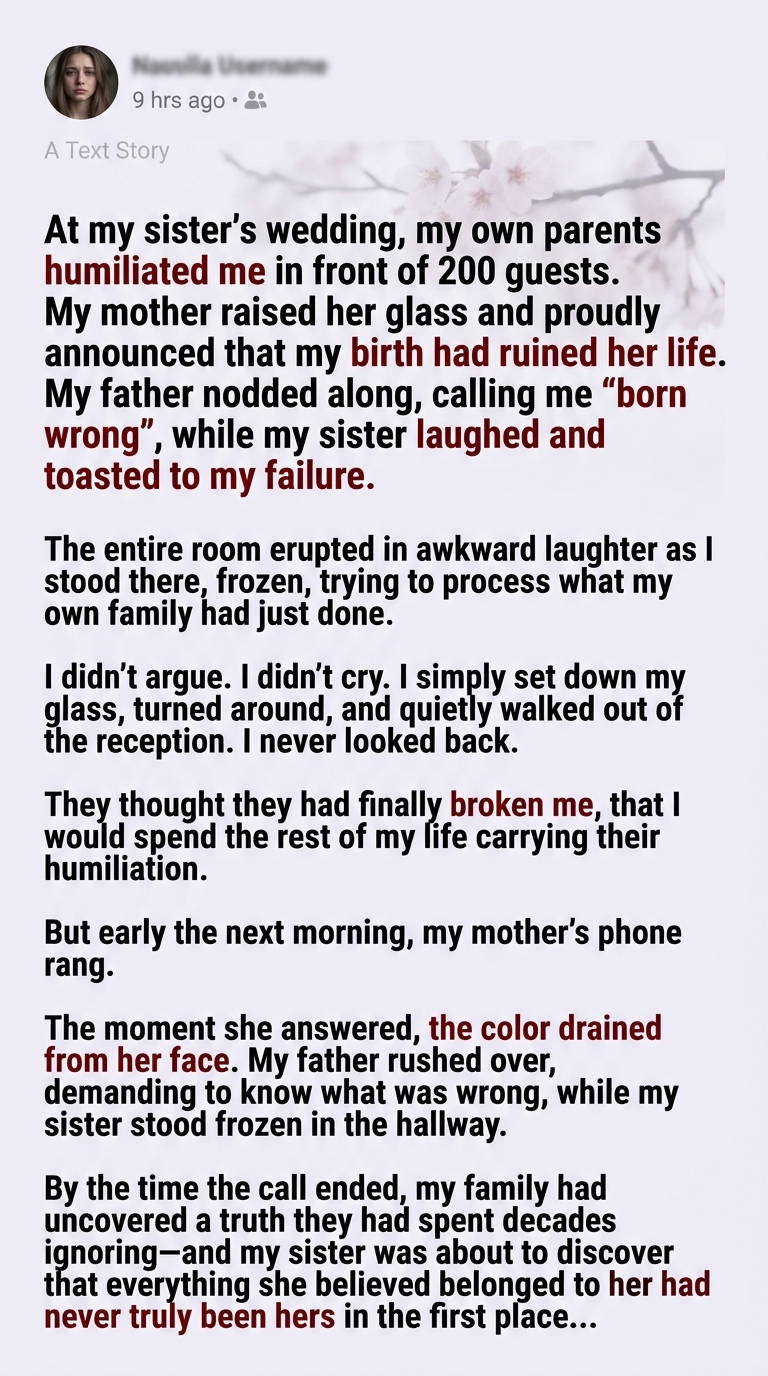
At my sister’s wedding, my own parents humiliated me in front of nearly 200 guests.
My mother raised her champagne glass, smiled at the crowd, and said, “If there’s one mistake I made in my life, it was giving birth to someone who never amounted to anything.”
People stopped talking.
Then my father laughed.
“Some children are born to make their parents proud,” he said. “Others are simply born wrong.”
My sister, Emily, stood beside her new husband in her expensive white wedding dress, laughing as though their words were the funniest joke she had ever heard.
“Come on, Mom,” she said, pretending to defend me. “Don’t be so harsh. She’s trying her best.”
The room erupted in uncomfortable laughter.
I stood there holding a glass of champagne, feeling as if every eye in the room had been turned into a knife.
I was thirty-two years old. I had a job, my own apartment, savings, and a life I had built without asking anyone for help. Yet standing in that reception hall, I suddenly felt like the little girl who had spent her entire childhood trying to earn her parents’ love.
My mother had always preferred Emily.
Emily was beautiful, outgoing, and talented at making people admire her. She knew how to smile at the right moment, say the right words, and make everyone believe she was the perfect daughter.
I was the quiet one.
The daughter who worked after school. The daughter who paid her own college tuition. The daughter who took care of my grandmother when everyone else was too busy.
But none of that mattered.
Whenever Emily needed something, my parents gave it to her.
When she wanted a car, they bought one.
When she wanted to travel, they paid for it.
When she started a business and failed, my father called it a learning experience and gave her more money.
When I needed help, my mother told me I was old enough to figure things out on my own.
I had learned a long time ago not to expect anything from them.
But I never expected them to humiliate me at a wedding.
I slowly placed my glass on the table.
My mother looked at me with a satisfied smile, as if she was waiting for me to cry.
“Are you going to say something?” she asked.
I looked at her.
Then I looked at my father.
Finally, I looked at Emily, who was still smiling.
“No,” I said quietly.
I picked up my purse and walked away.
Behind me, I heard my father say, “See? She can’t even take a joke.”
The laughter followed me toward the exit.
I kept walking.
I didn’t cry until I reached my car.
And even then, I didn’t cry for the insult.
I cried because, for the first time, I finally understood that I had spent my entire life trying to be loved by people who enjoyed making me feel small.
That night, I made a decision.
I would never beg them to respect me again.
The Phone Call the Next Morning
At 7:14 the following morning, my mother’s phone rang.
She was still in bed when she answered.
“Hello?”
A man on the other end introduced himself as the attorney handling my grandmother Margaret’s estate.
My grandmother had passed away six months earlier.
My mother immediately sat up.
“Is there a problem with the inheritance?”
The attorney paused.
“Actually, Mrs. Carter, there is something you and your husband need to know. Your mother’s final documents have been verified, and the transfer instructions are being finalized. I need to inform you that the property and financial assets will not be distributed according to the arrangement you previously discussed with your family.”
My mother’s smile disappeared.
“What arrangement?”
“Your mother left a signed and legally witnessed will, along with a separate letter explaining her intentions. The primary beneficiary is your younger daughter.”
My mother went silent.
“What?”
The attorney continued.
“The estate includes the family property, investment accounts, and several other assets. Your mother specifically requested that these remain under your younger daughter’s control.”
My mother began shouting.
“That’s impossible! Emily was supposed to receive the house!”
The attorney calmly replied, “That was never what the final will stated.”
My mother dropped the phone.
My father rushed into the bedroom.
“What happened?”
She stared at him, her face pale.
“She left everything to her.”
“To whom?”
My mother whispered my name.
My father grabbed the phone and demanded to speak to the attorney.
Within minutes, my sister was called.
Emily arrived at my parents’ house still wearing yesterday’s makeup and carrying her wedding gifts in the car.
“What is going on?” she asked.
My mother started crying.
“Your grandmother left everything to your sister.”
Emily stared at her.
“Everything? What do you mean everything?”
“The house. The accounts. The investments. All of it.”
Emily’s expression changed from confusion to anger.
“That house was supposed to be mine!”
My father paced the room.
“Something must have happened. Your grandmother was confused. We need to challenge this.”
But the attorney had already anticipated their reaction.
He explained that my grandmother had updated her will several years earlier, had the documents properly witnessed, and had also recorded her reasons for making the decision.
The family couldn’t simply pretend the will didn’t exist.
And the reason behind it was about to destroy the story they had told themselves for decades.
The Secret My Grandmother Had Kept
Two days later, we gathered at the attorney’s office.
I hadn’t spoken to my parents since the wedding.
When I walked in, Emily immediately crossed her arms.
“You must be really happy,” she said bitterly. “You got exactly what you wanted.”
I looked at her.
“I haven’t asked for anything.”
“Don’t pretend you’re innocent. Grandma always liked you better.”
The attorney interrupted.
“Before we discuss the estate, Mrs. Margaret requested that a letter be read aloud to all four of you.”
He opened an envelope.
The handwriting was unmistakably my grandmother’s.
“To my family,
I know that when I am gone, some of you will question my decision. You may believe I was unfair, or that I was manipulated. But I made this decision with a clear mind, after years of watching what happened in this family.
I watched one granddaughter grow up believing she could never do anything right, while the other was taught that the world owed her everything.
I watched my younger granddaughter work quietly, sacrifice her own comfort, and show up when nobody else did.
When I was sick, she was the one who sat beside me. She was the one who brought groceries, drove me to appointments, and stayed awake through nights when I was frightened.
I never asked her to do those things. She did them because she loved me.
I also watched how her parents treated her. I heard the insults. I saw the dismissive smiles. I saw how her achievements were ignored while her sister’s mistakes were forgiven.
I am not leaving this estate to punish anyone. I am leaving it to the person I trust to protect what I worked my entire life to build.
The house is not a prize. The money is not a reward for being the favorite.
It is a responsibility.
And I know the granddaughter I chose understands that.”
By the time the attorney finished reading, my mother was crying.
My father looked down at the table.
Emily’s lips trembled.
But there was one more page.
The attorney turned it over.
“Your grandmother also included a specific explanation regarding the family property.”
He read the final paragraph.
“The property was never promised to Emily. I know she was told that, and I know she believes it. But I never made that promise. I asked the family to respect my wishes, and I was disappointed to discover that someone had already begun making plans for a house that was not theirs.
I hope this will finally teach them that entitlement is not the same as inheritance.”
Emily suddenly stood up.
“That’s a lie!”
The attorney calmly placed a folder on the table.
Inside were copies of the legal documents, dates, signatures, and records showing that the estate had been finalized according to my grandmother’s wishes.
Emily stared at the pages.
Then she looked at my mother.
“You told me the house was mine!”
My mother couldn’t answer.
The Truth About the House
Emily turned toward my father.
“You told me I could move into Grandma’s house after the wedding! You said we would renovate it and sell the condo!”
My father rubbed his forehead.
“We thought your grandmother would leave it to you.”
“Thought?” Emily shouted. “You told me it was mine!”
The attorney cleared his throat.
“There is one additional matter. Margaret left instructions that the beneficiary should receive the property free of any family pressure. She also included records documenting expenses she had paid on behalf of certain family members over the years.”
My mother looked up.
“What records?”
The attorney opened another folder.
It contained a detailed list of loans my grandmother had given my parents and Emily.
Some had been described as gifts.
Others had been explicitly recorded as loans.
Emily’s wedding itself had been partially funded by my grandmother.
The attorney explained that the wedding expenses were a gift, but several large transfers to Emily’s business had been documented as loans. Those loans were not automatically forgiven by the will.
Emily’s face went white.
“You’re saying I owe Grandma money?”
“Her estate is entitled to collect outstanding documented debts, subject to the terms of the estate and applicable law,” the attorney answered.
My father slammed his hand on the table.
“This is ridiculous! We are family!”
The attorney looked directly at him.
“Family relationships do not invalidate legal documents.”
For the first time in her life, Emily couldn’t smile her way out of a problem.
They Came to My Door
That evening, my parents showed up at my apartment.
I opened the door and immediately regretted it.
My mother was crying.
My father looked angry.
Emily stood behind them, still wearing her wedding ring, her face red from crying.
“We need to talk,” my father said.
“About what?”
“Your grandmother’s estate.”
I stepped aside, but I didn’t offer them anything to drink.
My mother sat on my couch and started sobbing.
“Your grandmother made a terrible mistake. She was influenced by you.”
I stared at her.
“I barely discussed the estate with Grandma.”
“Don’t lie!” Emily shouted. “You were always there! You manipulated her!”
I slowly shook my head.
“I was there because she was my grandmother. She was sick. She needed someone. I went because I loved her.”
Emily pointed at me.
“Now you’re going to take the house away from me?”
I couldn’t believe what I was hearing.
“You were never given the house.”
“Dad promised!”
I turned toward my father.
“Did you promise her something that didn’t belong to you?”
He looked away.
That silence told me everything.
My mother wiped her tears and leaned forward.
“You can fix this. Just tell the lawyer you don’t want the inheritance. We can divide everything fairly between you and Emily. Your sister has just gotten married. She needs a home.”
I looked at Emily.
“Where were you when Grandma needed help?”
Emily rolled her eyes.
“I had my own life.”
“Exactly.”
My mother immediately snapped.
“Don’t you dare act superior! You think you’re better than your sister because you took care of an old woman?”
“No,” I said. “I think I was the only one who showed up.”
The room went silent.
My father stepped forward.
“You’re still our daughter. You owe us some respect.”
I looked straight at him.
“Respect isn’t something you can demand after spending your entire life giving me none.”
He raised his voice.
“You are going to destroy this family over money!”
I felt my hands trembling, but I didn’t back down.
“You destroyed something at that wedding. Not me.”
I opened the door.
“Please leave.”
Emily started crying.
“You’re really doing this to me?”
I answered quietly.
“No. I’m finally not doing everything for you.”
They walked out.
And for the first time, I didn’t feel guilty watching them go.
The Final Decision
Over the following weeks, I worked with the attorney to settle my grandmother’s estate.
I didn’t sell the house.
I kept it exactly as she had wanted.
The garden was still full of roses she had planted. Her favorite reading chair remained beside the window. Her old kitchen table still had the small scratches from decades of family dinners.
I used part of the inheritance to repair the house and create a small scholarship fund for students who had to work while attending college.
I also honored my grandmother’s documented wishes regarding the estate and outstanding debts.
Emily and her husband eventually moved into a smaller home they could afford without relying on money they had never legally owned.
My parents stopped calling for a while.
Then, about four months later, my mother sent me a message.
We miss you. Can we have dinner?
I stared at it for a long time.
The old version of me would have rushed to respond.
I would have apologized for making things difficult. I would have offered to meet them. I would have tried to make everything normal again.
But I wasn’t that person anymore.
I replied:
I’m willing to talk when you’re ready to acknowledge what happened at the wedding and how you’ve treated me for years. I won’t pretend it was okay just to keep the peace.
She didn’t answer for three days.
Then she wrote:
Your father says we shouldn’t have said those things.
It wasn’t an apology.
It was a sentence designed to make the problem disappear.
I didn’t respond.
One Year Later
A year after the wedding, I held a small gathering at my grandmother’s house.
Nothing extravagant. Just a few close friends, food on the table, flowers from the garden, and the sound of people laughing without anyone being humiliated.
I stood by the window looking at the roses when someone knocked.
It was my mother.
She was alone.
She looked older than I remembered.
“I know you may not want to see me,” she said.
I didn’t move.
She took a deep breath.
“I came to apologize.”
For once, she didn’t mention the inheritance.
She didn’t mention Emily.
She didn’t ask me to share the house or fix the family.
She simply said, “What we said at the wedding was cruel. Your father and I had no right to humiliate you. I spent years treating you like you were less important than your sister, and I convinced myself you were strong enough to handle it. That wasn’t an excuse. It was wrong.”
I didn’t immediately forgive her.
I had spent too many years accepting half-apologies and pretending they were enough.
“Why did you do it?” I asked.
She began crying.
“Because I was wrong. Because I didn’t see how much I hurt you. Because I thought you would always forgive me.”
I looked at her for a long time.
“That was the problem, Mom. You thought I would always forgive you, no matter what you did.”
She nodded.
“I know.”
I let her sit for a while.
We talked, but things weren’t suddenly fixed. Trust takes longer than a conversation. Forgiveness doesn’t erase the past, and an apology doesn’t automatically reopen every door.
Emily never apologized.
She sent a message months later asking whether I could help her financially because she and her husband were struggling with their expenses.
I declined.
Not because I wanted revenge.
But because I had finally learned that loving someone doesn’t mean sacrificing yourself every time they refuse to take responsibility.
The Last Letter
That evening, after everyone left, I returned to my grandmother’s bedroom.
I was cleaning a drawer when I found a small envelope tucked inside her old book.
My name was written on the front.
Inside was a final note.
“My dear girl,
If you are reading this, I hope you have finally stopped trying to prove your worth to people who refuse to see it.
You were never the disappointment they called you.
You were never born wrong.
You were never difficult to love.
Some people spend their entire lives trying to make others smaller because they are afraid of what those people might become if they ever realized their own strength.
Don’t let anyone make you believe that your kindness is weakness.
But remember, kindness does not mean allowing people to hurt you repeatedly.
You are allowed to walk away.
You are allowed to say no.
You are allowed to build a life that doesn’t include people who keep breaking your heart.
And if you ever wonder whether I was proud of you, remember this:
I was proud of you long before you inherited anything.
I loved you long before you achieved anything.
And I will always be proud of the person you are.
Love,
Grandma.”
I sat on the floor and cried.
Not the way I cried after the wedding.
This time, the tears weren’t from humiliation.
They were from finally hearing the words I had spent my entire life waiting for.
I folded the letter carefully and placed it back inside the envelope.
Then I walked out into the garden.
The house was quiet.
The roses were blooming.
And for the first time in my life, I didn’t feel like I needed to prove anything to anyone.
My parents had called me a disappointment in front of 200 people.
But the truth was, I hadn’t lost my family that night.
I had finally stopped losing myself trying to keep them.
They thought they had broken me at my sister’s wedding. They never realized that the moment I walked out, I was beginning the life they could no longer control.