My Mother Called Me a Failure in Front of 200 Wedding Guests—By Morning, My Sister Discovered Who I Really Was
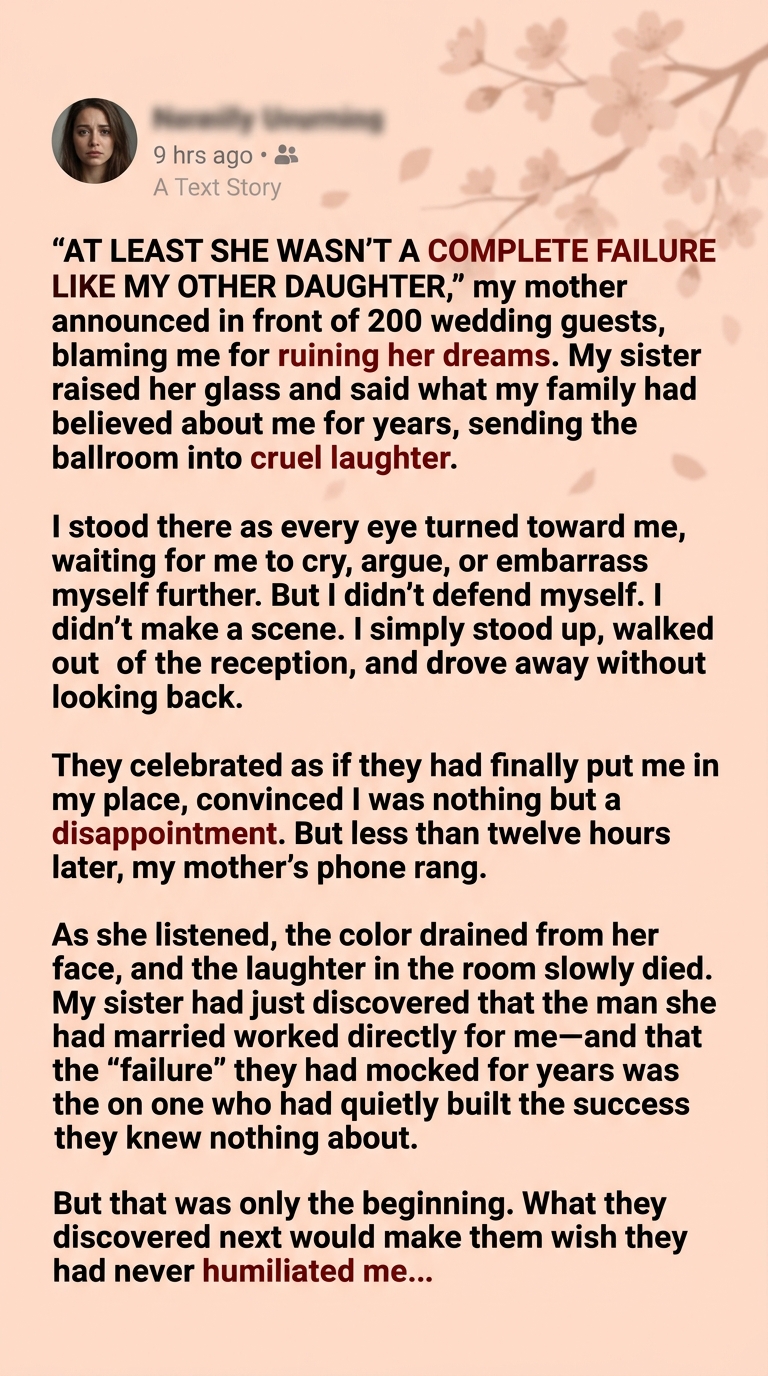
“At least she wasn’t a complete failure like my other daughter.”
My mother’s voice echoed across the ballroom.
Two hundred wedding guests sat beneath crystal chandeliers, holding champagne glasses and watching me standing near the head table.
My sister, Lauren, laughed.
“Honestly, Mom, we stopped expecting anything from her years ago.”
A few people chuckled.
Then my mother raised her glass.
“To daughters who make their parents proud.”
Everyone applauded.
I stood there in a navy dress, holding a gift envelope I’d spent weeks preparing, listening to the woman who raised me explain why I had disappointed her entire life.
My mother had always compared me to Lauren.
Lauren was the pretty one.
The successful one.
The daughter who knew how to make an entrance, how to smile for photographs, how to impress people with expensive vacations and designer handbags.
I was the daughter who worked too much, dressed simply, and rarely talked about what I did.
For years, my mother had introduced me with the same sentence.
“She works in business. Nothing particularly exciting.”
I never corrected her.
I had learned that explaining myself to my family was like trying to fill a leaking bucket.
That night, my sister’s new husband, Nathan, stood beside her in a perfectly tailored tuxedo. He was a senior executive at a technology company, the kind of man my mother had spent months bragging about.
“Lauren finally married someone with a future,” my mother said during the toast.
Then she looked directly at me.
“Unlike some people who never figured out what to do with their lives.”
The laughter was louder this time.
I felt the humiliation settle over me, but I didn’t cry.
I didn’t argue.
I didn’t remind her that I had paid my own way through college, built a company from a rented office, or spent the last seven years working eighteen-hour days.
I simply placed the envelope on the table.
Then I stood up.
My sister called after me.
“Don’t be dramatic! It’s a wedding!”
I turned around once.
“No. It’s your wedding. Enjoy it.”
Then I walked out.
I drove home, removed my earrings, washed my face, and sat in silence.
At 11:47 p.m., my phone began ringing.
It was my business partner.
“Are you sitting down?”
“What happened?”
“Your sister’s husband is Nathan Cole, right?”
“Yes.”
“Do you know where he works?”
I almost laughed.
“Of course I do.”
There was a pause.
“Nathan just sent an email to the executive team. He wants to know if the rumors about your company are true.”
I sat up.
“What rumors?”
My partner forwarded the email.
Nathan had apparently discovered that the company he worked for was about to sign a major acquisition agreement with our firm.
And he had just realized who owned it.
Me.
I had started my company seven years earlier.
At the time, I had been twenty-six, living in a tiny apartment, working two jobs, and trying to build software that would help small retailers manage inventory without paying the ridiculous fees charged by larger systems.
My mother had called it a hobby.
My sister had called it “one of those little projects that probably won’t last.”
But it lasted.
The company grew from three employees to thirty, then eighty, then several hundred.
We expanded into multiple markets.
We secured contracts with national retailers.
We eventually became one of the most competitive companies in our sector.
I didn’t post about my success.
I didn’t buy a mansion.
I didn’t drive an expensive car.
I kept my life private because I had learned early that the people who constantly demanded to know how much you earned were often the same people who had nothing to say when you needed help.
My family had never asked what my company was worth.
They had never asked how many people worked for me.
They had never asked what I was building.
They only knew I was “still working too much.”
And I had never corrected them.
Until Lauren married Nathan.
Nathan worked for Westbridge Technologies, a corporation that had spent the previous six months negotiating a partnership with my company.
He was a senior executive in their strategic development division.
He had been involved in the acquisition review.
He knew the name of my company.
But he had never known the identity of its founder.
Because I had insisted on meeting the executive team through formal business channels, and I had never attended the social events where Nathan might have connected the dots.
The acquisition was scheduled for final approval the following Monday.
And Nathan had just discovered that the woman his new wife called a failure was the founder and majority owner of the company his employer was preparing to acquire.
At 7:12 the next morning, my mother called.
I ignored it.
She called again.
Then Lauren.
Then Nathan.
Finally, I answered my mother’s call.
“What is going on?” she demanded.
I took a sip of coffee.
“Good morning.”
“Lauren’s husband says you own a company that Westbridge is trying to buy.”
“That’s correct.”
There was a long silence.
Then she whispered,
“Why didn’t you tell us?”
I almost smiled.
“You never asked.”
“Don’t be ridiculous. We’re your family.”
“Yesterday, you told two hundred people I was a failure.”
“That was a joke!”
“Everyone laughed.”
My mother began crying.
“People are saying you’re worth millions.”
I looked out the window.
“People have been saying a lot of things about me for years. You never believed any of them.”
She changed her tone.
“Your sister is very upset. Nathan is worried about his position at work. You need to talk to him.”
I leaned back.
“Why?”
“Because this is affecting his career!”
I couldn’t believe it.
Not once had she asked whether I was hurt by what happened the night before.
Not once had she apologized.
Her first concern was Nathan’s job.
“Mom,” I said quietly, “you called me a failure in front of two hundred people. I’m not responsible for what Nathan discovers at work.”
She hung up.
At 8:30, Nathan called.
His voice was polite, but I could hear the panic.
“Emily, I think we need to talk about the acquisition.”
“I’m happy to discuss it through the proper channels.”
“I’m not calling as an executive. I’m calling as family.”
I laughed softly.
“Yesterday, I wasn’t family.”
He went silent.
Then he said,
“I didn’t know who you were.”
“That doesn’t change what happened.”
“Look, Lauren told me your company was small. We didn’t realize—”
“You didn’t realize I was successful enough to deserve respect?”
“That’s not what I meant.”
“Then what did you mean?”
He had no answer.
I told him that the acquisition review would continue under the company’s independent legal and financial teams. I would not interfere with the process, and he should not attempt to use our family relationship to influence it.
He agreed.
But the consequences were already beginning.
Westbridge’s compliance department had received a disclosure regarding the relationship between Nathan and the company’s founder.
They initiated an internal review to determine whether Nathan had any conflict of interest in the acquisition process.
Nathan was temporarily removed from the negotiations.
He wasn’t fired.
He wasn’t punished because of my family.
But he was no longer allowed to participate in the deal he had been helping manage.
And Lauren was furious.
That afternoon, my sister called.
“You ruined my wedding!”
I was sitting in my office reviewing a presentation.
“Excuse me?”
“Nathan got removed from the acquisition team because of you!”
“I didn’t remove him.”
“You could have told everyone you were the owner!”
I put down my pen.
“Lauren, your mother called me a failure during your wedding toast. You laughed. You told everyone you stopped expecting anything from me. Why would I stand up and announce my business achievements to make you feel better?”
“You’re being vindictive!”
“No. I’m being professional.”
She began crying.
“Nathan could lose his promotion.”
“He should speak to his compliance department.”
“You’re my sister!”
I paused.
Then I said,
“Yesterday, you were happy to remind everyone I was your disappointment. Today, you’re upset because you need something from me. Do you hear the difference?”
She hung up.
The following week, the acquisition continued.
Nathan’s conflict was managed through the company’s compliance process. He was excluded from the negotiations, and the independent teams completed their review.
The deal eventually closed.
My company secured the partnership, and Westbridge received the technology it had been pursuing.
Nathan retained his job, but his promotion was postponed while the internal review was completed.
My mother sent me a long message about forgiveness.
Lauren sent one about family.
Neither mentioned the toast.
Neither apologized for calling me a failure.
So I didn’t respond.
Three months later, my mother invited me to dinner.
I declined.
She replied,
“We can’t let one misunderstanding destroy our family.”
I sent her one final message.
“It wasn’t a misunderstanding. You said what you believed about me. I heard you clearly.”
Then I stopped trying to earn their respect.
I had spent years building something meaningful while they were busy deciding my life wasn’t impressive enough.
The irony was that I never wanted them to admire my money.
I wanted them to be proud of the daughter they had without needing her to be richer, prettier, louder, or more successful than someone else.
But that wasn’t what they wanted.
They wanted a daughter who made them look good.
And when I didn’t fit their expectations, they turned me into the family joke.
I never exposed them.
I never posted the wedding video.
I never told the guests what happened afterward.
I simply went back to work.
And the next time someone asked my mother what I did for a living, she apparently answered differently.
“She owns a technology company.”
But I no longer cared how she introduced me.
Because the most important thing I learned that night wasn’t that my family had underestimated my success.
It was that I had spent far too long waiting for their approval.
I didn’t need a room full of wedding guests to recognize my worth.
I didn’t need my mother’s toast.
I didn’t need my sister’s apology.
I had built my own life.
And for the first time, I was perfectly happy letting them watch from the outside.