He Expected Me to Pay the $800 Dinner Bill—Then the Waiter Slipped Me a Note
My boyfriend and I had planned a quiet dinner for two. But when I arrived at the restaurant, I discovered that he had invited his entire family—and apparently, I was expected to pay for all of them.
I just didn’t know it yet.
I’d been dating Marcus for seven months. He was charming, confident, and always seemed to know exactly what to say. He told me he admired how independent I was and often joked that I was the most responsible person he’d ever met.
Looking back, I realize those compliments had another purpose.
That evening, he had made reservations at an upscale restaurant downtown. He told me it was going to be a special night, just the two of us. I spent extra time getting ready because I thought he might have planned something romantic.
When I walked through the restaurant doors, I spotted him at a large table near the window.
But he wasn’t alone.
His mother, father, two sisters, a brother-in-law, and a cousin were all sitting around him.
I stopped.
Marcus immediately stood up, kissed my cheek, and smiled.
“Surprise! My family wanted to meet you. I thought tonight would be perfect.”
I glanced around the table. Everyone was already seated, and several menus were open.
“You didn’t tell me they were coming,” I whispered.
He laughed as though I had said something amusing.
“Come on, don’t be like that. They’re excited to meet you.”
I felt awkward, but I didn’t want to embarrass him in front of his family. So I smiled, greeted everyone, and took the empty seat beside him.
At first, everything seemed pleasant.
His mother asked about my job. His sisters wanted to know how long we’d been together. His father asked where I lived.
Then the ordering began.
Marcus’s mother ordered an expensive filet mignon. His father chose a premium steak and added a seafood appetizer. His sisters ordered lobster tails and cocktails. The brother-in-law requested a seafood platter large enough for several people.
Marcus ordered a steak for himself, then casually suggested that I try the restaurant’s signature dish.
Nobody asked whether I was comfortable with the prices.
Nobody discussed splitting the bill.
I tried to ignore my growing discomfort.
When the waiter returned, Marcus’s sister ordered another bottle of wine. His mother added desserts before anyone had finished eating.
I leaned toward Marcus.
“Are we splitting this with everyone?” I whispered.
He barely looked at me.
“Don’t worry about it. Just enjoy yourself.”
That answer should have been enough to make me suspicious.
But I still didn’t understand what he was planning.
By the time dinner ended, the table was covered with empty plates, wine glasses, and dessert dishes.
The waiter approached with the check.
Marcus didn’t even look at it.
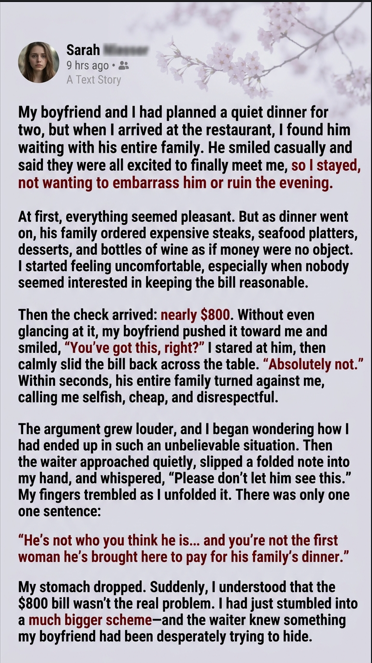
He simply picked it up, slid it across the table toward me, and smiled.
“You’ve got this, right?”
I stared at him.
“What?”
He leaned back.
“You’re doing well at your job. I thought you could treat everyone tonight.”
I looked at the bill.
$786.40.
For a moment, I genuinely thought he was joking.
“Marcus, you invited your family. We planned a dinner for two. Why would I pay for all this?”
His smile disappeared.
His mother immediately frowned.
“Well, that’s embarrassing. Marcus told us you wanted to do something nice for the family.”
I turned toward him.
“You told them I was paying?”
His sister rolled her eyes.
“It’s just dinner. Why are you making such a big deal?”
I slowly pushed the check back across the table.
“Absolutely not.”
The atmosphere changed instantly.
Marcus’s father called me disrespectful. His mother said I was being cheap. One of his sisters accused me of ruining a family evening over money.
Marcus shook his head and spoke loudly enough for nearby tables to hear.
“I can’t believe you’re acting like this. I thought you cared about me.”
That was when something inside me finally shifted.
He wasn’t embarrassed that he had put me in an uncomfortable position.
He was angry that I wouldn’t pay.
I reached for my purse, intending to pay for my own meal and leave. But before I could say anything, the waiter approached.
He placed the bill folder on the table, then quietly slipped a folded piece of paper into my hand.
As he walked away, he leaned close and whispered:
“Please don’t let him see this.”
My heart began pounding.
I unfolded the paper beneath the table.
There was one sentence written in hurried handwriting:
He’s not who you think he is… and you’re not the first woman he’s brought here to pay for his family’s dinner.
My stomach dropped.
I looked up at the waiter.
He gave me the smallest nod.
Suddenly, the expensive dinner wasn’t the biggest problem.
I excused myself and walked toward the restroom. Once inside, I read the note again.
A few seconds later, my phone buzzed.
It was a message from an unknown number.
My name is Daniel. I’m the waiter who served your table. I need to explain something. Please don’t pay that bill.
I typed back:
What do you mean?
His reply came almost immediately.
This has happened before. A few months ago, another woman came here with Marcus. He told her it was a dinner with his family, then left her with the bill. She paid because everyone at the table pressured her. I recognized him tonight.
I stared at the screen.
How do you know it was the same situation?
Daniel replied:
Because I was the one who served them then, too. And because I remember the woman crying after they left.
I felt sick.
I asked him whether the restaurant had done anything about it.
He explained that the previous woman had complained to management. The restaurant had reviewed the transaction and learned that she had paid the entire bill herself. There hadn’t been enough evidence to prove that Marcus had planned it in advance, and the restaurant couldn’t force him to reimburse her.
But Daniel remembered something else.
The woman had later returned to the restaurant with a friend. She told the manager that Marcus had approached her through a dating app, spent weeks talking about commitment, and then introduced her to his family at an expensive dinner.
The same pattern.
The same family.
The same pressure.
I asked Daniel if he had any proof.
He told me the restaurant had retained a record of the previous complaint and that the manager could confirm what had happened. He also said Marcus had made a habit of telling the staff that his dates would be handling the bill.
I read that message twice.
Then I took a breath and walked back to the table.
Marcus was still sitting there, looking irritated.
“Finally,” he said. “Can we get this over with?”
I placed my phone beside the bill.
“I know about the other woman.”
His expression changed.
“What other woman?”
“The one you brought here a few months ago. The one you left with an $800 bill after telling her your family wanted to meet her.”
His mother stopped talking.
Marcus looked at the waiter station, then back at me.
“Who told you that?”
I didn’t answer.
Instead, I asked, “How many women have you done this to?”
His sister immediately interrupted.
“Don’t listen to whatever someone told you. You’re making things up.”
I turned toward her.
“Then why did the waiter recognize him?”
Nobody answered.
Marcus leaned forward.
“You’re seriously going to believe a waiter over your boyfriend?”
I looked directly at him.
“You’re the one who invited me to dinner under false pretenses, told your family I would pay, and pushed an $800 bill in front of me without even asking. I don’t need anyone to explain what that says about you.”
He stood up.
“You’re embarrassing me.”
I almost laughed.
“You embarrassed yourself.”
Then the restaurant manager approached. Daniel had already informed him about the note, and he wanted to make sure the situation was handled properly.
The manager calmly explained that I was responsible only for the food and drinks I had personally ordered. The rest of the bill belonged to the people who had ordered them.
Marcus protested.
“We’re together. She agreed to dinner.”
The manager replied that the reservation had been made in Marcus’s name and that no agreement had been made for me to cover the entire table.
I paid for my own meal and left.
Behind me, I could hear Marcus arguing with the manager and his family complaining about the situation.
But I didn’t turn around.
The next morning, Marcus called me seventeen times.
His first message said I had humiliated him.
His second said his family was offended.
His third said I was overreacting and that he had only wanted to see whether I was generous.
That last message made everything clear.
I replied once.
You didn’t test my generosity. You tested whether I would let you use me. I won’t.
Then I blocked him.
A week later, Daniel contacted me again. He told me the previous woman had agreed to speak with me. We met for coffee, and she confirmed the story. She had paid the bill because Marcus and his family had made her feel guilty for refusing.
She also showed me messages from Marcus, including one in which he had promised to reimburse her.
He never did.
I later learned that his family had been part of the arrangement from the beginning. They knew the women were being invited under the impression of a romantic dinner or a casual family introduction. They also knew that Marcus intended to make the women feel too embarrassed to refuse the bill.
The restaurant couldn’t establish how many times they had done it, but the two of us had enough information to make a formal complaint to the appropriate consumer authorities. The restaurant also documented the incidents and decided not to accept future reservations made by Marcus.
I never saw him again.
A few months later, I received a message from another woman who had matched with him online. She had searched his name after noticing something strange about his dating profile.
She wanted to know whether I had ever met his family.
I told her everything.
She thanked me and said she had canceled their planned dinner.
That was when I realized the waiter hadn’t just saved me $800.
He had helped prevent someone else from being manipulated.
I still think about that evening sometimes. Not because I regret refusing to pay, but because I almost did.
I almost handed over my money just to avoid an argument with people who had no intention of treating me fairly.
Marcus wanted me to believe that refusing the bill made me selfish.
But the truth was much simpler.
I wasn’t responsible for paying for a family I had never invited.
And I certainly wasn’t responsible for proving my love by allowing someone to take advantage of me.
The most expensive thing at that restaurant wasn’t the seafood platter or the bottles of wine.
It was the lesson I learned about the person sitting beside me.
And I will never forget the waiter who quietly passed me that little note.